
The surface is part of the anchorage
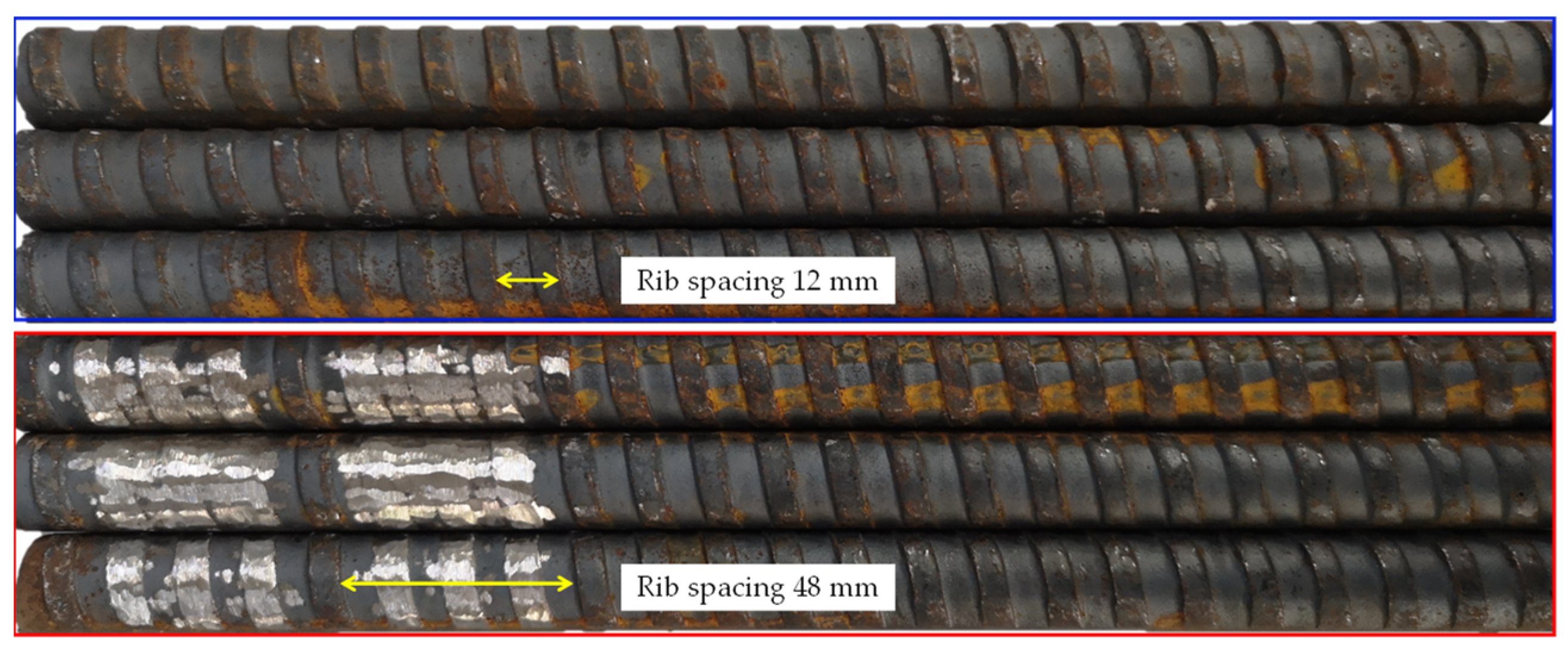
These laboratory bars share a nominal diameter but have different rib spacing. The lower specimens were deliberately modified for research; grinding ribs off an installed or ordered bolt is not a field recommendation.
Select an image to open the full-size original and inspect its labels.
Key takeaways
- Match the anchorage mechanism to the ground and installation route.
- Order a defined rod, head, plate, nut and connection system, not a list of nominal sizes.
- Compare load together with displacement, test configuration and failure location.
- Keep steel, GFRP and post-tensioning requirements in their own specification families.
Mining rock-bolt selection starts with the hole
Before asking for a stronger bolt, ask what the support must hold and when it must begin working. A stable drilled hole, a collapsing hole and a heading expected to deform present different purchasing questions. The mine’s ground-control design supplies those conditions; the enquiry must carry them through to the offered product.
NIOSH’s fully grouted roof-bolt research separates failure near the head, in the rod and in the anchorage. This is a useful way to read a specification: identify where force enters, where it is transferred and which interfaces the proposed tests actually cover. [NIOSH]
The head, the rod and the anchorage are different failure locations
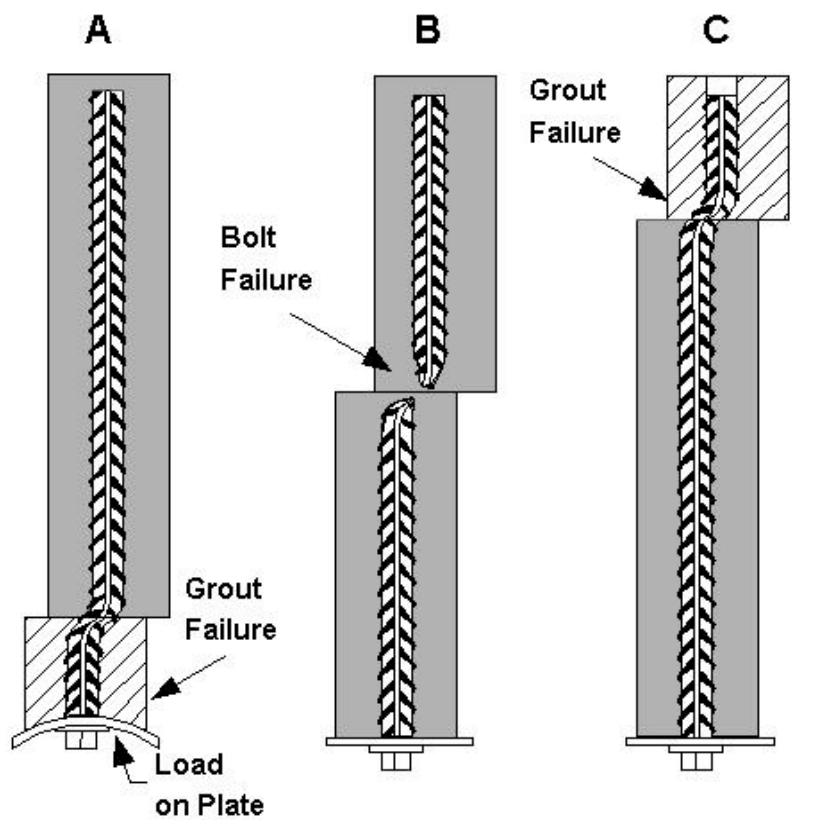
A higher rod strength addresses only one part of this picture. Plate seating, the connection and load transfer into the surrounding ground still need their own requirements.
Select an image to open the full-size original and inspect its labels.
- Ground and excavation: rock description, discontinuities, water, opening geometry and excavation sequence.
- Support duty: intended life, deformation demand, static or dynamic loading, and interaction with mesh or shotcrete.
- Installation: drilling method, achievable hole condition, equipment, available clearance and approved anchoring medium.
Compare how each route transfers load
Names overlap. “Hollow” describes the bar; “self-drilling” describes an installation route; “resin anchored” describes a bonding system. Keep those descriptions separate when comparing quotations.
| Route | How load is transferred | Confirm before ordering |
|---|---|---|
| Mechanical point anchor | A matched head or expansion shell engages the borehole at a defined position | Head model, rod connection, hole range, plate/nut and approved installation method |
| Resin- or cement-grouted bar | The specified bonded length transfers load through the bar–grout–ground interfaces | Bar profile, hole geometry, grout/resin system, encapsulation and curing conditions |
| Self-drilling hollow anchor | The hollow tendon is used for drilling and remains as reinforcement after grouting | Bit and coupler system, thread, bore, flushing/grouting route and drilling equipment |
| Driven or expandable friction bolt | Contact with the borehole provides anchorage along the contacting length | Exact product family, hole condition, installation equipment and supplier-defined checks |
| GFRP route | A composite tendon works with its specified anchorage and head components | Solid/hollow configuration, cuttability, head capacity, connection and durability basis |
Epiroc lists inflatable rockbolts in its quasi-static range. Specify whether the design calls for an inflatable tube or a driven split tube so the installer can select the applicable installation and verification method. ASTM F432 covers several steel bolt and accessory families; the order still has to identify the actual product and applicable requirements. [Source] [ASTM]
Hollow bars and self-drilling anchors are different
Epiroc describes an SDA as a hollow core rockbolt that serves as the drill string and then the grouted support tendon. Its hollow-core alternative goes into a pre-drilled hole without a sacrificial drill bit. A central passage alone does not establish the drilling duty of a product. [Source]
Write the route on the enquiry: pre-drilled insertion or self-drilling installation. Then list the bit, coupler, centralizer, plate and nut actually required. Ask whether the proposed coupling has been tested with the offered bar and whether the bore remains usable across the connection.
The hollow bar is only one line on the order
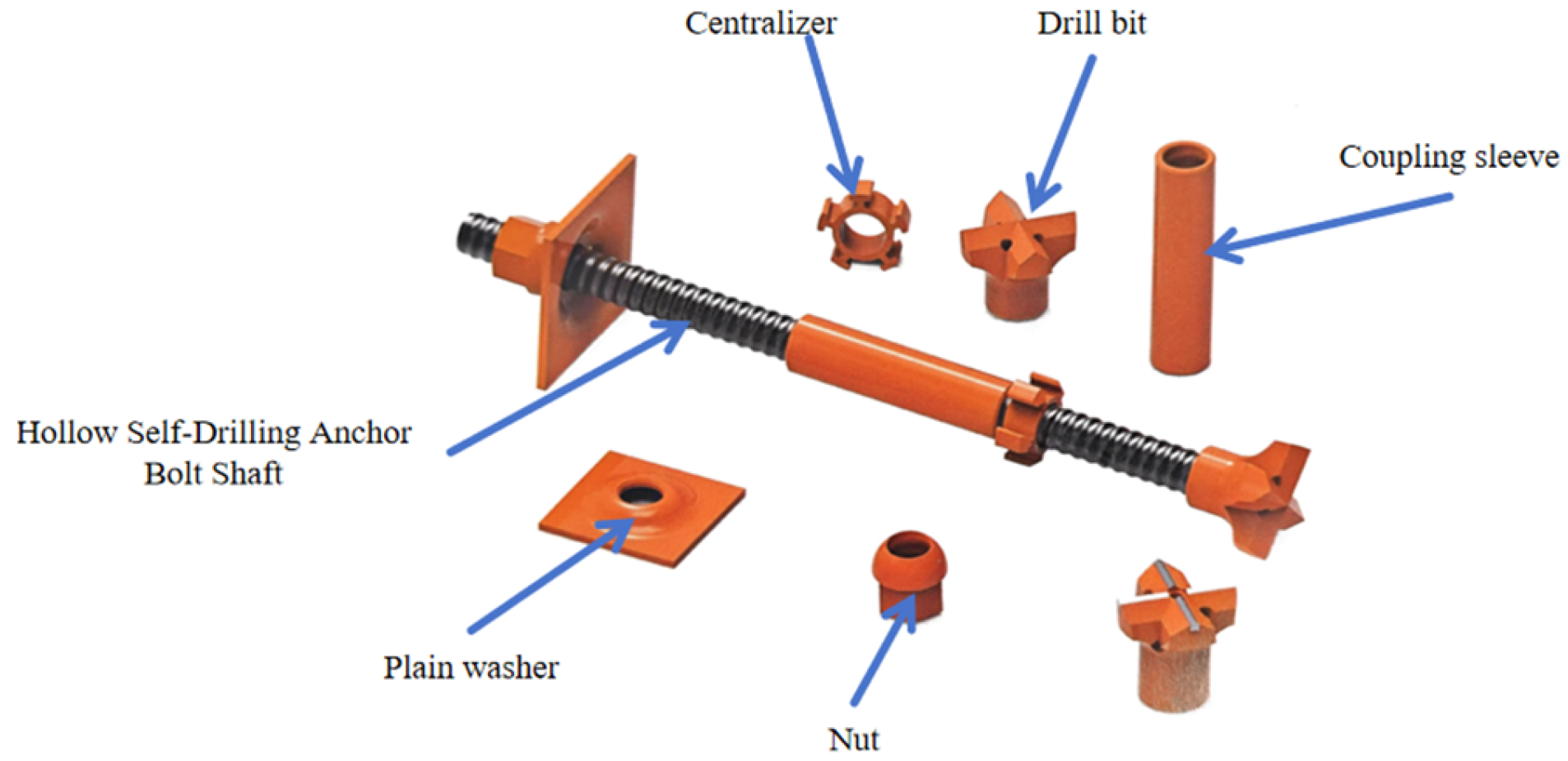
Use the figure to identify interfaces, not to select dimensions. The source labels the bearing plate “Plain washer”; the exact plate, nut and seating geometry still belong on the approved assembly schedule.
Select an image to open the full-size original and inspect its labels.
The published illustration accompanies a slope-anchoring investigation. It shows the component relationships; its project arrangement is not a mine-support approval. [Source]
This also prevents a simple commercial mismatch: a price for bare hollow bar can look attractive beside a price for a complete installation set. Compare the same bill of materials.
R32 is not a load rating
Epiroc’s public hollow-bar table gives three R32 entries with different yield and ultimate loads. These are that manufacturer’s listed variants, not JOTAIN ratings or interchangeable product approvals. [Source]
| Listed bar size | Yield load, kN | Ultimate load, kN |
|---|---|---|
| R32 — entry 1 | 160 | 210 |
| R32 — entry 2 | 230 | 280 |
| R32 — entry 3 | 280 | 360 |
The purchasing lesson is straightforward. Keep the exact model, section, thread and manufacturer’s data sheet with the quotation. A shared designation is not a substitute for checking the bar and matched connection.
Where the ground is expected to move significantly, compare the full load–displacement behaviour and the required dynamic evidence. The review by Li, Stjern and Myrvang shows why peak load alone misses the distinction between conventional and energy-absorbing bolts. [Source]
Specify every interface that carries the load
A nut that starts on the thread is not yet a verified connection. Plate-hole geometry, bearing faces, washers, coupler engagement and the permitted installation angle can all determine what the assembled product does under load.
| Item | Put on the drawing or schedule |
|---|---|
| Tendon | Product/model, material, dimensions, profile or thread, section and surface protection |
| Anchor or bonded zone | Head type or anchoring medium; relevant hole and embedment requirements |
| Coupler | Matching thread, approved engagement, connection capacity and bore continuity if needed |
| Nut, washer and plate | Exact mating models; seating arrangement; plate geometry and required assembly evidence |
| Installation accessories | Bit, centralizers, grout connections and any additional project-specified items |
| Acceptance | Document set, lot identity, test arrangement, acceptance criteria and responsible approver |
The test fixture has a specification too
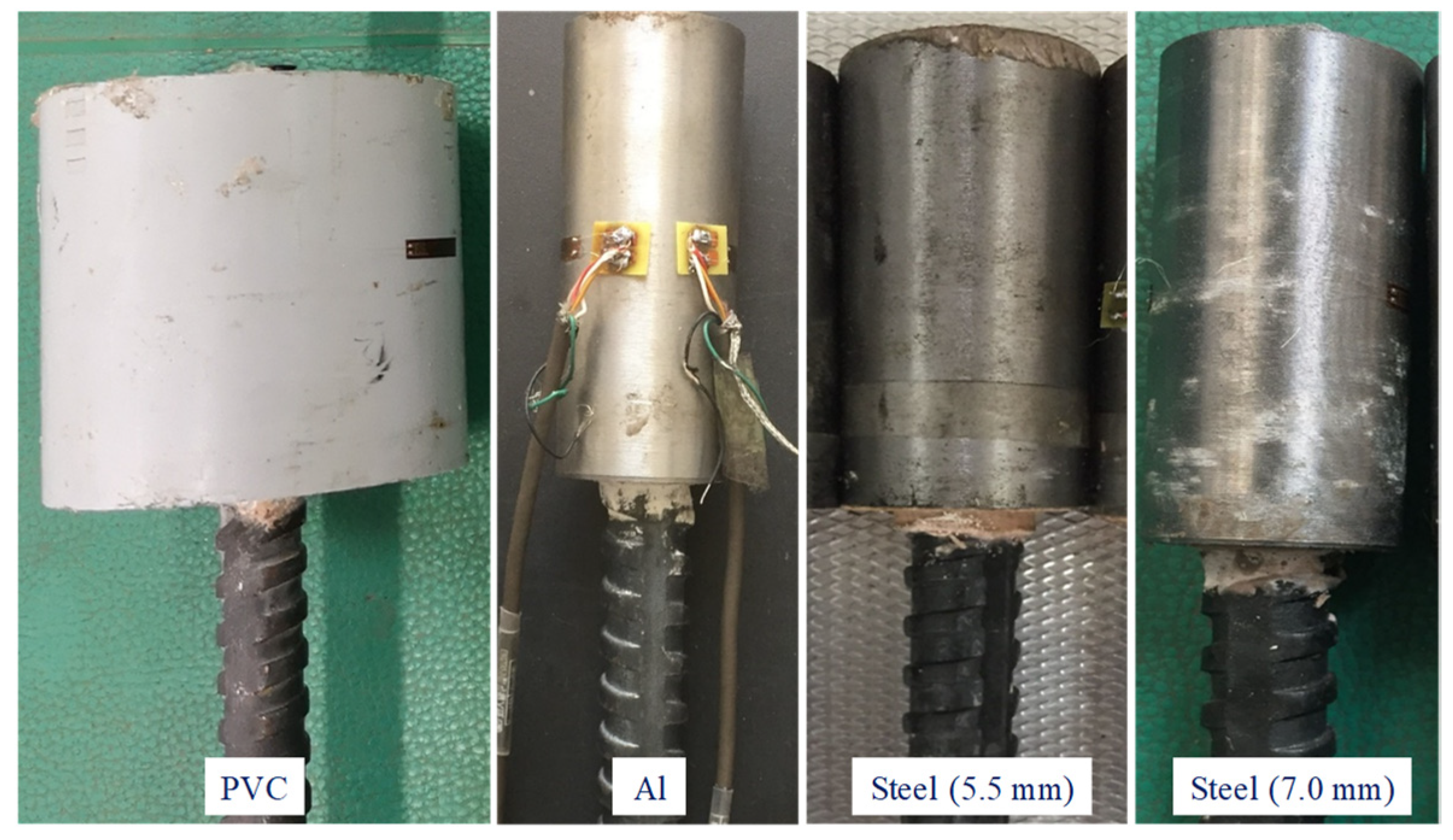
These are laboratory confinement specimens, not saleable rock-bolt assemblies. The surrounding material is a controlled test variable, so a pull-out result needs that information alongside the bolt description.
Select an image to open the full-size original and inspect its labels.
Zhang and colleagues deliberately changed the confinement around their bolts. The companion verification guide works through the measured results and explains what they do—and do not—establish. [Research]
Cuttability changes the component discussion
GFRP is worth examining where later excavation or cutting forms part of the project. Normet’s published range distinguishes solid and hollow products, temporary and permanent configurations, and different head-capacity options. Those are model-specific choices, not properties proved by the word “GFRP”. [Source]
If the assembly must be cuttable, identify every part left in the excavation path. The tendon, nut, plate and coupler may not all be the same material. Put the cuttability requirement against the complete bill of materials, together with the proposed cutting operation.
Keep composite verification separate from steel certificates. The relevant evidence must address the offered tendon and head/connection system, the intended environment and the support life. Steel tensile results do not qualify an FRP assembly.
Turn the ground-control requirement into a comparable offer
For JOTAIN’s mining-support product routes, send the approved drawing and assembly schedule, then identify what is included in the requested supply. We can review the material and component scope against that specification. A project acceptance decision needs the matching product evidence and site requirements.
What came back out of the hole
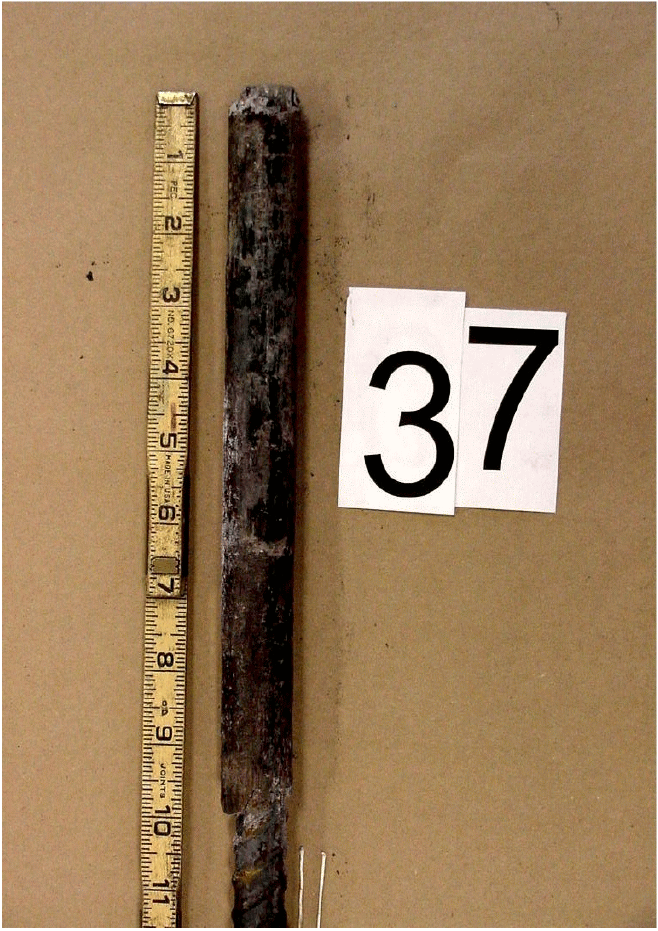
A resin-grouted anchor recovered during NIOSH field research. The purchasing record must connect the specified material and bonded length to the installation and its acceptance checks.
Select an image to open the full-size original and inspect its labels.
Keep post-tensioning bars on a separate enquiry. A threaded tendon used to prestress a structure and a rock bolt used to reinforce an excavation have different system duties. Similar-looking threads do not make their standards, anchors or tests interchangeable.
Before comparing price, resolve the three easy-to-miss gaps: who supplies the accessories, what the load figure represents, and which evidence the site needs before installation.
Questions buyers ask
What are the main types of mining rock bolts?
Common routes include mechanical point anchors, grouted bars, self-drilling hollow anchors, friction bolts and specified composite systems. Energy-absorbing behaviour is a further design distinction. Compare the anchorage mechanism, installation route, deformation requirement and complete assembly rather than choosing by name alone.
Are hollow rock bolts and self-drilling anchors the same?
No. A self-drilling anchor uses the hollow tendon during drilling and retains it as reinforcement. Other hollow-core products are inserted into pre-drilled holes. Confirm the offered model, drill-bit and coupling arrangement, and approved installation procedure.
Does R32 identify a rock bolt’s load capacity?
Not on its own. Published R32 product variants can carry different yield and ultimate load ratings. Obtain the exact manufacturer and model, section and connection data, and keep the rating tied to its stated test configuration.
Can a GFRP rock bolt replace a steel bolt?
Only through an approved design and product comparison. Check tendon behaviour, head and connection capacity, anchorage, environmental durability and the intended life. If cuttability is required, confirm it for every relevant assembly component, not just the rod.
Can a post-tensioning bar specification be used for a mine rock bolt?
Do not treat the two systems as interchangeable. The support duty, anchorage, installation and acceptance requirements differ. Use a ground-support specification for the rock-bolt assembly and identify the relevant product standard and test plan.
RFQ checklist
- Ground-control drawing, excavation sequence and support duty.
- Selected anchorage and installation route; exact product/model.
- Complete assembly schedule, connections and accessories.
- Dimensions, protection, life and any cuttability requirement.
- Load/displacement criteria, required reports and site-verification plan.
- Quantities, packing identity, destination and supply-stage responsibility.
References
- Anchorage Pull Testing for Fully Grouted Roof Bolts
Christopher Mark, Craig S. Compton, David C. Oyler and Dennis R. Dolinar; NIOSH (2002). Full report (PDF).
- Quasi-static rockbolts
- ASTM F432-19(2026): Roof and Rock Bolts and Accessories
- Self-Drilling and Hollow Core Rockbolts
- A Review on the Performance of Conventional and Energy-Absorbing Rockbolts
- An Equivalent Radial Stiffness Method of Laboratory SEPT on Anchorage Performance Prediction of Rockbolts under Different Field Geoconditions
Ming Zhang, Jun Han, Zuoqing Bi, Chen Cao, Tao Wu and Shuangwen Ma; Applied Sciences 11, 8041 (2021). Publisher’s full paper (PDF).
- GFRP Fully Thread Bolts
- Research on the Self-Drilling Anchor Pull-Out Test Model and the Stability of an Anchored Slope
Inquiry support
Working from a part drawing?
For this review, send the borehole and ground conditions, the complete assembly drawing and mating parts, the design load and loading conditions, and the inspection and acceptance plan. For a quotation, also include the quantity and destination.