
Read the test arrangement before the peak load
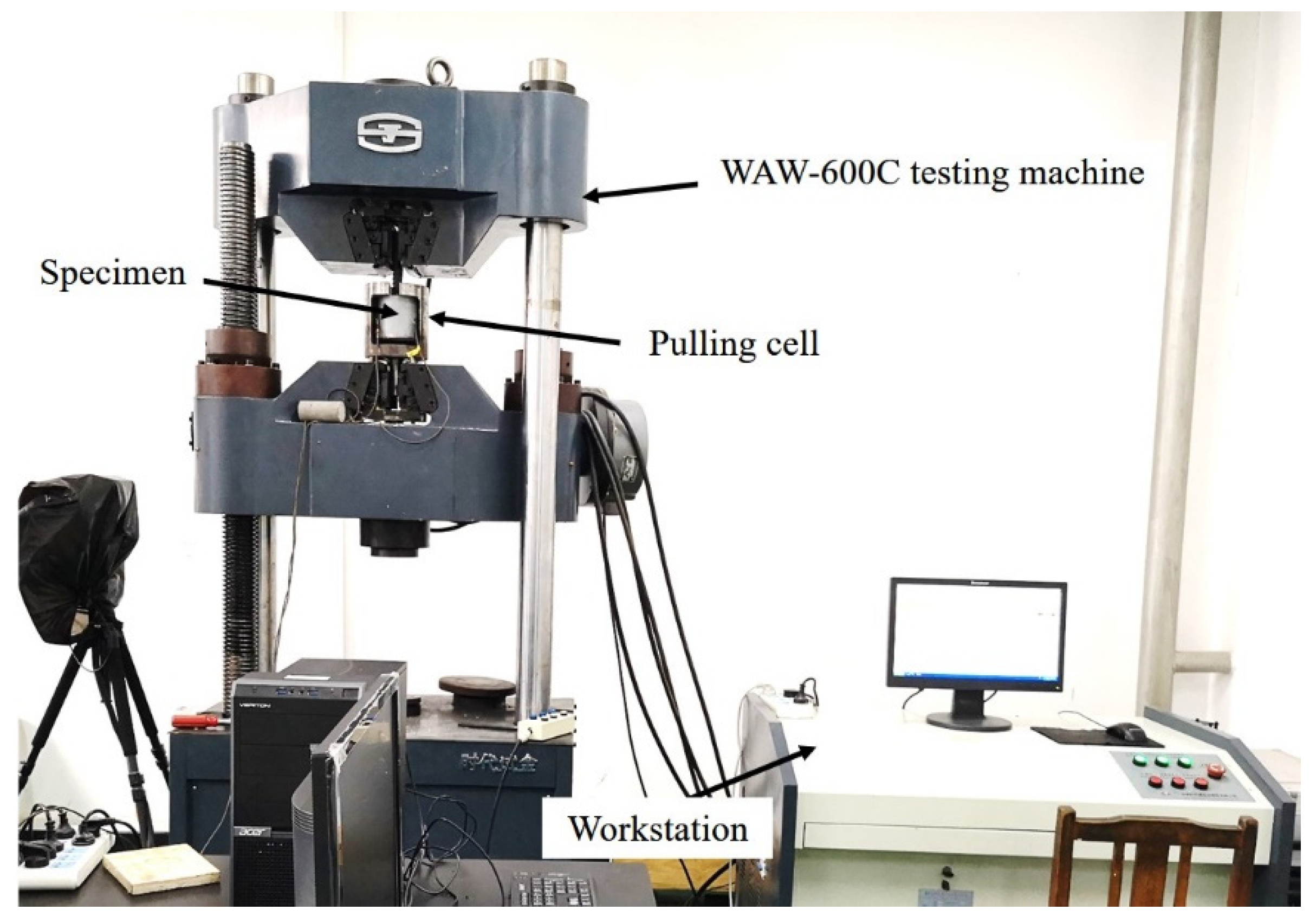
The published test rig makes the boundary visible: a short specimen held in a laboratory fixture. A useful report describes this boundary as carefully as it reports the force.
Select an image to open the full-size original and inspect its labels.
Key takeaways
- A material certificate, an assembly test and a site pull test answer different questions.
- Keep the delivered lot, drawing revision and tested configuration connected.
- Record load and displacement, failure location and the anchorage conditions—not just “passed”.
- Agree the project test method and acceptance criteria before supply or site testing.
Three records, three different questions
For a buyer, the first job is to stop unlike documents being filed as equivalent evidence. A steel test result belongs to a material and test unit. An assembly result belongs to a configuration. A field result belongs to a location and an installation.
| Level | What to identify | What the record can establish | Who closes the acceptance step |
|---|---|---|---|
| Material | Grade, heat/lot, delivered condition and sampled product | Specified material test results for the identified test unit | Supplier QA and purchaser inspection under the order |
| Product / assembly | Rod, thread, coupler, head, nut and plate; drawing revisions | Performance of the tested components and configuration | Responsible product/design reviewer against the approved requirements |
| Installed anchorage | Hole, location, ground, anchoring medium and installation record | Response of the tested anchor under the defined field procedure | Authorized site ground-control / acceptance team |
Read the identity before reading the strength
Match the purchase order, product description, heat or manufacturing lot and delivered condition first. Then check which tests were ordered, which specimen they describe and whether the results represent the supplied product. Keep the certificate connected to bundle labels and any identity transfer after cutting or processing.
Follow the heat number through the record
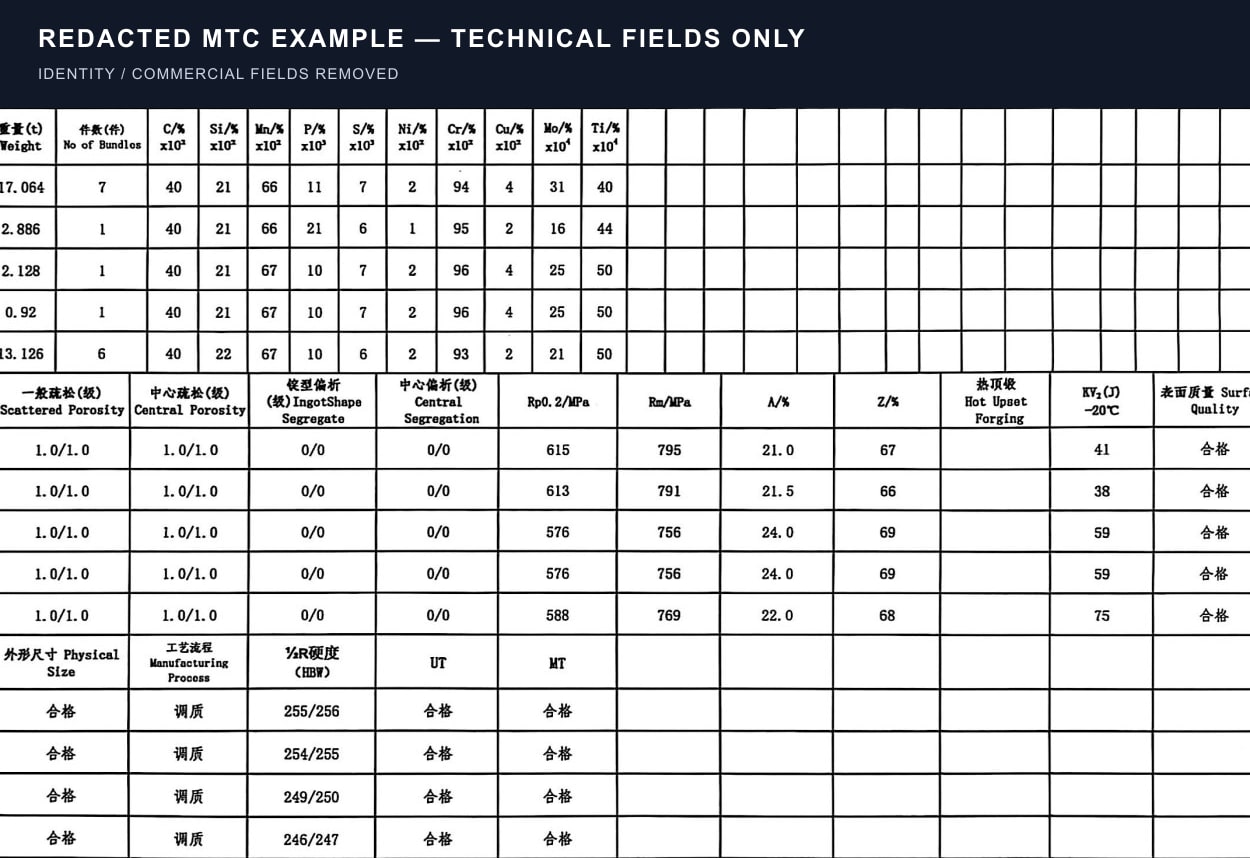
The redaction protects identity fields. Use the unredacted delivery-specific record for a real receiving decision; these visible figures do not define rock-bolt acceptance limits.
Select an image to open the full-size original and inspect its labels.
Do not compare MPa with kN as though they were the same number. MPa describes stress; kN describes force. As an arithmetic illustration, a 20 mm solid circular section has an area of about 314 mm². At an assumed 500 MPa, stress × area gives about 157 kN. That is not a rated bolt load: a hollow section, a thread, a connection or a different test specimen changes the calculation and its meaning.
For a receiving-record structure, use the existing heat-number traceability guide. For a composite tendon, request the composite product and assembly evidence; a steel mill certificate is the wrong starting document.
Ask what was actually in the test machine
A bar tensile test does not include the coupler unless the coupler was present. A nut-and-plate test does not establish the anchorage in the rock. Ask for the drawing, bill of materials, sample identity and test arrangement that belong to the reported result.
- Record the exact rod and connection models, thread and engagement, plate/nut/washer set, material condition and protection.
- State the loading mode, fixture and unsupported length, load/displacement measurement and equipment identification.
- Keep individual results, failure location and photographs; identify how samples were selected.
- List every permitted variation. A different coupler, coating, plate or processing route needs an explicit review, not a silent substitution.
ASTM F432’s public scope includes bolt and accessory requirements. The applicable clauses, product category and ordered edition must be resolved in the inspection plan; the same report cannot be assumed to cover every product called a rock bolt. [ASTM]
For deformation-sensitive or dynamic support, ask for the relevant displacement and energy-absorption evidence. Li and colleagues’ review compares these behaviours separately from ultimate load. A static tensile pass is not a dynamic-system qualification. [Source]
Same bolt profile. Nearly twice the pull-out force.
Zhang and colleagues tested 20 mm bars using different confinement tubes. For the original 12 mm rib-spacing series, each confinement condition had three pull-out specimens. The published mean and standard deviation are shown below. [Research]
The surrounding sleeve was the experimental variable
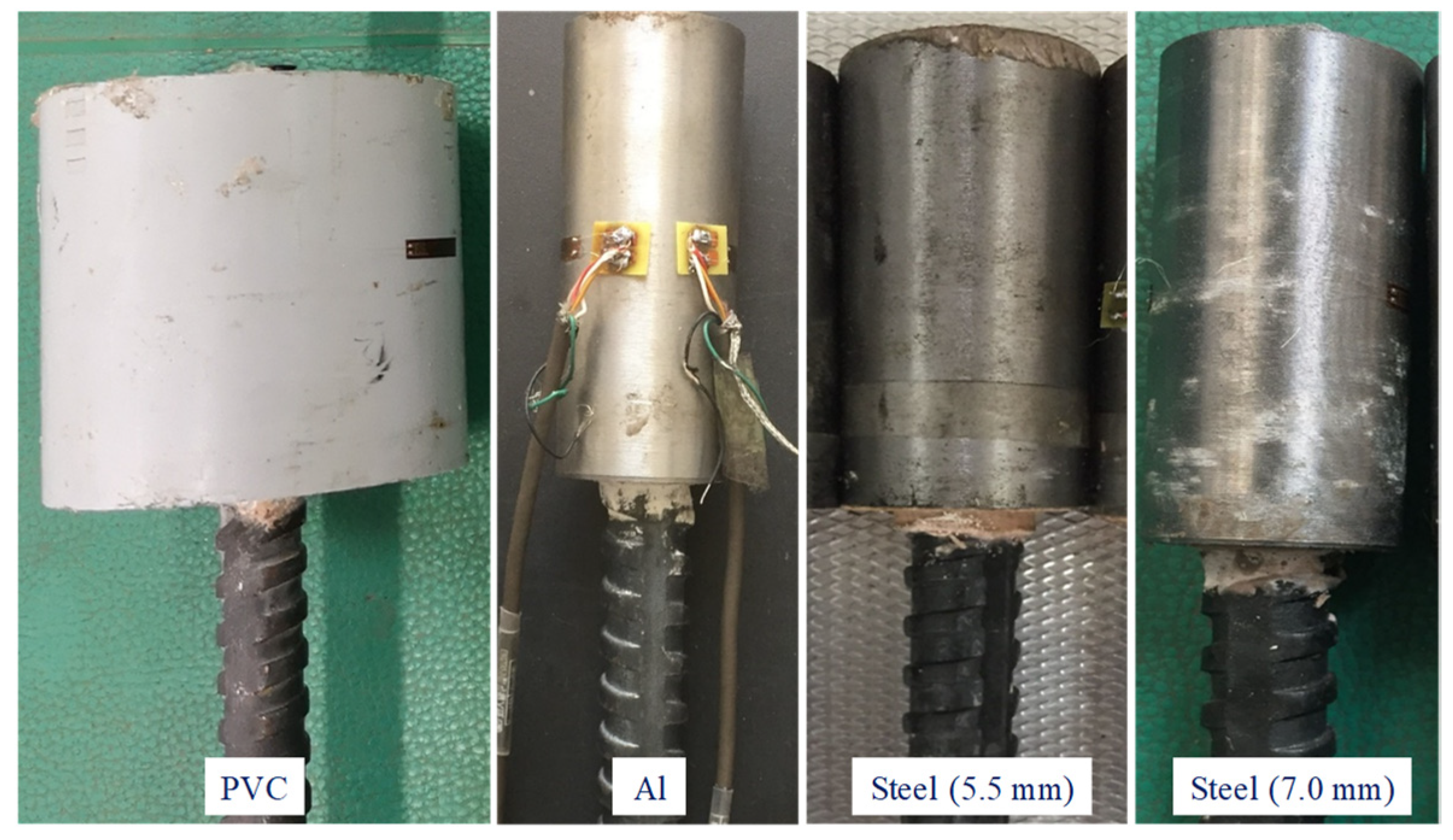
These sleeves simulate different confinement conditions in a research setup. They are not interchangeable descriptions of actual rock masses.
Select an image to open the full-size original and inspect its labels.
| Confining tube | Mean anchorage force, kN | Standard deviation, kN |
|---|---|---|
| PVC | 66.4 | 3.5 |
| Aluminium | 87.3 | 8.0 |
| Steel, 5.5 mm wall | 118.2 | 4.5 |
| Steel, 7.0 mm wall | 131.0 | 1.0 |
The last mean is about 1.97 times the first. The near-twofold difference came from confinement in this laboratory series, not a change of steel grade. Keep that test arrangement with the quoted result: these are small laboratory test groups, not product characteristic capacities or site acceptance limits.
When two reports give different loads, check their bonded lengths, anchoring medium, cure, confinement, displacement measurement and loading arrangements before comparing the steel. Keep the full curve and failure description with the headline result.
A site pull test answers a local question
NIOSH examined short-encapsulation pull testing to investigate anchorage near the upper part of fully grouted roof bolts. In the reported method, only a short resin length—about 1 ft, or 0.3 m—was used. That changes what the test interrogates; it is not the same as pulling on an otherwise fully bonded installed bolt. [NIOSH]
What came back out of the hole
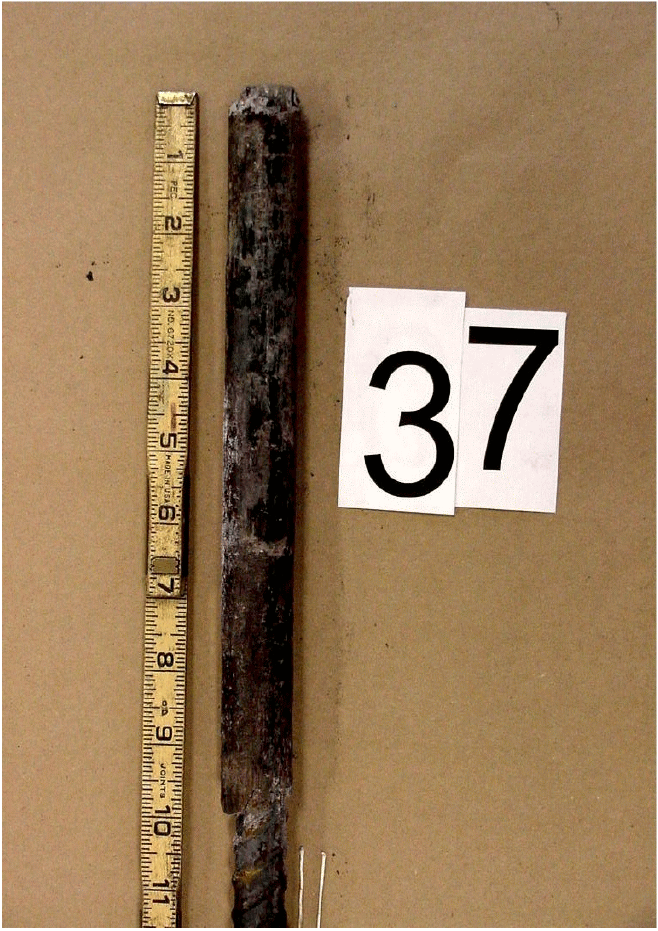
This recovered sample connects a measured result to the physical anchor. A report becomes much more informative when it records what remained bonded and where failure occurred.
Select an image to open the full-size original and inspect its labels.
The field procedure must identify its purpose: suitability investigation, installation quality check, proof loading or another defined task. Set the method, hold points, sampling basis and acceptance criteria through the authorized project team before testing. A destructive investigation and a proof test of retained support are not the same operation.
| Record group | Include |
|---|---|
| Location and ground | Mine/heading, hole identifier, orientation, rock description and relevant discontinuities or water |
| Product and installation | Model/lot, length, hole and bonded dimensions, anchoring medium batch, installation time and cure |
| Test setup | Approved procedure/revision, jack and load measurement, calibration, reaction arrangement and displacement reference |
| Observed result | Load–displacement record, hold behaviour where required, failure/slip location, photographs and anomalies |
| Disposition | Acceptance basis, responsible decision, retained/replaced status and follow-up action |
The mine’s approved procedure governs isolation, exclusion zones, test execution and the disposition of tested support. The site ground-control design sets the permissible test loads; bar diameter alone does not.
Check the method’s status, not just its familiar number
ASTM D4435-13e1 is listed as withdrawn in 2022, with no replacement. Its historical scope concerns rock-bolt anchor pull testing, not evaluation of the entire mine roof-support system; it also excludes tests for pretensioned bolts. Do not label it a current universal site-acceptance standard. [ASTM]
If an existing project references it, have the responsible engineer resolve the contractual edition and the approved procedure explicitly. A proposal to reinstate a standard is not a published replacement. New orders should identify the accepted method, edition and project criteria rather than copying a number from an old certificate.
Apply the same discipline to every report: a method describes how something is tested; the order and support design determine what must be achieved. Record both.
Close the evidence gaps before the bundles disappear underground
Keep an acceptance register with one line per delivered lot and assembly configuration. Attach the material record, the applicable product/assembly report and the installation or field-verification requirement. Mark a missing document as missing; do not infer coverage from a similar model’s report.
| Field | What the buyer should be able to trace |
|---|---|
| Delivery identity | PO line → bundle/lot → offered model and drawing revision |
| Material evidence | Test unit, actual results, delivered condition and required inspection document |
| Assembly evidence | Matching components, report number, test configuration and permitted variants |
| Site handover | Installation procedure, required field checks and responsible acceptance team |
| Open points | Deviation, owner, due date and release/hold decision |
When requesting a JOTAIN offer, send the specification and the evidence schedule together. That lets us define the product and inspection scope at quotation stage, with any project-specific verification clearly assigned.
Still deciding on the anchorage route? Start with mining rock-bolt selection. A good verification plan is much easier to write when the full assembly is already defined.
Questions buyers ask
Does a material certificate prove a rock bolt is ready for installation?
It establishes the reported material results for its identified test unit. Match it to the delivery, then check the required component or assembly evidence and site acceptance steps. It does not, by itself, prove installed anchorage performance.
What does a rock-bolt pull test prove?
It measures the response of the tested anchor or assembly under the specified arrangement. Interpret the result with the location, ground, bonded length, anchoring medium, cure, loading and reaction setup. It is not automatic acceptance of all bolts or the whole support system.
Is ASTM D4435 a current rock-bolt pull-test standard?
ASTM lists D4435-13e1 as withdrawn in 2022 with no replacement. If a project refers to this historical method, the responsible engineer must resolve the applicable edition and approved procedure. It is a withdrawn test method, not a current acceptance standard.
Can tensile strength in MPa be compared directly with pull-out load in kN?
No. MPa is stress and kN is force. Converting between them requires the applicable section and a defined loading case. A thread, hollow bore, connection or anchorage can govern before a nominal rod-area calculation becomes relevant.
How many site pull tests are required, and at what load?
The approved project plan sets the sampling basis, locations, test purpose, loading and acceptance criteria. They depend on the support system and ground conditions. A supplier’s generic table or one published laboratory experiment cannot set those values for a mine.
RFQ checklist
- Order, model, drawing revision and physical lot identity.
- Material condition, actual results and required inspection document.
- Tested assembly bill of materials and configuration match.
- Test method/edition, equipment/calibration and full result record.
- Ground, installation, cure and field-test traceability where required.
- Name of the person accepting the lot, unresolved deviations and the recorded release decision.
References
- ISO 10474:2013: Steel and Steel Products — Inspection Documents
- ASTM F432-19(2026): Roof and Rock Bolts and Accessories
- A Review on the Performance of Conventional and Energy-Absorbing Rockbolts
- An Equivalent Radial Stiffness Method of Laboratory SEPT on Anchorage Performance Prediction of Rockbolts under Different Field Geoconditions
Ming Zhang, Jun Han, Zuoqing Bi, Chen Cao, Tao Wu and Shuangwen Ma; Applied Sciences 11, 8041 (2021). Publisher’s full paper (PDF).
- Anchorage Pull Testing for Fully Grouted Roof Bolts
Christopher Mark, Craig S. Compton, David C. Oyler and Dennis R. Dolinar; NIOSH (2002). Full report (PDF).
- ASTM D4435-13e1: Rock Bolt Anchor Pull Test — Withdrawn 2022, No Replacement
Inquiry support
Working from a part drawing?
For this review, send the complete assembly drawing and mating parts, the borehole and ground conditions, the design load and loading conditions, and the inspection and acceptance plan. For a quotation, also include the quantity and destination.