
How JOTAIN tracks steel from heat to shipment
JOTAIN Materials traces steel bars from the producing mill’s heat through processing, inspection, packing and shipment. The mill certificate, processing records, bundle tags and packing list form the document trail.
Before production, we agree with the buyer whether records will follow each heat, processing lot, bar or bundle, and which documents and release checks are required. Cutting, heat treatment, surface processing and rebundling must preserve that link. The mill certificate identifies the source material; JOTAIN’s records cover work at its own facilities.

Which identifier must follow the steel
Start by naming the identifier the buyer actually needs: heat number, batch number, lot number, individual bar number, bundle identifier, or a stated combination. Do not use those terms as automatic synonyms. The purchase order should identify the controlling product and inspection-document standards, ordered line, grade, condition, size, quantity, and the identity field that must follow the material.
The official scope for ISO 10474:2013 confirms that steel inspection-document types are supplied in accordance with order requirements. That scope supports an order-controlled document route; it doesn't provide a free marking procedure, select the buyer's identity unit, or establish the tests and acceptance values required for a particular bar order.
Settle the identity vocabulary during quotation and carry the same terms into the order, document index, inspection plan, marking instruction, packing list, and release record. Treat a different supplier term as a deviation for written review.
Sources:[1]
One identity chain across material and records
An auditable identity chain lets a reviewer reconcile the ordered line to the inspection document, physical bar or bundle, processing record, inspection report, packing list, and shipment package. Each handoff should retain the agreed identifier plus enough context to distinguish grade, condition, size, quantity, and order item.
The identifier is useful only when records agree. A plausible heat number on an MTC does not close a mismatch in grade, condition, size, quantity, marking, or shipment identity. Review the complete chain and hold any contradictory record for correction or an approved written deviation before release.
State the required records and timing. If the buyer needs a draft MTC, marking layout, tag sample, cutting-transfer record, packing-list cross-reference, or pre-shipment identity check, include that deliverable and its approver in the inquiry rather than reconstructing the chain after packing.
Sources:[1]
Marking after cutting and processing
Write where the identifier must appear and how it may be carried: bar-end marking, paint marking, durable label, bundle tag, individual piece number, or an agreed processing traveller. Also state the required fields, character legibility, placement, protection, and whether the mark must remain readable at delivery.
Cutting, peeling, turning, heat treatment, machining, inspection, and rebundling can separate material from its original mark. Define who records the incoming identity, assigns any child-piece or processing-lot reference, transfers the mark, verifies the transfer, and records scrap, rework, mixing risk, or an unreadable identifier.
Photographs can support a marking review when the order requests them, but they should show the agreed identifier and shipment context rather than stand in for the inspection document or physical release check.

Sources:[4]
MTC and inspection records
A traceability check asks whether the identified material and records belong to the same controlled order line. An inspection check asks whether a specified examination, result, method, sampling basis, acceptance criterion, report, witness activity, and approval were completed. One control cannot add or replace the other.
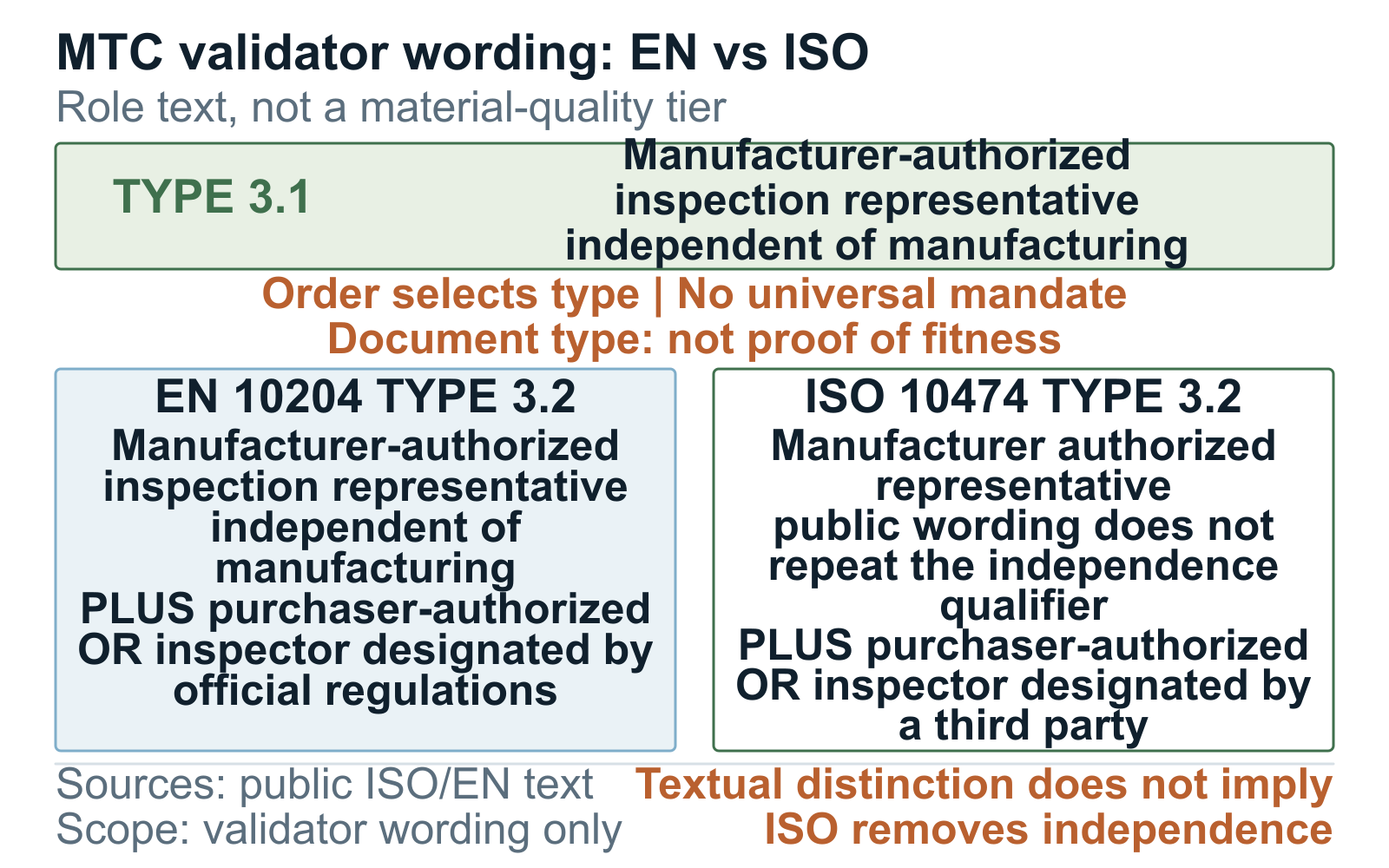
Name the required inspection-document standard, edition, type, actual results, and validation route separately from marking. The dedicated MTC guide explains the type 3.1 and 3.2 roles. Before release, make sure the accepted document and the physical material carry the same identity. [1]
Do not describe traceability as certification or proof of fitness for service. The buyer's product specification, drawing, inspection plan, test results, deviation decisions, and designated acceptance decision remain controlling.
See the redacted 40Cr MTC example for chemistry, mechanical results and inspection status. Identity fields are removed from this published sample. For an actual order, review the complete certificate and linked material records.
What happens when identities do not match
Define what happens when an identifier is missing, unreadable, duplicated, or inconsistent. The order should name the hold point, segregation action, evidence required for correction, person authorized to approve a deviation, and record that closes the issue. Do not silently replace a mark or infer identity from appearance.
Before packing or shipment release, reconcile the accepted order item, quantity, size, condition, physical marks, bundle or piece identifiers, inspection documents, processing and test records, packing list, and shipment references. If third-party or purchaser review is required, define the notice period and release records before production begins.
Keep corrections auditable. A replacement tag, amended certificate, or revised packing list should retain the order reference, revision status, reason, approver, and link to the material being released.
A traceability-ready RFQ
Send the product form, controlling grade and standard edition, size, quantity, delivery condition, and processing route. Define the required identity unit, marking method and location, and transfer rule after cutting. Specify MTC and inspection records, review timing, and packing-list cross-reference. Give the destination and name the deviation approver.
Ask the supplier to state the proposed identity chain and any exclusions during quotation. Availability, marking method, individual-bar control, document type, outside inspection, and processing transfer remain to be confirmed for the specific RFQ and accepted order.
Make the order's traceability chain testable. Identify the material unit, where its identifier appears, and the records it must match. State who verifies each handoff. Define the hold-and-release rule for a mismatch.
Use the steel-bar packing guide so the buyer can match the delivered bundles to the packing list and inspection records.
Questions buyers ask
What should heat number marking connect in a steel bar order?
It should connect the accepted order line to the inspection document, physical bar or bundle, any cutting or processing transfer record, inspection reports, packing list, and shipment identity at the control level required by the order.
Are heat number, batch number, lot number, and bundle number interchangeable?
Not necessarily. They can refer to different material, processing, inspection, or packing units. The RFQ and accepted order should name the exact identifier required and define how it connects to any child-piece, processing-lot, or bundle reference.
Does a matching heat number prove steel bar compliance?
No. A matching identifier supports identity reconciliation only. Grade, condition, dimensions, tests, acceptance, document validation, engineering approval, and fitness for service must be established under their own controlling requirements.
How should identity be preserved after bars are cut or processed?
Define who records the incoming identifier, assigns any child-piece or processing-lot reference, transfers the physical mark, verifies the transfer, and records rework, scrap, unreadable marks, or deviations before release.
RFQ checklist
- Ordered product form, grade, controlling standard and edition, condition, size, quantity, and order item
- Exact identity unit: heat, batch, lot, bar, bundle, or an agreed combination
- Required bar-end mark, paint mark, durable label, bundle tag, piece number, or processing traveller
- Fields, placement, legibility, protection, and delivery-stage marking requirement
- Identity-transfer rule after cutting, peeling, heat treatment, machining, inspection, or rebundling
- MTC standard, edition, type, actual-result fields, validation route, and submission timing
- Separate test, inspection, witness, report, sampling, and acceptance requirements
- Packing-list and shipment-record cross-reference to each released bundle or piece group
- Mismatch hold, segregation, correction, deviation approval, and release approval
- Destination, packing, document language or format, third-party review, and buyer-specific instructions
References
- ISO 10474:2013 Steel and steel products — Inspection documents
- ISO 10474:2013 Steel and steel products — Inspection documents public preview
- EN 10204:2004 Metallic products — Types of inspection documents public copy
- ASTM A700-14(2019) Standard Guide for Packaging, Marking, and Loading Methods for Steel Products for Shipment
Inquiry support
Need to tighten the inspection plan?
Send the drawing or RFQ with the grade, size, condition, processing, inspection, quantity, and destination. We can flag open points before quotation.