
Key takeaways
- Match the grade, condition, heat or lot, and dimensions to the order and the material being shipped.
- Check each required test, its units, specimen location, result, and acceptance requirement before reviewing signatures.
- Confirm the document type and validator under the standard named in the contract; EN 10204 and ISO 10474 use different type 3.2 wording.
- List separate inspections, reports, witness points, and release approvals in the order so the certificate request does not leave those activities undefined.
Download the PO and MTC review checklist Record the order requirement, certificate entry, discrepancy, and correction for each item.
What the inspection document is for
An MTC is the material test or inspection certificate requested with the steel. The purchase order should spell out the inspection-document standard, edition, and type, together with the product specification and delivery condition. ISO 10474 covers inspection documents supplied according to order requirements. The document type alone does not specify all the tests to be performed.
Begin with identity. Match the order line, grade, product form, condition, and dimensions. Follow the heat or lot reference from the certificate to the bundle marking and packing list. Heat, treatment batch, and shipment lot may identify different groups of material, so record how they connect instead of treating the terms as synonyms.
Next compare the reported results with the order: test method, specimen location and condition, units, result, and any required acceptance value. A correctly printed heat number cannot resolve a missing impact temperature or a result taken from an unrepresentative section. List such gaps for correction before the material is released.
Type 3.1: who validates the document
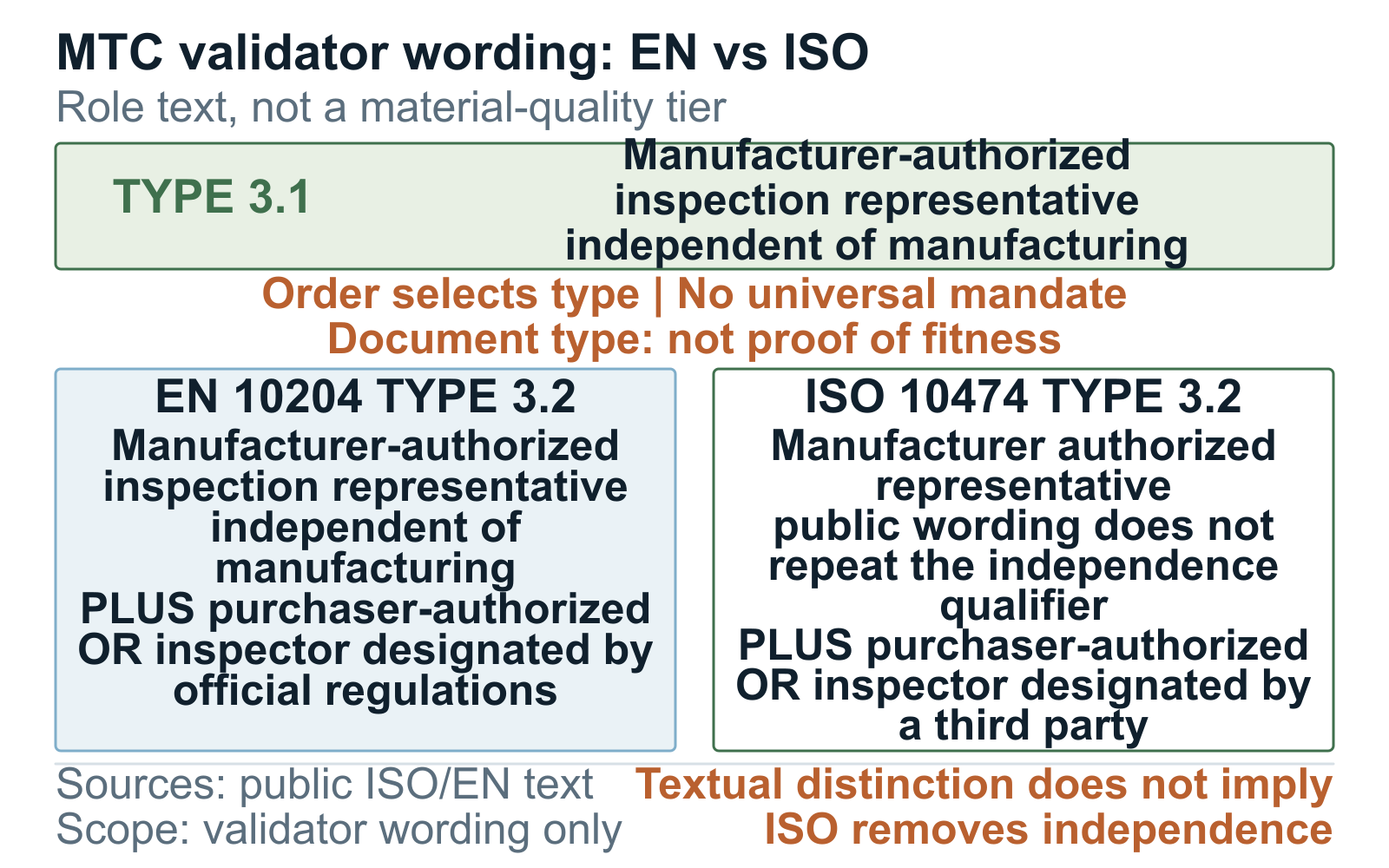
Under type 3.1, the document is validated by the manufacturer's authorized inspection representative independent of the manufacturing department. Check who has signed or validated it and whether that role matches the requested document type. A production signature with no stated inspection responsibility needs clarification.
The manufacturer remains responsible for the stated conformity and reported results. Review those results against the product standard and order, including the heat-treatment condition and sampling requirements. The 3.1 heading does not tell you that ultrasonic testing, impact testing, or an independent witness was included.
Use the licensed EN 10204 or ISO 10474 edition named in the order when checking the role and document wording. The public copies cited in the references are reading aids; they do not establish which national adoption or edition applies to a contract. Resolve that point during quotation if the customer's specification is unclear.
Type 3.2: the additional validator
EN 10204:2004 type 3.2 names the manufacturer's authorized inspection representative independent of manufacturing. It also names either the purchaser's authorized inspection representative or an inspector designated by official regulations. ISO 10474:2013 type 3.2 names the manufacturer's authorized representative. Its additional validator is either the purchaser's authorized representative or an inspector designated by a third party. The public ISO type 3.2 wording does not repeat the independence qualifier. This textual difference is insufficient to conclude that ISO removes independence as a general practice. Preserve each standard's manufacturer-role and alternate-validator wording.
The required type must come from the contract, governing product or equipment specification, or applicable regulation. Agree the additional representative, any official appointment, witness activities, and submission timing before production starts. If outside validation is requested, obtain confirmation of the actual appointment and work scope; a company name in a quotation is insufficient.
Older specifications may still refer to EN 10204:1991 types. European Commission PED Guideline 7/5 maps 1991 type 3.1.B to 2004 type 3.1 and 1991 type 3.1.C to 2004 type 3.2. That mapping is historical guidance under the superseded Directive 97/23/EC. For a current pressure-equipment order, check the applicable requirements under Directive 2014/68/EU and the project specification; the historical mapping does not make type 3.2 compulsory for every steel purchase.
Purchase order and certificate must agree
Work through the certificate with the purchase order, drawing, test reports, and packing list open together. Record the requirement, the reported value or reference, and any unresolved difference. The table below is a JOTAIN receiving and document-review checklist, not a table from EN 10204 or ISO 10474.
For example, one heat may be split into separate heat-treatment batches. If the certificate lists one tensile result, ask which batch and specimen it represents and how that batch maps to the shipped bundles. Record the supplier's correction or explanation against the order line. Keep the previous document revision so the release record shows what changed.
For a document example, see the redacted MTC and inspection-document walkthrough and compare the marked fields with the checklist.
| PO field | Certificate evidence to locate | Identity/traceability match | Validator role | Separate inspection action | Discrepancy disposition |
|---|---|---|---|---|---|
| Standard and edition | Inspection-document standard, edition, and requested type | References match the purchase order without silent substitution | Validation is checked under the requested edition and type | Resolve edition-specific inspection references in their controlling documents | Hold review for correction or an approved written deviation |
| Product and grade | Product form or order identity, grade, and product specification | Descriptions map to the ordered line and accepted equivalence route | Validator covers the identified inspection document | Confirm product checks under separately stated requirements | Quarantine the mismatch until disposition is authorized |
| Delivery condition | Supplied condition and required processing references | Condition matches the ordered and marked material | Validator signs the document carrying that stated condition | Review condition-specific records under their own requirements | Correct the record or obtain an approved technical disposition |
| Heat or batch | Exact heat, batch, or lot identifier used by the controlling documents | Identifier connects certificate, material marking, bundle, and shipment | Validator's document identifies the controlled material unit | Check any inspection report against the same identity chain | Stop release if the chain is missing or contradictory |
| Required tests and results | Required records, specifications, results, and units | Reported data maps to the correct controlled material and condition | Validator role is appropriate to the requested document type | Evaluate each test under its separately agreed acceptance basis | Request correction, retest records, or formal deviation as applicable |
| Document type | Clear EN 10204 or ISO 10474 type and the applicable edition | Type matches the purchase-order requirement | Check type-specific manufacturer and alternate-validator roles in the controlling licensed edition | Do not infer a new inspection requirement from the type label | Reject substitution unless the approver accepts it in writing |
| Marking and shipment identity | Bar or bundle marking, packing-list reference, quantity, and shipment identifiers | Physical and document identifiers reconcile to the ordered line | Validation remains tied to the identified material package | Complete any agreed marking or release inspection separately | Correct identity gaps before packing or shipment release |
| Approval timing | Submission status, revision, review date, and release records | Approved revision applies to the shipment being released | Required reviewer or validator has acted at the agreed point | Complete hold, witness, and report reviews on their own schedule | Maintain the hold until the named owner closes the discrepancy |

Certificate content and inspection requirements
Specify inspections separately from the certificate type. For each required examination, state the method, extent, stage, acceptance requirement, report, and any witness or hold point. This applies to hardness, tensile and impact testing, dimensions, surface examination, and ultrasonic testing. The results may be assembled in one document package, but each test still needs a clear order requirement.
When a separate UT or other report is supplied, compare its material identity and inspection stage with the MTC and packing list. Check that the report covers the required material and that any exclusions have been resolved. A test photograph can show the activity; the identified report carries the result needed for release.
A certificate review establishes whether the supplied documentation and reported material results meet the order. The finished component still needs the drawing's design, processing, and inspection requirements. If an order requires customer or third-party release, record that decision separately from receipt of the certificate.
RFQ wording and approval timing
In the RFQ, name the product line, grade and product standard, delivery condition, heat or lot identification, inspection-document standard and edition, type, and required results. Add the required format, submission date, reviewer, witness or hold points, and release condition. State whether controlled copies, originals, or customer forms are needed.
If document layout matters, review a blank or redacted sample during quotation. Agree where the order reference, test condition, specimen location, result, and validation will appear. Approval of that format does not approve later test values or shipment identity. Review the completed package against the actual material before release.
Use the downloadable checklist to record missing fields and corrections. Require the supplier to identify document or inspection exclusions in its offer and obtain written acceptance of proposed alternatives before order confirmation. Keep the approved order, revised certificate, supporting reports, and shipment markings together in the final record.
Questions buyers ask
What is the difference between EN 10204 type 3.1 and type 3.2?
Type 3.1 identifies the manufacturer-side inspection representative role. Type 3.2 adds a standard-specific alternate validator, but EN 10204 and ISO 10474 describe the manufacturer and alternate-validator wording differently. Use the controlling licensed edition before stating who validates the document.
Is type 3.2 a higher material-quality level or a requirement for every order?
No. It is an inspection-document designation with an additional validator role. The contract, governing specification, or applicable regulation must select the required type; the label alone cannot confirm product quality or suitability.
What should buyers reconcile between a steel-bar PO and MTC?
Check the inspection-document standard and edition, product and grade, delivery condition, exact heat or batch identity, required tests and results, document type, validator role, marking and shipment identity, revision, and approval timing.
Does an MTC request define separate inspection?
No. State every required examination, extent, stage, acceptance basis, report, witness point, and approver separately. A report may join the certificate package, but the document type cannot add its technical requirement.
RFQ checklist
- Inspection-document standard, adopted edition, type, language, format, and controlled-copy requirement
- Product form, dimensions or order line, grade specification, and approved equivalence route
- Delivery condition, processing references, and exact heat, batch, or lot identity term
- Required results, methods or specifications, units, and separate acceptance references
- Type-specific manufacturer and alternate-validator roles under the controlling licensed edition
- Bar or bundle marking, packing-list reference, quantity, and shipment identity chain
- Draft review, hold or witness points, correction and deviation owner, and final submission timing
- Separate inspection requirements, report references, packing, destination, and shipment release approver
References
- ISO 10474:2013 Steel and steel products - Inspection documents
- ISO 10474:2013 Steel and steel products - Inspection documents public preview
- EN 10204:2004 Metallic products - Types of inspection documents public copy
- European Commission PED 97/23/EC Guideline 7/5
- Directive 2014/68/EU on pressure equipment, consolidated text
Inquiry support
Need to tighten the inspection plan?
Send the drawing or RFQ with the grade, size, condition, processing, inspection, quantity, and destination. We can flag open points before quotation.