
Key takeaways
- Read each MTC result with its units, column multiplier, test basis and material identity. A redacted teaching sample cannot approve a shipment.
- An inspection-document type, an ultrasonic test report, and a shipment release record are separate documents with separate authority.
- Specify UT method, product scope, coverage, calibration or reference basis, acceptance, personnel, and report fields before testing.
- Require every report to reconcile with heat, bar or bundle, inspection lot, PO line, and accepted revision.
- A certificate marked pass cannot prove an inspection activity or acceptance criterion that the order never defined.
Direct answer for inspection documents
A complete steel bar RFQ asks for more than documents. It states which certificate or report is required, which tests are expected, whether ultrasonic testing is needed, and how the documents should connect to grade, heat number, size, delivery condition, and application.
The chemistry units in a real 40Cr MTC excerpt
This is the same redacted 40Cr document excerpt published on the JOTAIN Quality page. Identity and commercial fields have been removed. Use it to practise reading technical fields; it cannot authenticate an issuer, establish a heat-to-shipment link or approve a current order. The chemistry and mechanical blocks must not be assumed to describe the same heat simply because their first visible rows are shown together.
Start with the unit and multiplier printed above each chemistry column. In this excerpt, the carbon and chromium columns use a multiplier of 100, while phosphorus uses 1,000. Divide each printed value by its own column multiplier to recover mass percent. Reading the integer 40 as 40% carbon, or applying the carbon multiplier to the phosphorus column, would change the meaning of the result.
| Field | Printed value and multiplier | Read as mass percent | Interpretation |
|---|---|---|---|
| Carbon, C | 40; column marked ×10² | 0.40% | Divide 40 by 100 |
| Chromium, Cr | 94; column marked ×10² | 0.94% | Divide 94 by 100 |
| Phosphorus, P | 11; column marked ×10³ | 0.011% | Divide 11 by 1,000 |
Sources:[5]
![[5]](https://jotainmaterials.com/images/quality/documents/mtc-sample-redacted-40cr.jpg)

Sources:[5]
Measured results, inspection status and acceptance
The first visible mechanical row reports Rp0.2 of 615 MPa, Rm of 795 MPa, elongation A of 21.0% and reduction of area Z of 67%. The impact block shows a KV2 result of 41 J under a −20°C heading. These are transcribed example results, not minimum values for every 40Cr bar. Before comparing an actual result with an order, confirm the test standard, specimen dimensions, orientation, location, material condition and applicable sampling rule.
The lower block includes the Chinese condition label 调质, meaning quenched and tempered, and an HBW hardness field. Its UT and MT fields are marked 合格, meaning reported conforming. A status field tells you the recorded disposition; it does not reveal the procedure, scan coverage, sensitivity, acceptance class or examined-bar identity. Request the linked examination report when those details are required by the order.
The redaction prevents a complete traceability check. For the unredacted order dossier, reconcile the heat number and inspection lot with the bar or bundle marks, purchase-order line, supplied size and condition, report identifiers and packing list. Confirm the issuer, authorized signatory and applicable document type. Resolve missing results or deviations before the shipment hold point is cleared.
Keep the distinction visible when sharing extracts: a specimen result describes the recorded test, an inspection status records a disposition, and shipment acceptance depends on the complete agreed requirements. This example supplies a reading method; acceptance limits and evidence for a future order must come from that order and its own inspection records.
What to state for MTC review
When a material test certificate is needed, state its type or project wording, heat-number traceability, grade standard, dimensions, delivery condition, and required test results.
When UT should be included
Ultrasonic testing should be requested when the drawing, project specification, application risk, or buyer quality route requires it. State UT requirement, size range, acceptance wording if known, and whether third-party inspection or witness review is expected.
Document timing and shipment planning
Inspection documents affect shipment preparation. Buyers should mention whether documents are needed before shipment, with shipment papers, or for customer approval, and should attach any drawing, specification, or inspection checklist that controls the order.
Build the dossier from decisions, not document names
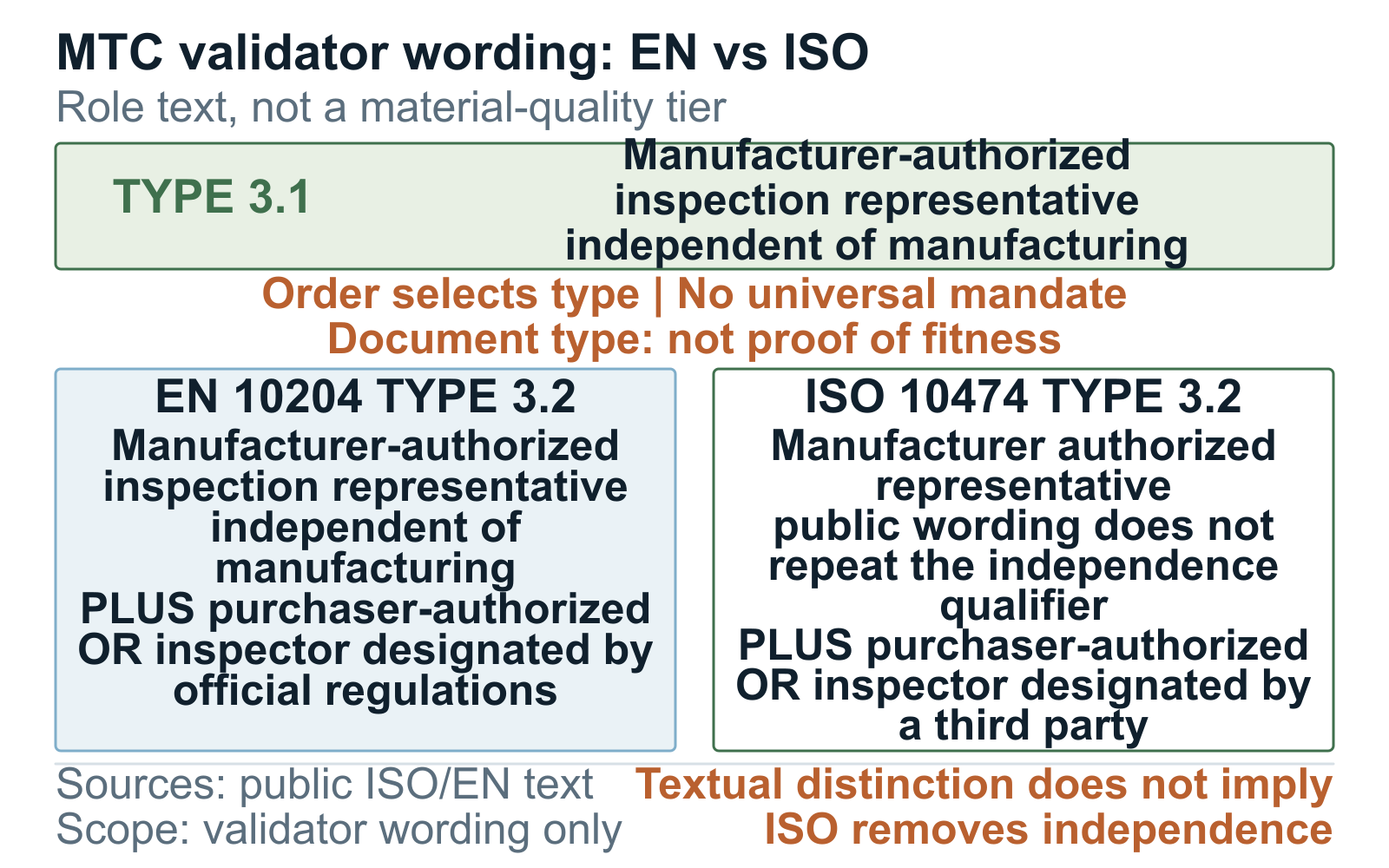
Start with an order requirement matrix. For each characteristic, identify the controlling product or test standard, method, sample or coverage, acceptance rule, responsible issuer, traceability key, review timing, and release effect. ISO 404 provides general delivery context, while ISO 10474 defines inspection-document categories supplied according to an order. Neither makes the shorthand request MTC plus UT technically complete.
Documents and tests are different requests
| Decision | Order fields | Evidence returned | Boundary to state |
|---|---|---|---|
| Inspection document | ISO 10474 type, required actual results, issuer route, traceability, and review timing | Signed document plus linked result register | Document category cannot add unstated tests or acceptance values |
| UT technical requirements | Applicable bar method, product state, scan coverage, reference basis, acceptance, end zones, and reporting | Approved procedure and examination report | BS EN 10308 scope does not choose the order-specific class or technique |
| Personnel | Required qualification scheme, method, sector, level, employer authorization, and approval evidence | Current personnel records linked to report signatory and activity | ISO 9712 certification does not define procedure or product acceptance |
| Release reconciliation | Heat, bar or bundle, inspection lot, PO line, deviations, hold point, and shipment approver | Cross-reference index, closed exceptions, and signed release record | Report completion and shipment authorization remain different decisions |
Reconcile procedure, examination, identity, and release
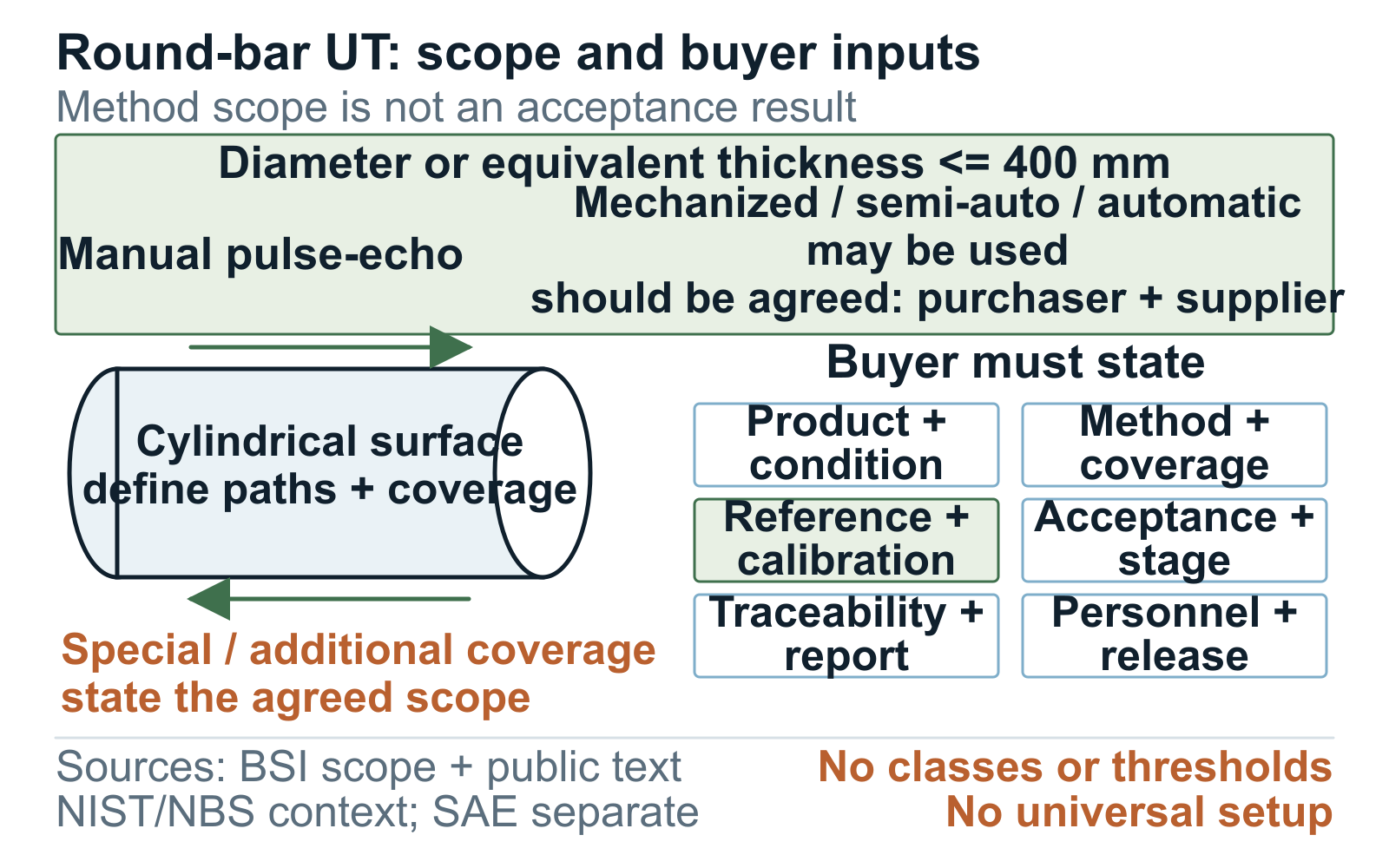
Start UT wording with the product form and state being examined. Define accessible surfaces, coverage and excluded zones, technique, calibration or reference basis, and sensitivity controls. State evaluation and acceptance criteria, any specified recording threshold, personnel requirements, and equipment checks. Add the report content and how indications will be handled. BS EN 10308 provides a steel-bar UT standard, but the buyer and supplier must still resolve the order-specific choices. Do not claim that UT proves material defect-free. [3][4]
RFQ example
Item: Steel round bars per [PO schedule and revision]
Inspection document: ISO 10474 type [state], actual ordered results, authorized issuer route, heat and lot identity, and linked report register
UT: BS EN 10308 when applicable to the ordered product; approved procedure to state product state, technique, coverage, excluded zones, reference basis, acceptance, recording, and report fields
Personnel: ISO 9712 qualification and employer authorization for the ordered method and sector as stated in the inspection plan
Traceability: Report maps each examined bar or bundle and inspection lot to heat, size, condition, PO line, marks, and final packing line
Review: Draft templates before testing; indexed final dossier and closed deviations at the shipment hold point
Release: No dispatch until the buyer clears the hold point in writingQuestions buyers ask
What is the difference between MTC and UT in a steel bar RFQ?
An MTC is a material test certificate request tied to material identity and test results, while UT refers to ultrasonic testing if specified by the project, drawing, application, or buyer inspection route.
Should every steel bar RFQ include ultrasonic testing?
No. Buyers should request UT when the specification, application risk, customer approval route, or internal quality requirement calls for it, and should state the requirement clearly with the inquiry.
How should buyers request MTC and UT documents?
State the required certificate type, grade standard, heat number traceability, UT requirement, acceptance criteria if known, inspection timing, third-party involvement, destination, and whether reports must accompany shipment documents.
How do I read scaled chemistry values on an MTC?
Use the multiplier printed in each column header. In the redacted 40Cr example, C = 40 under ×10² reads as 0.40% carbon, while P = 11 under ×10³ reads as 0.011% phosphorus. Check every column separately and compare the decoded result with the controlling order specification.
RFQ checklist
- Required certificate type or project document wording
- Grade standard, heat number traceability, diameter, length, and quantity
- Chemical composition and mechanical testing expectations
- UT requirement, acceptance wording, and size range if specified
- Third-party inspection or witness requirement when needed
- Drawing, specification, destination, and document timing
- Controlling PO, product specification, inspection plan, revisions, and document precedence
- Inspection-document type, issuer or validator route, actual fields, and review timing
- UT product state, technique, coverage, excluded zones, reference basis, and acceptance
- Personnel method, sector, level, certification evidence, authorization, and report signatory
- Heat, bar or bundle, inspection lot, report, deviation, and packing cross-reference
- Draft status, nonconformance closure, witness or hold points, waiver, and release approval
References
- ISO 404:2013 Steel and steel products — General technical delivery requirements
- ISO 10474:2013 Steel and steel products — Inspection documents
- BS EN 10308:2002 Non-destructive testing — Ultrasonic testing of steel bars
- ISO 9712:2021 Non-destructive testing — Qualification and certification of NDT personnel
- Redacted 40Cr MTC example: technical fields only
Inquiry support
Need to tighten the inspection plan?
Send the drawing or RFQ with the grade, size, condition, processing, inspection, quantity, and destination. We can flag open points before quotation.