
Key takeaways
- Record the mill, feed, water, charge, liners and operating period for each comparison.
- Keep product-test results separate from the mill’s measured outcome.
- Report changes in duty so a better or worse result can be interpreted.
The same grade cannot add the same exposure
The grade and inspection record describe the delivered material. The mill record describes its exposure in service. Feed, slurry, speed, shell and liner geometry, charge mix, and operating practice can change the contact conditions even when two deliveries have the same grade, dimensions, and hardness requirement.
Rod-mill studies have changed feed size, charge, flow, solids, speed, lifter geometry, and rod dimensions and observed different grinding or energy responses inside their test conditions. They don't predict a buyer's rod life. They show why an operating description belongs beside the material record.
Review delivered-lot conformity and the operating comparison separately. Record any material nonconformance against the order, and any process change against the mill timeline. A change in duty does not remove a delivery requirement; an operating symptom still needs examination before it is attributed to the material.
| Claim | What would support it | What it cannot confirm |
|---|---|---|
| The rods have the same grade designation | Controlling standard, ordered grade, heat identity, chemistry record, allowed substitutions, and inspection document linked to the delivered lot. | The same heat-treatment response, geometry distribution, internal condition, mill exposure, or service result. |
| The rods met the same hardness target | Same method and edition, preparation, locations, depth, equipment status, sampling basis, individual results, and acceptance basis. | Equivalent toughness, straightness, wear, breakage resistance, charge motion, or batch consistency. |
| The rods were compared in equivalent service | Same named mill or justified matched mills, aligned feed and product targets, charge state, liner state, process environment, exposure, and event ledger. | A result assumed to apply outside the recorded block or an automatic causal verdict when the outcomes differ. |
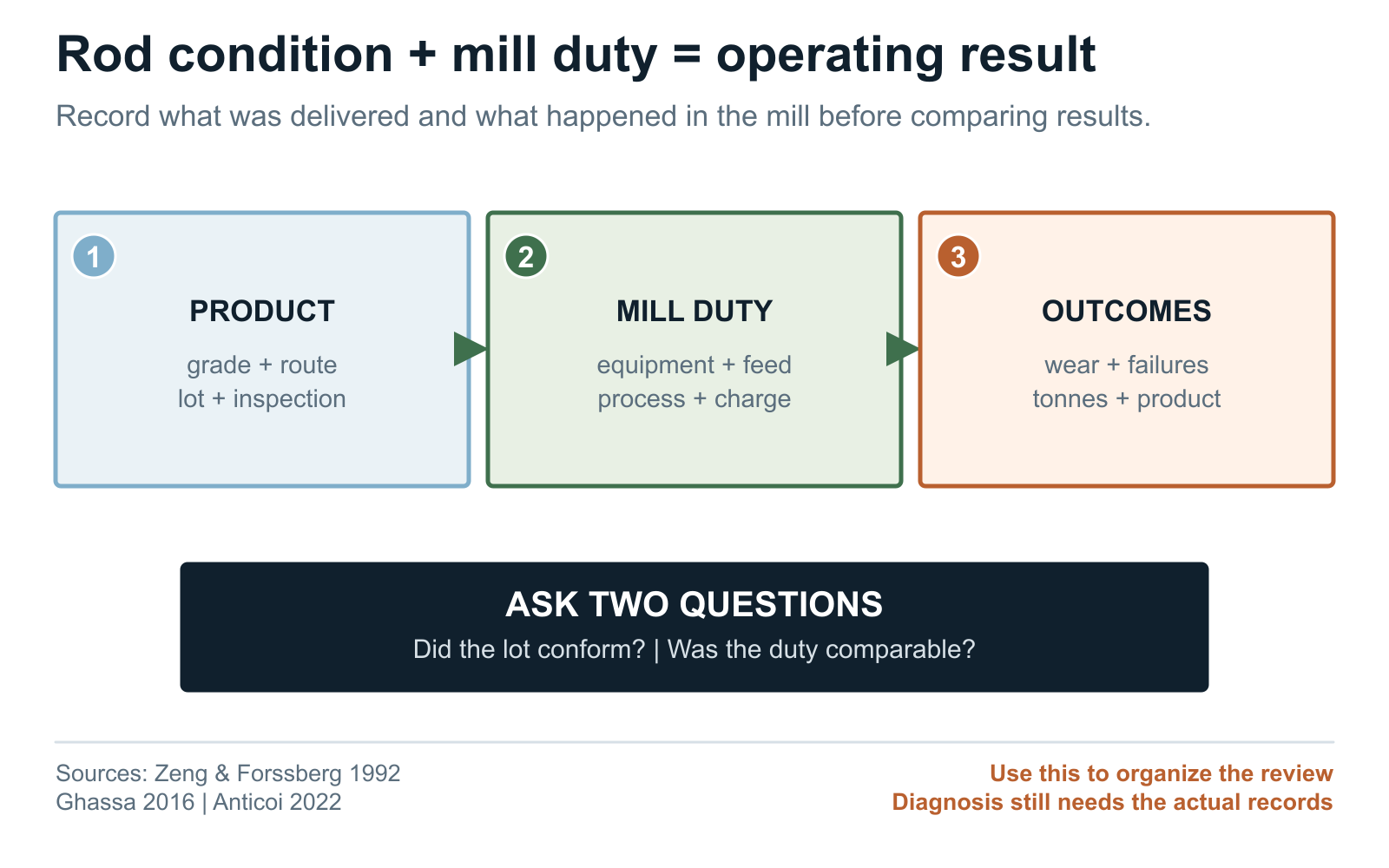
Mill duty before product comparison
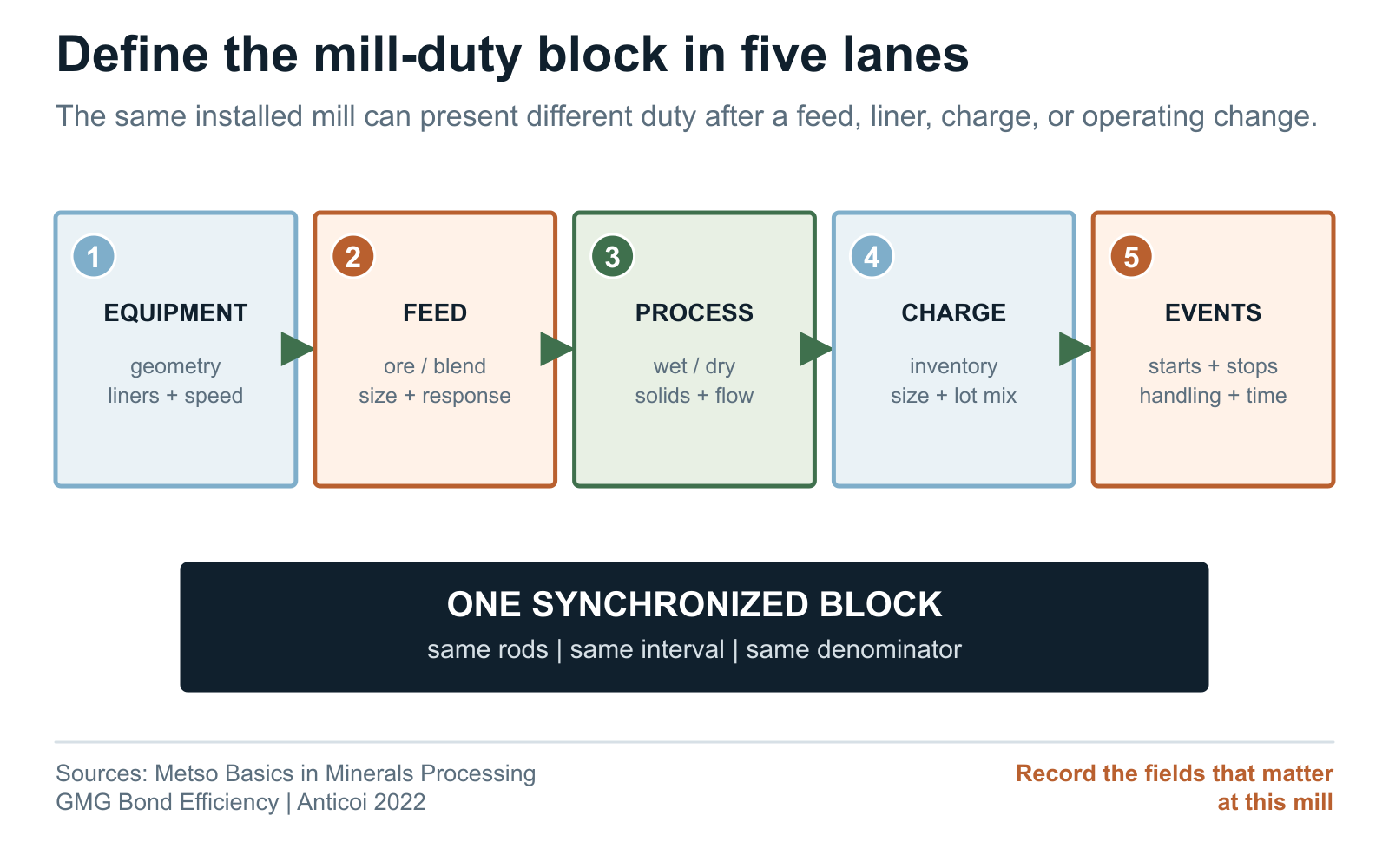
Mill duty is the equipment, feed, process environment, media charge, operating practice, and exposure period attached to a result. The same installed mill has a different duty after a liner change, ore campaign, charge clean-out, slurry change, or new product target.
Record the equipment that was actually in service: mill tag, internal diameter, usable grinding length, liners and lifters, speed, discharge arrangement, and relevant drive or power data. Then add feed identity and size distribution, ore response, wet or dry condition, solids and water data where useful, throughput, and product target.
Finish with the rods and time period covered: starting charge, additions by lot, rod size mix, worn and broken removals, inventory estimate, trips, clean-outs, charging practice, operating hours, and dry tonnes. The numerator, denominator, and rods covered must use the same interval.
| Duty lane | Record | Why the field matters | If unavailable |
|---|---|---|---|
| Equipment | Named mill; internal diameter; effective length; liner and lifter design, age, and inspection state; discharge; speed; power context. | Defines the physical environment and flags changes that may alter charge motion or energy transfer. | Mark unknown; do not replace an unknown installed condition with catalogue data. |
| Feed | Ore or blend ID; sampling window; top size; size distribution; F80 if used; competency or abrasion evidence; moisture. | Separates a feed change from a media change and shows which feed the samples covered. | Retain samples or available production proxies and downgrade comparability. |
| Process environment | Wet or dry; slurry solids; relevant water chemistry; flow; circuit position; product target and measured product size. | Connects rod exposure to transport, contact, corrosion-related, and grinding conditions. | State the missing measurements and avoid making a correction that cannot be supported. |
| Media charge | Starting inventory; lot IDs; additions; diameter and length distribution; mixed suppliers; removals; residual inventory. | Identifies which rods were actually exposed and whether a transition or mixed charge confounds the result. | Treat the block as mixed or transitional; do not label it as one supplier's clean result. |
| Operations and events | Throughput; dry tonnes; operating hours; starts, stops, trips, clean-outs, jams, recovery work, and changes in control settings. | Aligns performance outcomes with the same time and production denominator and preserves abnormal events. | Use a qualified narrative block, not an apparently precise but unsupported comparison. |
How duty can change the outcome without changing the grade
A rod mill is an interacting system of feed, rods, liners, fluid or air, and rotating shell. Changing one operating field can alter contact, transport, residence time, energy use, product size, wear, and damage. No single input explains every outcome.
Higher kg/t may follow a harder ore, finer product target, inventory correction, unweighed removal, or product difference. A breakage cluster may coincide with material variation, a charge upset, handling, liners, or several factors together. The symptom tells the team what to preserve, not whom to blame.
Report consumption together with throughput, product size, operating time, charge transition, abnormal events, breakage, bending, tangling, and removal categories. A candidate that looks better on one measure may carry a trade-off that disappears in a single-score comparison.
Anticoi and co-authors varied operating parameters in a laboratory rod mill treating potash. Changes in speed, media loading and slurry conditions affected energy use and product size. That result supports recording duty alongside a media comparison; the laboratory savings are not a forecast for another ore or an industrial mill. [3]
| Observed outcome | Duty fields to review | Product fields to review | Unsafe shortcut |
|---|---|---|---|
| Adjusted consumption changes | Dry tonnes, feed and product size, ore block, slurry state, charge inventory, transition, removals, throughput, and operating time. | Lot mass, identity, diameter and length mix, heat-treatment and hardness evidence, breakage and residual pieces. | A changed kg/t value proves the grade is better or worse. |
| Premature breakage changes | Incident timeline, charge condition, liner state, starts and stops, feed events, jams, recovery, and handling. | Fracture register, piece and bundle identity, retained same-lot rod, chemistry, process route, mapped tests, and examination. | Every broken rod is a material defect, or every break is an operating issue. |
| Bending or tangling changes | Mill and liner geometry, charge mix, worn-rod mix, discharge state, speed changes, handling, and abnormal events. | As-delivered and as-found straightness, diameter, length, ends, surface, lot identity, and damage record. | Nominal diameter alone establishes fit or root cause. |
| Throughput or product size changes | Feed distribution and competency, flow, solids, operating set points, power, circuit state, sampling, and product target. | Actual media mix, additions, removals, and transition state rather than brochure size only. | A product-size change is treated as a rod-material performance result. |
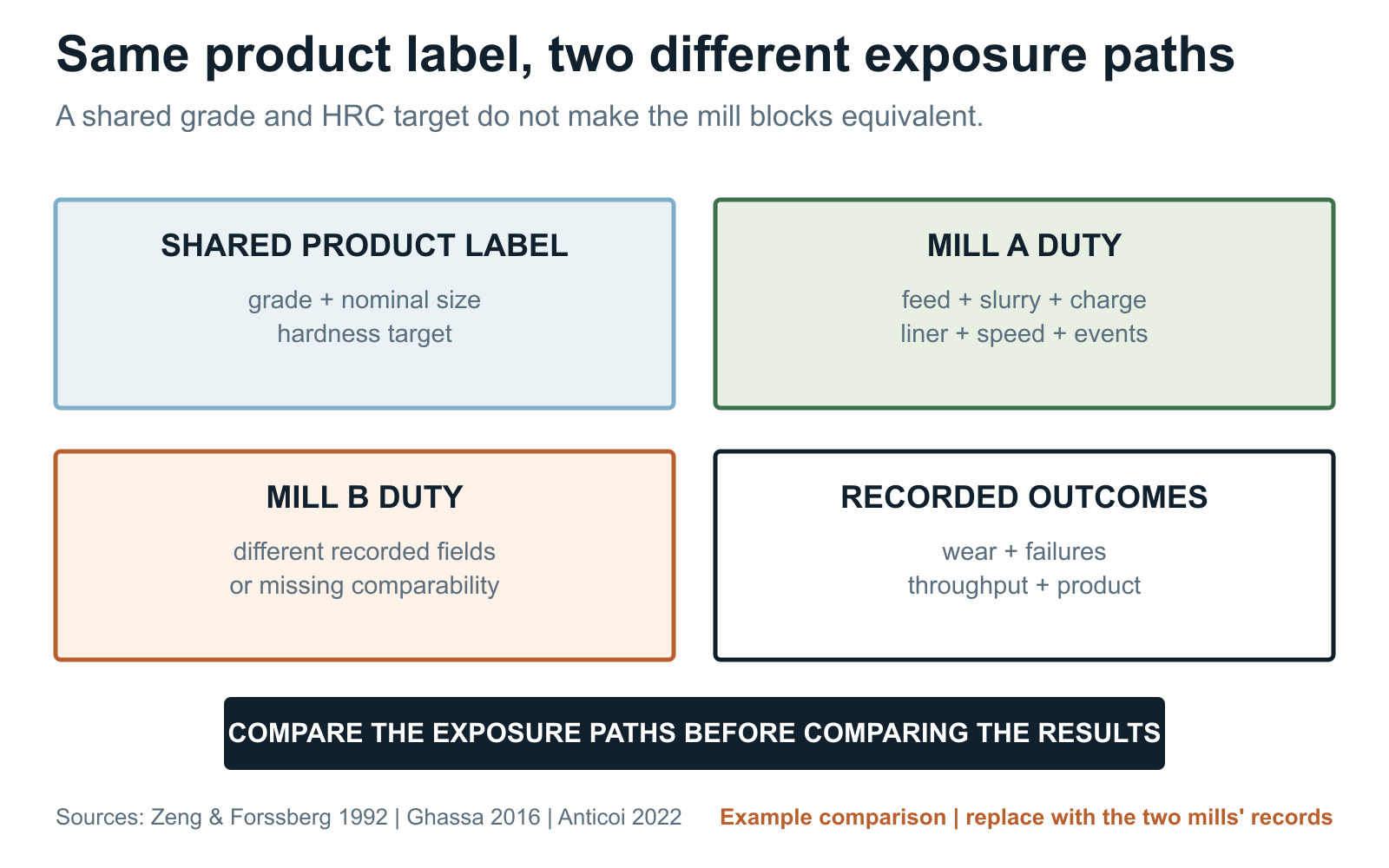
Product variation and mill variation
Check both records when a result changes. On the product side, compare identity, dimensions, treatment, process changes, nonconformance, and damage before charging. On the operating side, compare feed, charge transition, liners, settings, abnormal events, measurements, and the mass ledger. Keep unresolved interactions visible until the records or tests distinguish them.
Traceability decides which product records belong with which plant block. Measurement discipline decides whether the observed difference is real: keep the method, location, instrument status, operator or laboratory, units, rounding, and raw values for hardness, mass, moisture, size analysis, and inventory.
“Unresolved” is a valid result. Mixed or missing evidence should lead to a better next block, not a confident blame statement. State what is known, what differs, and which field must be controlled or measured next.
| Hypothesis lane | Examples to test | Evidence that may support or conflict | How the result is used |
|---|---|---|---|
| Rod lots and bundles | Wrong or mixed lot; geometry variation; process-route deviation; localized material feature; transport or storage damage. | Heat and process genealogy, bundle ledger, retained sample, mapped dimensions and hardness, process records, fracture or metallographic evidence where justified. | A plant symptom alone cannot confirm nonconformity or root cause. |
| Mill-duty block | Feed or ore change; liner or lifter change; altered speed or solids; mixed charge; transition; abnormal stop; recovery or handling event. | Time-synchronized historian data, feed and product samples, maintenance and event logs, charge ledger, photographs, operator records, and block exclusions. | A changed operating field doesn't necessarily excuse a nonconforming delivered lot. |
| Product-duty interaction | Conforming rod is not suitable for the actual duty; size or route that worked in one mill is unsuitable after a plant change. | Conformity dossier plus matched trials across the relevant duty range, with the product target and stop rules agreed beforehand. | Suitability is duty-specific and cannot be transferred as a grade ranking for every mill. |
| Measurement system | Changed sample location, mass basis, moisture correction, instrument status, screen method, counting rule, or rounding. | Method revision, calibration and validity records, raw readings, duplicate or reference checks, uncertainty, and data lineage. | Do not correct or normalize a measurement difference without a documented basis. |
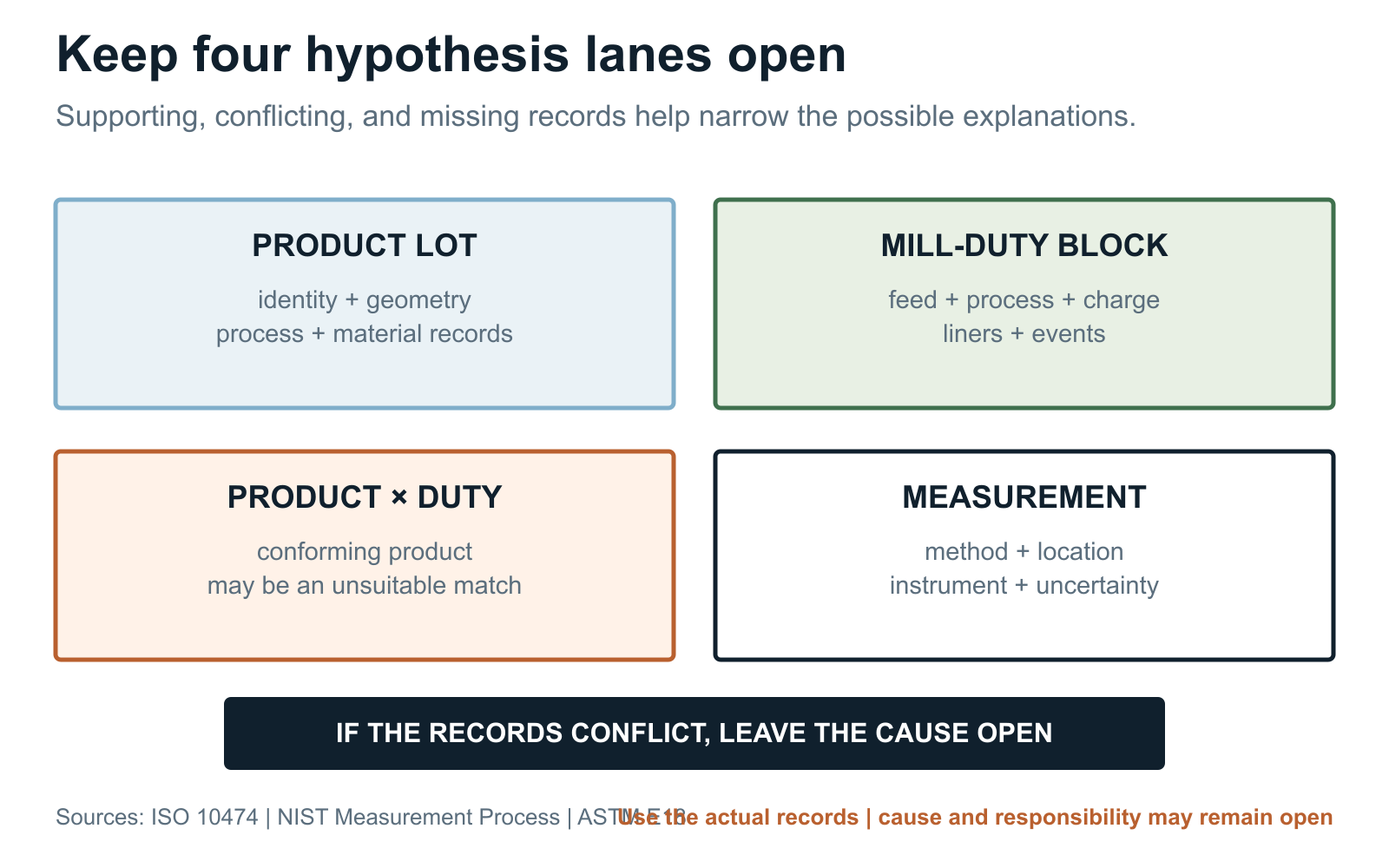
Matched operating blocks
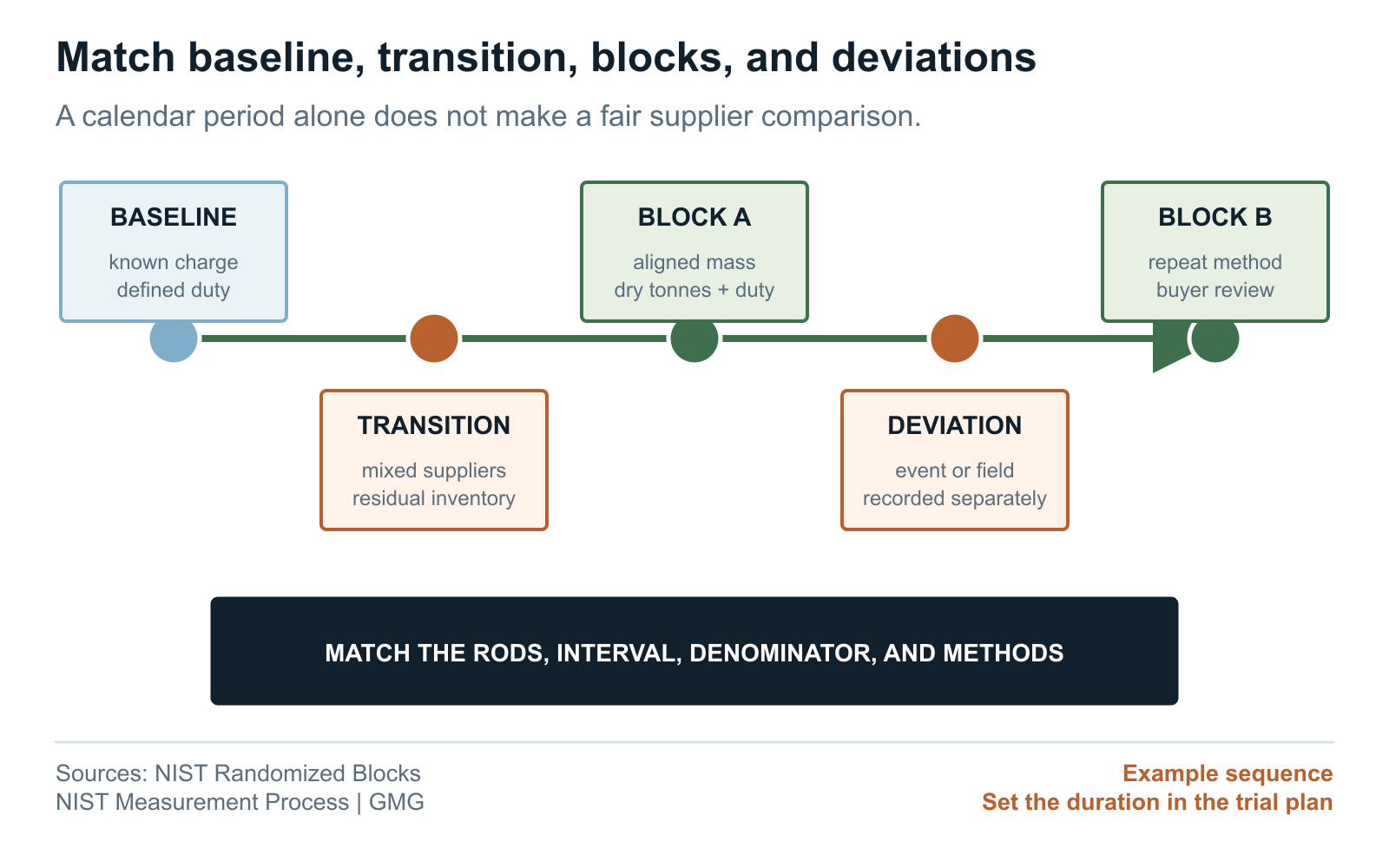
A comparison block needs a clear start and finish and a list of the rods included. State which bundles entered the mill, what old rods remained, and how additions, removals, inventory, dry tonnes, events, and product samples will be reconciled.
The strongest comparison uses the same mill with planned blocks, but time, ore, liner wear, and transition still matter. If two mills are compared, list their physical and operating differences and narrow the conclusion. “Same model” is not enough.
Write the exclusion rule before seeing the result. A jam, clean-out, missing weigh record, feed excursion, unidentified mixed charge, or instrument fault may form a separate qualified block. Keep the original data, explain any adjustment, and let the buyer decide whether the block can support the commercial decision.
Record baseline and trial conditions in the grinding rod consumption trial ledger before interpreting the kg/t difference. Its operating-context checks flag missing or different entries; matching entries are not engineering approval that two blocks are comparable. The plant still decides exclusions, safety stops and acceptance.
| Control | Before the block | During the block | At review |
|---|---|---|---|
| Rods covered | Identify supplier, heat, process lot, bundle IDs, transition plan, and residual mixed charge. | Log every addition, removal, recovered piece, unidentified item, and transfer. | State the represented and unrepresented mass; do not assign mixed exposure to one supplier. |
| Duty window | Set mill, feed, product, throughput, slurry, charge, liner, and operating ranges plus stop rules. | Capture time-synchronized values and deviations rather than end-of-month recollection. | Compare distributions and deviation time, not only block averages. |
| Outcome definitions | Define adjusted kg/dry t, breakage, bending, tangling, product size, throughput, and event counting. | Use the same measurement and classification methods for every candidate. | Show raw values, corrections, uncertainty, exclusions, and unresolved classifications. |
| How the result is used | Agree minimum exposure, repeat-block logic, decision margin, safety stops, and approver. | Do not change the winning metric after seeing results. | Approve, repeat, adjust, hold, or stop within the scope agreed before the trial. |
When the two mills cannot be matched, narrow the claim
Plants cannot hold every field constant. That doesn't make the record useless; it limits the claim. A result from Mill A during a named block belongs first to Mill A, that duty, and those rod lots. Use it to form a hypothesis or site baseline before extending it elsewhere.
Classify each comparison field as matched, different but understood, or materially missing. A block with major gaps may still help safety or troubleshooting, but it isn't a sound supplier ranking. Do not “correct” differences with a model unless the calibration range, assumptions, uncertainty, and owner are visible.
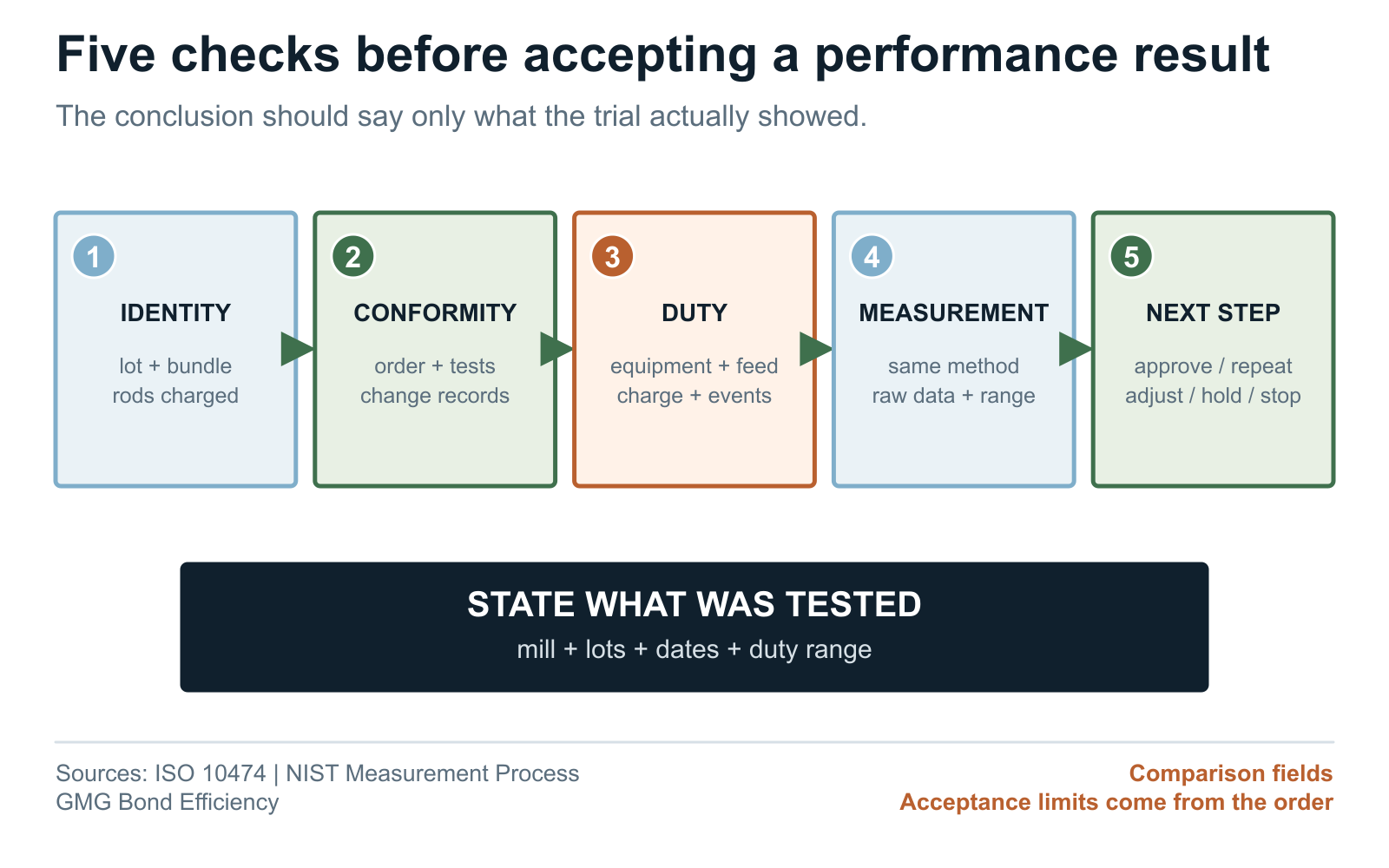
Write the conclusion at the resolution of the evidence: what happened, in how many blocks, on which mill and lots, under which duty, and with which deviations. If ore and liner states were not comparable, say that a directional difference was observed and repeat the work under an agreed window.
| Status | Meaning | Permitted use | Do not say |
|---|---|---|---|
| Green | Critical fields are measured by aligned methods and remain within the approved comparison ranges. | Use in the sourcing review, with the limits stated. | The result applies beyond the recorded duty or guarantees future lots. |
| Amber | A field differs or is partially missing, but the difference and treatment are documented and approved. | Use as qualified evidence, sensitivity analysis, or a trigger for a repeat block. | The adjustment removed all confounding. |
| Red | A material field is unknown, mixed, outside the allowed range, or cannot be synchronized with the outcome. | Use for incident response, hypothesis generation, and redesigning the trial. | One product or supplier won the comparison. |
Mill duty in the RFQ and trial protocol
The RFQ gives the supplier enough mill context to review the proposed rod route and gives the buyer a structure for the trial. The supplier returns product, process, inspection, traceability, packing, and change information. The plant keeps control of operations, exclusions, calculations, safety stops, and the final decision.
Define the outcome before charging. For consumption, state the adjusted mass balance, dry-tonnes basis, transition, product and throughput constraints, abnormal events, uncertainty, and repeat rule. For breakage or tangling, define the event and evidence-preservation steps.
State the decision for the named mill, operating period, and rod lots: approve, approve with conditions, repeat, adjust one variable, hold, or stop. Record the supporting product results and operating data, the remaining uncertainty, and the person responsible for the next action. Carry the result to another mill only after reviewing its duty.
| Field | Supplier response | Buyer or plant responsibility | Decision output |
|---|---|---|---|
| Product route | Grade and standard; dimensions; process route; heat-treatment target; inspection; lot hierarchy; change notification; packing and marking. | Confirm controlling documents, allowed alternatives, consequence, and acceptance decision. | Order-defined product and record file. |
| Mill duty | Review stated duty and disclose assumptions, exclusions, and information needed for route assessment. | Own mill settings, feed and process data, charge and event records, safety, and operating decisions. | Approved duty envelope for the trial. |
| Trial and measurement | Supply traceable trial lots and agreed product records; support investigation with preserved same-lot evidence. | Own block design, mass balance, sampling, outcome definitions, uncertainty, exclusions, and performance calculation. | Auditable matched-block report. |
| Final review | Review findings and respond to evidence without converting hypotheses into claims. | Authorize approval, repeat, adjustment, hold, rejection, claim route, or further investigation. | A conclusion limited to the recorded mill and trial conditions. |
GRINDING ROD MILL-DUTY TRIAL OUTLINE

Mill: [tag, internal diameter, usable length, liners/lifters, speed, discharge]
Feed and duty: [ore, top size/F80, wet or dry, solids, throughput, product target/P80]
Current charge: [rod sizes, mass, age, supplier/lot mix, worn and broken removals]
Candidate rods: [grade/standard, diameter, length, process and inspection lot, quantity]
Trial objective: [consumption / breakage / bending / tangling / product or throughput constraint]
Blocks: [baseline, transition, candidate, start/end and repeat plan]
Measurements: [additions, removals, inventory, dry tonnes, events, product size, operating time]
Allowed range and exclusions: [feed, throughput, mill state, stops, missing records]
Traceability and documents: [heat, process lot, bundle, certificate, raw inspection data]
Safety and evidence rules: [stop, isolation, recovery, photographs, retained pieces]
Decision: [approve / conditional / repeat / adjust / hold / stop]Questions buyers ask
Can the same grinding rod grade perform differently in two mills?
Yes. The same grade designation can be exposed to different mill geometry, speed, liners, feed, slurry, charge, throughput, product target, events, and handling. A difference is an observation to investigate, not automatic proof that the grade, supplier, or mill caused it.
What does mill duty mean for grinding rods?
For a buyer's RFQ or trial, mill duty is the recorded combination of equipment, feed, process environment, media charge, operating practice, and time or dry-tonnage exposure attached to a measured outcome block. It is more specific than a mill model or ore name.
Does a matching HRC certificate make two grinding rod trials comparable?
No. For a buyer, a matching hardness target can support one product-conformity question when method, location, sampling, and results align. It cannot confirm equivalent toughness, geometry, lot population, charge motion, feed, mill duty, or plant exposure.
Which operating variables should be recorded in a grinding rod trial?
The buyer's trial record should identify the named mill, internal geometry, liner and lifter state, speed, feed identity and size distribution, ore-response evidence, slurry or moisture state, throughput, product target and result, charge inventory and size mix, additions, removals, starts, stops, trips, handling, time, and dry tonnes.
Can results from one rod mill be transferred to another?
They can inform a hypothesis or route review, but transfer requires an clear comparison of equipment, feed, process, charge, measurement, and outcome boundaries. Without that work, the result should remain limited to the tested mill, lots, and duty blocks.
Who should decide whether two grinding rod trial blocks are comparable?
The plant team should agree the comparison ranges, exclusions, treatment of uncertain data, stop rules, and final approver before results are known. A supplier can review assumptions and provide product records, but should not grade the plant run on its own.
RFQ checklist
- Name the exact rod mill and the trial or investigation objective.
- Record internal diameter and effective grinding length as installed.
- Identify liner and lifter design, condition, inspection date, and changes.
- Record speed or the plant's approved speed basis and any setting changes.
- State wet or dry operation and the circuit position.
- Identify ore, blend, campaign, and represented sampling window.
- Record feed top size, size distribution, and F80 method when used.
- Attach available ore competency, hardness, or abrasion evidence with scope.
- Record slurry solids, flow, and relevant water data when applicable.
- Record throughput, operating hours, dry new-feed tonnes, and moisture basis.
- Define product target, sampling method, and measured P80 or other control size.
- Reconcile starting and ending working-charge inventory.
- Identify every new rod addition by supplier, heat, process lot, and bundle where required.
- Record rod diameter, length, and worn-size distribution in the working charge.
- Identify mixed suppliers and the residual transition mass.
- Weigh and classify planned, broken, bent, tangled, unidentified, and residual removals.
- Time-stamp starts, stops, trips, jams, clean-outs, liner work, and abnormal events.
- Record transport, storage, lifting, charging, and recovery events relevant to the block.
- Define adjusted consumption on a synchronized mass and dry-tonne interval.
- Define breakage, bending, tangling, and event-counting rules before the trial.
- Keep throughput and product-size criteria beside media outcomes.
- Use the same methods, units, locations, and rounding across candidates.
- Preserve raw values, equipment status, calibration links, and uncertainty where material.
- Separate baseline, transition, matched, and deviation blocks.
- Predefine allowed ranges and red, amber, or green comparability fields.
- Do not apply a model correction outside the range for which it was checked and approved.
- Show unadjusted and adjusted results when an approved correction is used.
- Keep product conformity separate from plant-performance acceptance.
- Retain unused same-lot rods or samples where consequence justifies it.
- Preserve incident pieces, photographs, tags, and timelines before destructive testing.
- State supplier and buyer responsibilities in the RFQ and trial protocol.
- Define safety stops, technical holds, minimum exposure, repeat logic, and decision margin.
- Name who can approve exclusions, deviations, and the final decision.
- Limit the conclusion to the tested lots, mills, duty ranges, and dates.
- Choose approve, conditional approve, repeat, adjust, hold, or stop without claiming a winner in every mill.
References
- Effects of mill feed size and rod charges on grinding performance
- Effects of flow rate, slurry solid content, and feed size distribution on rod mill efficiency
- Rod Mill Product Control and Its Relation to Energy Consumption: A Case Study
- Determining the Bond Efficiency of Industrial Grinding Circuits
- Basics in Minerals Processing
- ASTM E18-25 Standard Test Methods for Rockwell Hardness of Metallic Materials
- ISO 10474:2013 Steel and steel products — Inspection documents
- NIST/SEMATECH Engineering Statistics Handbook, Chapter 2: Measurement Process Characterization
- NIST/SEMATECH Engineering Statistics Handbook: Randomized block designs
Inquiry support
Working from a part drawing?
Send the drawing or RFQ with the grade, size, condition, processing, inspection, quantity, and destination. We can flag open points before quotation.