
Grinding rod wear rate: define the kg/t question first
For procurement, grinding rod wear rate should answer one reproducible question: how much rod mass left the working charge during a stated period for each metric tonne of dry new feed processed under the recorded operating conditions? The plant may also track mass per operating hour or mass per unit of mill energy, but kg/t should not be mixed with those denominators or with wet tonnes, concentrate tonnes, circulating load, short tons, or long tons.
A purchase ledger alone is not a wear measurement. Rod deliveries can replenish progressive mass loss, broken or bent rods removed early, a deliberate increase in charge inventory, transfers to another mill, lost pieces, or stock corrections. Start with a physical and accounting boundary around one mill or named compartment, then reconcile the rod charge at the opening and closing of every comparison window.
Sepúlveda's 2004 full-plant methodology was developed around ball-media consumption and extended control periods, not a finished specification for grinding rods. Its transferable lesson is the campaign discipline: define the operating condition, record the required data, and use a consistent calculation routine before comparing a supplier or product change. Aldrich's review reinforces the boundary because ore, slurry, media, and operating variables interact and make results from incompletely described mills difficult to compare directly.
Rod-mill context matters separately. Zeng and Forssberg's dry-batch study found that feed size, rod diameter, charge composition, and grinding time affected grinding response. It was not a supplier wear trial and supplies no kg/t prediction, but it is enough to reject a comparison that records media chemistry while ignoring the mill and charge conditions.

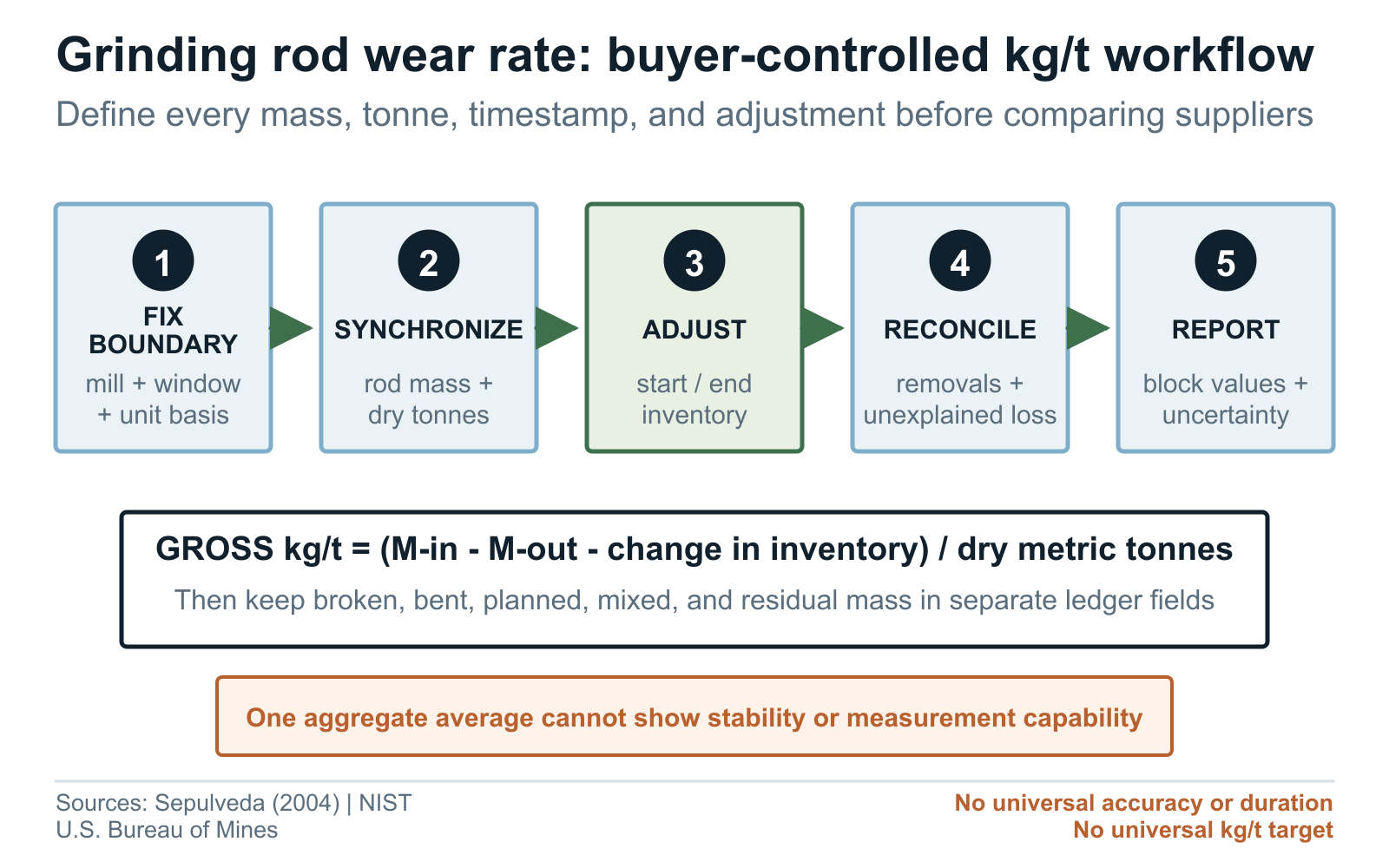
A reconciled kg/t mass balance
Choose one reporting basis and write it into the trial protocol. For a mill receiving rods from new supply or verified transfers, define M-in as all rod mass entering the mill boundary, M-out as weighed rods transferred out, and delta inventory as ending working-charge mass minus starting working-charge mass. Gross rod consumption for the window is M-in minus M-out minus delta inventory. Divide that result by metric tonnes of dry new feed processed in the same synchronized window to report gross kg/t.
Gross consumption is the replacement burden across the boundary; it isn't necessarily progressive wear. A second reconciliation can subtract separately weighed broken pieces, bent rods, planned withdrawals, and other recovered removals. The remaining mass-balance residual includes unrecovered wear, carryout, unweighed fragments, mixing, and measurement error. Call it a residual unless the plant has evidence that the other terms are negligible or separately quantified.
Use calibrated or controlled mass records for charged rods and recovered material, define how the in-mill charge is surveyed, and synchronize the ore weigh scale, moisture correction, rod charging log, and downtime log. NIST measurement guidance treats repeatability, reproducibility, stability, and uncertainty as properties of the measurement process. Those fields apply directly here: two suppliers cannot be separated reliably when the rod-inventory estimate or dry-tonne basis is less stable than the apparent difference.
Historical reports show why units and context must travel with the number. U.S. Bureau of Mines RI 9166 recorded total rod wear at one Pea Ridge iron-ore operation. The value was 0.9 lb per short ton of dry ore, using 3 in by 13 ft carbon-steel rods. This is equivalent to about 0.45 kg per metric tonne.
RI 7826 reported 2.1 lb per long ton of feed, about 0.94 kg per metric tonne, for its stated taconite rod-mill condition and described the wider investigation as directional because circuit equilibrium and ore variation limited interpretation. Neither case is a supplier target or a current JOTAIN result.
Use the grinding rod consumption trial ledger to enter opening and closing charge, additions, removals and dry feed for the same block. It calculates gross kg/t and offers a repeated-block Excel template; neither the calculation nor the illustrative example is a published JOTAIN trial result.
| Field | Buyer definition | Required record | Interpretation limit |
|---|---|---|---|
| M-in | New rods plus every verified rod transfer entering the named mill boundary during the window | Scale ticket or piece-mass basis, charge date and time, supplier, heat or process lot, size, and receiving mill | A purchase or warehouse issue date outside the synchronized window is not enough |
| M-out | Weighed serviceable rods transferred out of the same boundary | Mass, condition, identity where possible, date and time, origin, and destination | Do not combine transfers with discarded broken or bent removals |
| Delta inventory | Ending working-charge mass minus starting working-charge mass | Declared survey method, charge composition, worn-size rule, date, repeatability, and uncertainty | An unmeasured inventory change can make charging mass look like wear |
| Gross consumption | M-in minus M-out minus delta inventory | Calculation file retaining every input and correction | Includes progressive wear, discarded removals, unreconciled loss, and measurement error |
| Dry tonnes | Metric tonnes of dry new feed processed through the named mill in the same window | Weigh scale, moisture basis, time alignment, bypass or outage treatment, and data contact | Do not substitute wet tonnes, short tons, long tons, concentrate, or circulating load without relabeling |
| Reported kg/t | Gross consumption divided by dry tonnes, with rounding and uncertainty stated | Window result plus weekly or block-level values and deviations | One aggregate value does not reveal stability, breakage, bending, or operating differences |
Wear, breakage, bending, removals, and handling loss
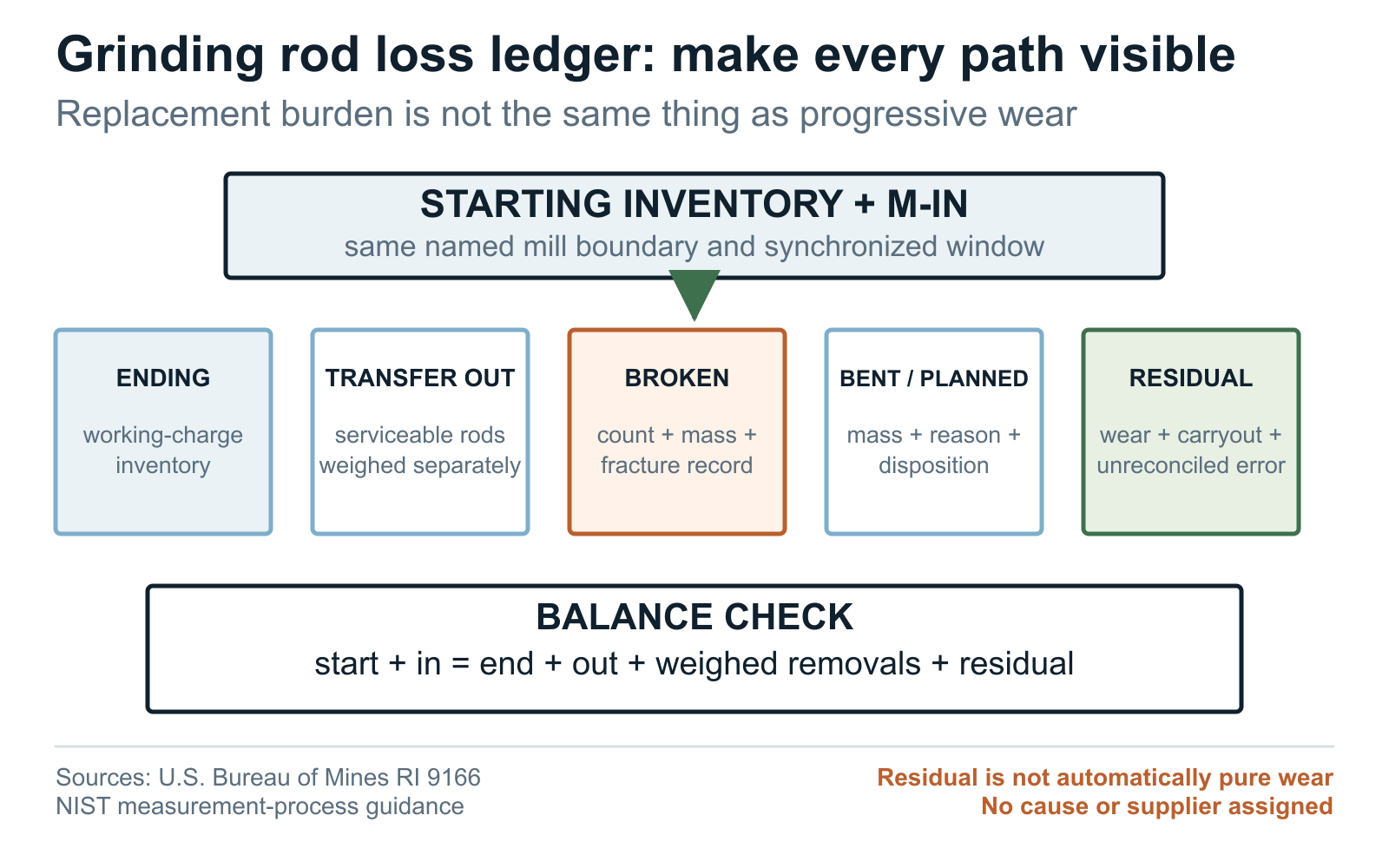
Build a loss ledger before the first baseline window. Progressive wear is mass no longer recovered from rods during service, but a plant balance normally observes it as a residual rather than weighing it directly. Breakage is a discrete failure record and should include count, recovered mass, fracture location, approximate in-service size, date, operating event, and supplier or lot identity where traceability remains possible. Do not report breakage only as a percentage unless the denominator is clear.
Bent rods and planned removals create a different cost and operating burden. Record their recovered mass, condition, removal reason, handling time, and whether they were scrapped, transferred, or returned for examination. Keep routine top-up, a deliberate charge increase, changeover removal, and emergency removal as different transaction codes. Mixed-media or unidentified pieces need their own category rather than being assigned to the trial supplier by assumption.
The balance must close visibly. Starting inventory plus rods entering equals ending inventory plus transfers out, weighed removals, and the mass-balance residual. If it doesn't close within the predeclared reconciliation tolerance, mark the window invalid, uncertain, or subject to buyer review. Never reduce the unexplained difference by silently changing the ore tonnage, inventory estimate, or failure classification after seeing which supplier appears to win.
RI 9166 is also a mechanism warning. In the one Pea Ridge rod-mill case, the report estimated electrochemical corrosion at about 4% of total rod wear for those recorded conditions. That result cannot be transferred to another ore, water chemistry, media, or mill. The ledger should record observations and losses first; a separate investigation owns the mechanism diagnosis.
A comparable operating window
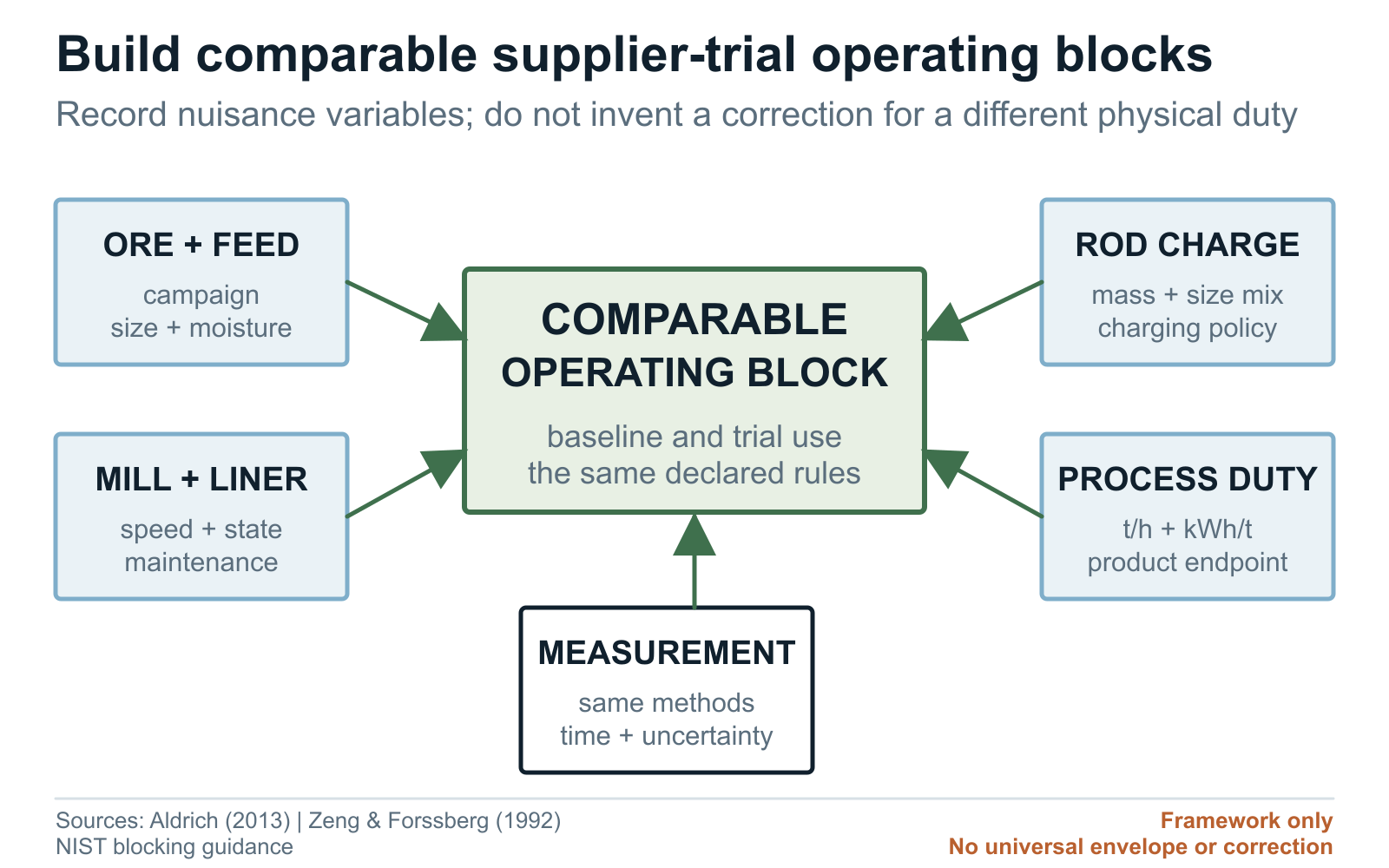
Do not normalize by arithmetic alone when the physical duty changed. First define comparable operating blocks with the buyer's engineering team. Check ore or feed family, feed-size distribution, moisture or solids basis, throughput range, and product-size target. Compare mill speed, power measurement, rod-charge mass and size mix, and water or slurry condition. Also compare liner state, discharge condition, and operating mode. The team must judge whether these conditions are similar enough for a valid comparison.
Record the values rather than writing normal operation. A supplier trial that runs on softer ore, a coarser product target, lower throughput, a new liner state, or a different rod charge may show lower kg/t without establishing a media effect. A trial exposed to an upset should not be rejected on that event alone. Keep the data, identify the deviation, and apply the agreed inclusion or exclusion rule.
Use specific energy in kWh per dry tonne and achieved product or circuit endpoints as companion variables, not as substitutes for kg/t. The rod-charge study by Zeng and Forssberg demonstrates that feed size, rod diameter, charge composition, and grinding time affect grinding response. Aldrich describes additional interacting media, ore, slurry, and process variables. Neither source supplies a single correction factor, so a buyer should not mathematically normalize dissimilar windows through an unsupported formula.
RI 7826 provides one caution from a government pilot investigation: the authors treated results as directional because the circuit needed time to reach equilibrium and ore variation could not be avoided. A modern supplier comparison should predeclare stabilization, exclude or flag transition material, and retain multiple comparable blocks instead of selecting the single best week.
Use the grinding rod operating-data checklist to freeze mill, feed, charge, wear, breakage, and trial fields before comparing kg/t.
| Block | Hold or match | Measure and retain | Deviation decision |
|---|---|---|---|
| Ore and feed | Ore family or campaign and agreed feed-size band where practical | Source, blend, feed-size distribution, moisture, hardness or abrasiveness data if routinely available | Block, stratify, or mark non-comparable; do not invent a correction |
| Mill and liner | Same mill, compartment, discharge mode, and comparable liner state | Speed, liner age or condition, power, load indicators, outages, and maintenance | Pause, start a new block, or retain as a declared different condition |
| Rod charge | Approved charge mass, top-size route, size mix, charging and worn-rod removal policy | Starting and ending inventory, additions, transfers, removals, and supplier-lot mix | Do not attribute mixed or unequal exposure to one supplier without an approved method |
| Process duty | Comparable throughput, product target, water or slurry basis, and operating mode | Dry t/h, kWh/t, solids or water context, product result, recycle or bypass, and downtime | Use the predeclared operating envelope and flag every excursion |
| Measurement | Same mass, moisture, time, inventory, removal, and rounding methods | Instrument identity, calibration or control status, data contact, missing values, and uncertainty | Invalidate or qualify a window when the measurement method changes |
Matched supplier trials and stop rules
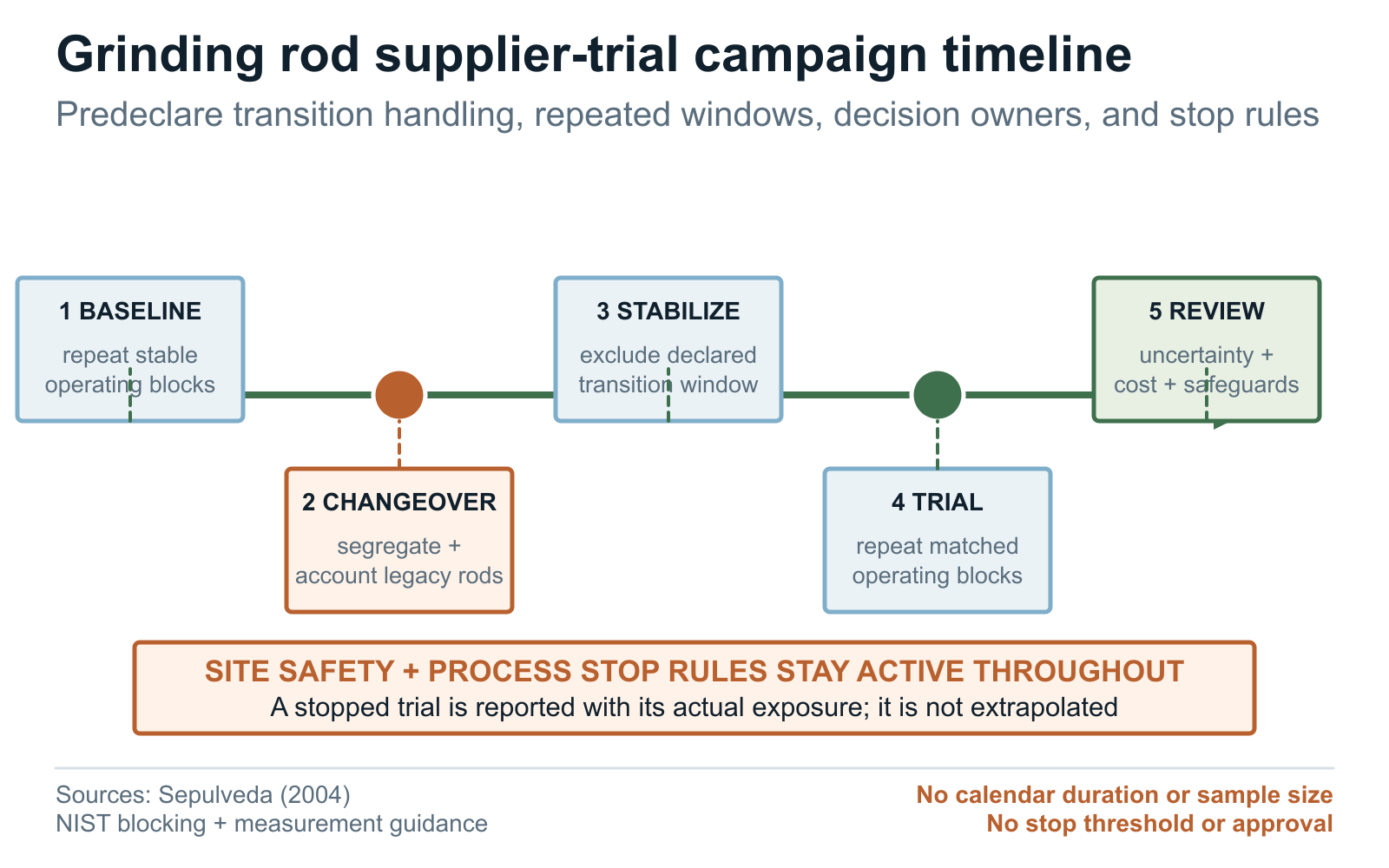
Write the campaign plan before material enters the mill. Begin with repeated baseline blocks under the approved measurement system. Then identify and segregate the trial supply by supplier, grade and standard, heat, heat-treatment or process lot, diameter, length, bundle, and charge event. Define how legacy rods are removed, mixed, marked, or accounted for and how long the transition or stabilization period is excluded. There is no fixed changeover duration; the plant's charge model and trial design control it.
Where production allows, use comparable blocks so each supplier is observed across important nuisance conditions such as ore campaign, liner state, operator shift pattern, or season. NIST describes blocking as a way to concentrate the effect of known nuisance variables while the factor of interest varies within homogeneous blocks. A rod-mill campaign may not support textbook randomization, but the buyer can still predeclare block definitions, supplier sequence, transition handling, and analysis rather than letting calendar order determine the winner. [8]
Repeat measurements across enough stable windows to show normal variation and the effect size that matters commercially. Do not choose duration from a marketing promise. The buyer's plant, engineering, statistics, procurement, safety, and finance owners should approve the minimum exposure, required repetitions, uncertainty method, and decision margin according to measurement capability, charge turnover, ore variability, and consequence of a wrong decision.
Safety and process stop rules override statistical completion. Predefine the site-specific response to abnormal breakage, bending or tangling, charge instability, unusual vibration or noise, blocked discharge, product or recovery excursion, power or throughput excursion, unsafe handling, traceability loss, or another management-of-change trigger. Record a stopped trial as a result with its exposure and evidence; do not extrapolate it to a full-life value.
When the plant has reconciled a baseline and candidate trial window, connect the result to the grinding rod application and quotation route so material, dimensions, inspection, packing, destination, and trial quantity are quoted together.
Cost per tonne, uncertainty, and operating outcomes
Calculate the recurring delivered media cost per dry tonne as adjusted gross kg/t multiplied by the delivered rod price per kilogram for the same commercial boundary. State whether freight, duty, insurance, inland delivery, currency, payment terms, scrap credit, and taxes are included. Report one-time trial, inspection, segregation, and changeover costs separately so they don't distort the recurring consumption comparison.
Add operating costs only when the allocation rule is agreed and the event record supports it. These may include documented handling labor, disposal, planned replacement work, and unplanned mill downtime. Keep product size, throughput, specific energy, recovery, quality, liner interaction, and safety as separate results before assigning a financial value. A media quote and a plant cost model answer different questions.
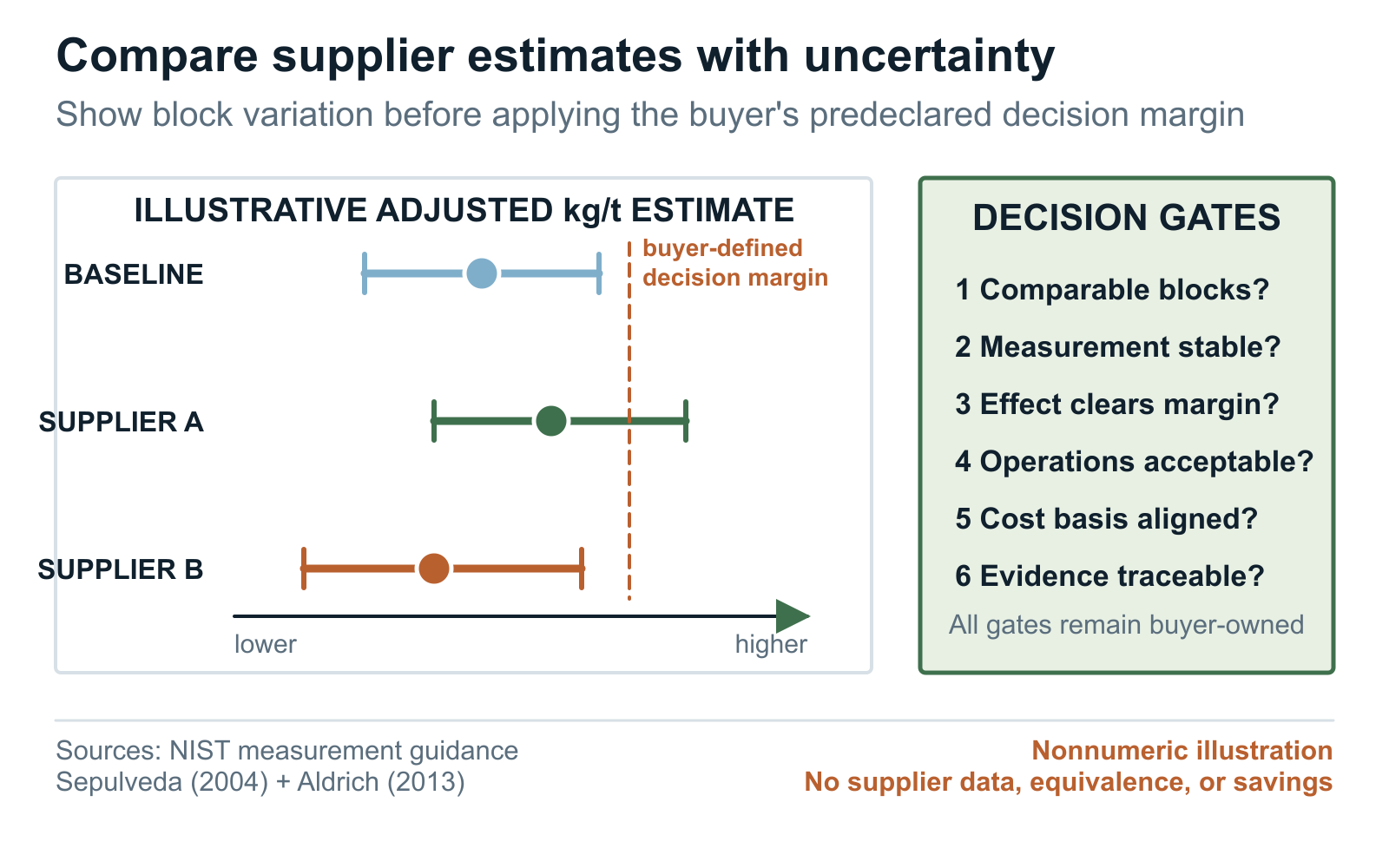
Show the individual weekly or operating-block kg/t values, not only the campaign mean. State the measurement and process variation, missing data, excluded windows, and analysis method. NIST measurement guidance emphasizes repeatability, reproducibility, stability, and uncertainty; those qualities determine whether a visible difference is larger than the noise of the measurement system and process.
Use a predeclared decision margin. The lowest point estimate doesn't necessarily win, and overlapping intervals do not by themselves prove equality. Review effect size, uncertainty, safety and process outcomes, traceability, supply reliability, commercial terms, and the consequence of an incorrect decision. State the conclusion as applicable to the recorded mill, material lots, campaign, and conditions only.
| Decision field | Report for each supplier | Comparison rule | Do not infer |
|---|---|---|---|
| Gross consumption | Block values, adjusted kg/t, mean or approved summary, uncertainty, and excluded windows | Same boundary, dry-tonne basis, inventory method, and operating blocks | That the lowest single window is the true wear rate |
| Failure and removal | Broken count and mass, bent-rod mass, planned removals, mixed pieces, and handling events | Same definitions, exposure basis, traceability, and attribution rule | That all replacement mass is progressive wear |
| Operating response | Throughput, kWh/t, product endpoint, downtime, process deviations, and safety observations | Predeclared envelopes and plant-owned interpretation | That media alone caused every process difference |
| Recurring cost | Adjusted kg/t times delivered price per kilogram plus approved recurring allocations | Same currency date, delivery boundary, inclusions, scrap treatment, and allocation rules | That purchase price alone is cost per tonne |
| Evidence and supply | Heat and process-lot records, inspection documents, deviations, delivery consistency, and support scope | Same required dossier and supplier-response deadline | That a certificate proves plant performance |
| Decision | Effect estimate, interval or uncertainty statement, decision margin, risks, and approvers | Apply the protocol written before results were reviewed | A grade, supplier, kg/t, saving, or service-life guarantee that applies to every mill |
What laboratory abrasion can—and cannot—tell you
ASTM G65 is a controlled dry sand and rubber wheel test for ranking metallic materials under a specified scratching-abrasion condition. Its official significance statement says the procedure does not duplicate every process condition, including abrasive geometry, pressure, impact, or corrosive elements, and should not be used to predict exact resistance in a specific environment. A G65 result can screen or characterize candidates only within its stated material and procedure scope; it cannot be converted into grinding rod kg/t or mill life.
Keep laboratory and plant records in separate evidence columns. If a supplier submits abrasion, hardness, microstructure, impact, chemistry, or heat-treatment data, require specimen identity, method and edition, condition, location, laboratory, actual result, heat covered or process lot, and transfer limitation. ISO 10474 inspection-document types present evidence required by the order but do not create a field-performance acceptance clause.
Issue the supplier RFQ and plant-trial protocol together. The supplier owns conformity to the accepted rod specification and traceability package. The buyer owns mill data definitions, operating control, safety, statistical review, cost assumptions, and the final plant decision. Any performance warranty, if commercially proposed, needs separate negotiated definitions, exclusions, remedies, and authority; none is implied here.
The template below leaves values in brackets because the plant must choose them. Attach the mass-balance worksheet, comparable-window table, campaign sequence, stop rules, data dictionary, and approval matrix. Require every bidder to respond to the same fields and list deviations before manufacture or trial release.
Item: Grinding rods for a controlled plant comparison at [site and mill]
Candidate rods: [supplier, grade/standard, diameter × length, heat-treatment condition, quantity]
Traceability: [heat, heat-treatment lot, bundle marks, certificate, delivery record]
Trial question: [what the plant is comparing and the result that will change the buying decision]
Mass balance: [additions, opening/closing charge, recovered pieces, bent rods, planned removals, unidentified media]
Throughput basis: [dry new feed, scale, moisture method, synchronized trial window]
Comparable duty: [ore/feed, size distribution, throughput, speed, power, product target, slurry/water, liner and charge state]
Sequence: [baseline blocks, transition, stabilization, candidate blocks]
Measurements: [scale checks, inventory method, raw-data contact, missing-data rule]
Event ledger: [breakage, bending, removals, handling, downtime, traceability]
Stop rules: [site safety, mill condition, breakage/tangling, product, power, throughput]
Cost basis: [delivered price, freight/duty boundary, scrap credit, recurring and one-time trial costs]
Decision: [block inclusion, uncertainty, commercial margin, proceed/repeat/stop authority]
Documents: [ISO 10474 type if ordered, actual results, manufacturing/inspection records, lot map, deviations]
The order and plant protocol define the comparison. Laboratory abrasion results remain screening evidence and are not converted into plant kg/t or savings.Questions buyers ask
What is grinding rod wear rate in kg/t?
For a buyer-defined mill and time window, kg/t should state the adjusted rod mass leaving the working charge divided by metric tonnes of dry new feed processed. Buyers should declare the mass boundary, inventory adjustment, removal categories, dry-tonne method, synchronized timestamps, rounding, and uncertainty. Do not mix metric tonnes with short or long tons.
How should buyers calculate grinding rod consumption when the charge inventory changes?
Define M-in as all rod mass entering the mill boundary, M-out as serviceable rods transferred out, and delta inventory as ending minus starting working-charge mass. Gross consumption is M-in minus M-out minus delta inventory. Divide by dry metric tonnes in the same window, then report broken, bent, planned, mixed, and residual mass separately.
Should broken and bent grinding rods be included in wear rate?
Include their replacement burden in gross consumption when they leave the working charge, but do not hide them inside progressive wear. Record broken count and mass, bent-rod mass, removal reason, exposure, operating event, and traceability as separate endpoints so suppliers and plant teams can see why material was replaced.
How long should a grinding rod supplier trial run?
There is no fixed duration. Run long enough to complete the buyer-approved changeover and stabilization, obtain the required repeated comparable operating blocks, and resolve the decision margin with the approved measurement capability and uncertainty method. Site safety and process stop rules can end the trial earlier.
Can ASTM G65 predict grinding rod consumption or mill life?
No. ASTM G65 ranks metallic materials under a specified laboratory scratching-abrasion condition and does not duplicate every field variable, including impact or corrosion. Use it as scoped screening evidence only; it cannot be converted directly into rod-mill kg/t, breakage, cost savings, or service life.
How should buyers compare grinding media cost per tonne?
Multiply adjusted gross kg/t by the delivered price per kilogram using the same delivery and currency basis. Add only preapproved recurring handling, disposal, replacement, or downtime allocations, and report one-time trial costs separately. Review uncertainty, operating response, safety, traceability, and supply terms before selecting a supplier.
RFQ checklist
- Named site, mill and compartment, plant data contacts, trial team, safety contact, and final approver
- Primary question, baseline supplier or route, trial supplier or route, commercial decision margin, and consequence of a wrong decision
- Rod grade and controlling standard edition, condition, diameter, length, mass or quantity, and permitted alternatives
- Supplier, steel heat, heat-treatment or process lot, bundle and charge-event identity through delivery and service observation
- M-in, M-out, starting and ending inventory, transfer, removal, mixing, and reconciliation boundary
- Metric dry new-feed denominator, weigh scale, moisture method, time synchronization, bypass, recycle, outage, and missing-data rule
- Gross kg/t formula, residual definition, block and campaign summary, rounding, and reporting units
- Scale and inventory method, calibration or control status, repeatability, reproducibility, stability, and uncertainty statement
- Broken-rod count and mass, fracture location, bent-rod mass, planned removals, handling loss, mixed pieces, and attribution rules
- Ore source or campaign, blend, feed-size distribution, moisture, and routinely available hardness or abrasiveness context
- Throughput, mill speed, power, kWh/t, product endpoint, water or slurry condition, operating mode, and downtime
- Starting and ending rod-charge mass, size mix, charging practice, worn-size removal rule, and legacy-media treatment
- Liner state, discharge condition, maintenance, abnormal events, process changes, and management-of-change records
- Repeated baseline blocks, changeover and stabilization exclusions, repeated trial blocks, and block inclusion or exclusion rules
- Site-specific safety and process stop thresholds, response owners, evidence retention, and stopped-trial interpretation
- Delivered price basis, currency date, freight, duty, tax, insurance, payment terms, scrap credit, and recurring cost allocations
- One-time trial, inspection, segregation, changeover, laboratory, and analysis costs reported separately
- Laboratory evidence identity, method, condition, result, lot covered, and clear prohibition on direct conversion to mill life
- ISO 10474 document type, actual ordered results, deviations, inspection records, packing, marking, and traceability map
- Raw data, calculation workbook, revision control, missing values, exclusions, uncertainty, conclusion scope, and approval signatures
References
- Methodologies for the evaluation of grinding media consumption rates at full plant scale
- Consumption of steel grinding media in mills — A review
- U.S. Bureau of Mines RI 9166: Determining Corrosion Rates in Industrial Ore Grinding Environments
- U.S. Bureau of Mines RI 7826: Flotation of Marquette Range Nonmagnetic Taconite Using Innovative Procedures
- Effects of mill feed size and rod charges on grinding performance
- ASTM G65-16(2021) Standard Test Method for Measuring Abrasion Using the Dry Sand/Rubber Wheel Apparatus
- NIST/SEMATECH Engineering Statistics Handbook, Chapter 2: Measurement Process Characterization
- NIST/SEMATECH Engineering Statistics Handbook: Randomized block designs
- ISO 10474:2013 Steel and steel products — Inspection documents
Inquiry support
Working from a part drawing?
Send the drawing or RFQ with the grade, size, condition, processing, inspection, quantity, and destination. We can flag open points before quotation.