
Why the same grade and HRC do not mean the same grinding rod batch
Two certificates can show the same grade and average HRC while describing very different batches. The steel source, process route, test points, number and spread of readings, or mill exposure may have changed. Check those differences before comparing the headline number.
Check whether the rod and its result can be traced to the relevant heat and process lot, whether the lot met the order, and whether the operating comparison is usable. Keep those conclusions separate in the review record. A certificate average supplies only part of the information needed to answer them.
Retain individual results, test locations, missing readings, retests, and rejected pieces. Compare their spread and any change in method or processing. Where an unusual result appears, the lot and bundle links should allow the affected material to be identified without treating every rod in the shipment as one batch.
| Claim | Question it can answer | What to keep | What it cannot confirm |
|---|---|---|---|
| Traceable | Can the rod, bundle, test result, and process record be linked to the same batch? | Stable IDs, heat-to-bundle links, split and merge records, inspection-lot definition, quantity reconciliation, and preserved labels. | That every covered piece met the rule, that the process was stable, or that the lot will perform like a previous lot. |
| Conforming | Did the inspected lot meet the order under the agreed test and sampling plan? | Controlling specification and edition, limits, sampling, raw results, retest and deviation records, and the final lot action. | That every untested item is defect-free, that future lots will conform, or that plant performance will be identical. |
| Consistent | Do comparable lots and mill blocks remain within an approved pattern of process, inspection, and service variation? | Repeated comparable data, defined baseline, distribution review, change control, matched operating blocks, and reconciled outcome measures. | Zero variation, guaranteed service life, freedom from every failure mode, or proof that a supplier caused an observed mill event. |
Steel heat to mill block: the complete genealogy
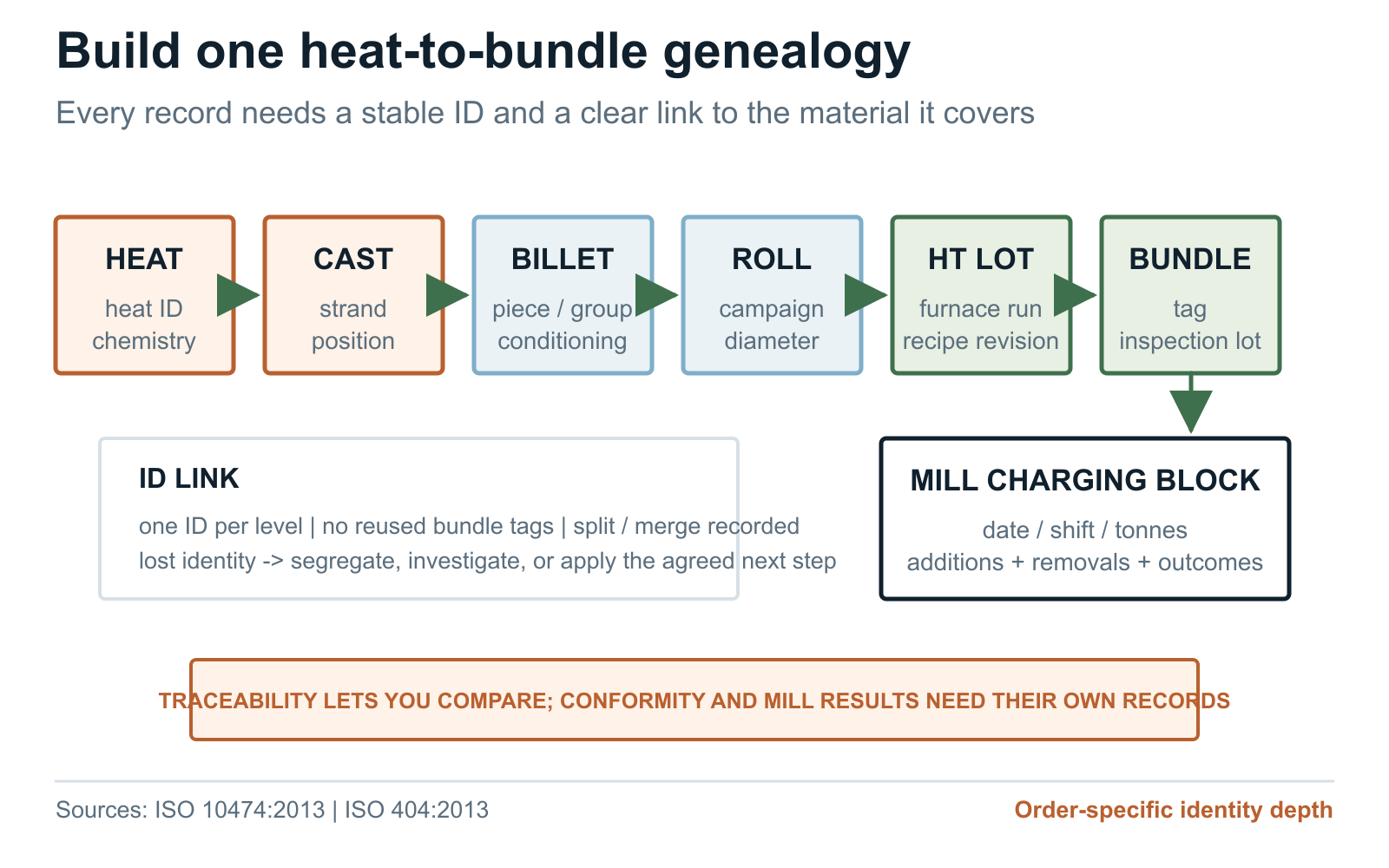
“One shipment” is rarely a workable batch definition. A delivery may contain several heats, cast positions, rolling campaigns, heat-treatment runs, inspection lots, and bundles. Define the identity levels that matter to the order and keep the links through delivery.
A practical chain runs from heat to billet or bloom, rolling campaign, heat-treatment lot, finishing and inspection lot, bundle tag, and finally the plant charging block. Record every split, merge, re-bundle, and identity transfer. Piece or mass reconciliation helps expose a gap before it becomes a complaint.
Cast position and retained samples should be requested where risk, history, and feasibility justify them. If identity is lost, follow a pre-agreed response—segregate, review, test, conditionally release, re-identify under an approved method, or reject. Reconstructing the link from memory after a failure is not traceability.
| Identity level | Fields to preserve | Main control question | Typical break in the chain |
|---|---|---|---|
| Steel heat | Heat ID, ordered grade route, chemistry record, source record, and quantity entering the next stage. | Which heat or cast sequence does the record cover? | Heat shown on a certificate but not linked to every downstream lot or bundle. |
| Cast sequence and position | Caster, strand, sequence, head/middle/tail or other agreed position logic, billet or bloom group, and yield reconciliation when required. | Does the order or investigation need position-sensitive identity? | All billets from a heat treated as interchangeable without preserving the position field that the control plan requires. |
| Billet or bloom | Piece or group ID, section size, conditioning, inspection status, and transfer to rolling. | Which billet or bloom pieces entered the rolling campaign? | Conditioned or substituted material enters the route without a linked transaction. |
| Rolling campaign | Campaign ID, date, product diameter, route or setup revision, start and end quantities, and deviations. | Were the rods rolled under the same declared configuration? | A diameter or setup change occurs inside an undivided lot. |
| Heat-treatment and finishing lot | Furnace run, recipe revision, load or zone identity, relevant monitoring records, quench setup, straightening or finishing route, holds, and deviations. | Which controlled downstream process history applies? | One certificate covers rods processed in separate runs with no lot split. |
| Inspection lot | Sampling basis, rod IDs and test locations, methods, individual results, rejected pieces, retests, and final lot action. | Exactly which rods does the inspection represent? | A report gives results but no sample-to-lot map. |
| Bundle and shipment | Unique tag, linked process and inspection lots, piece count or mass, packing-list position, label replacement history, and destination. | Can the receiving plant segregate and charge the lot as planned? | Mixed or re-bundled rods receive a generic shipment label. |
| Mill charging block | Bundle IDs, charging time, additions, withdrawals, operating window, tonnes treated, incident register, recovery observations, and closing inventory. | Which service outcomes can be matched to the released lot? | Bundles enter a mixed charge without a transition or exposure record. |
Comparable inspection from lot to lot
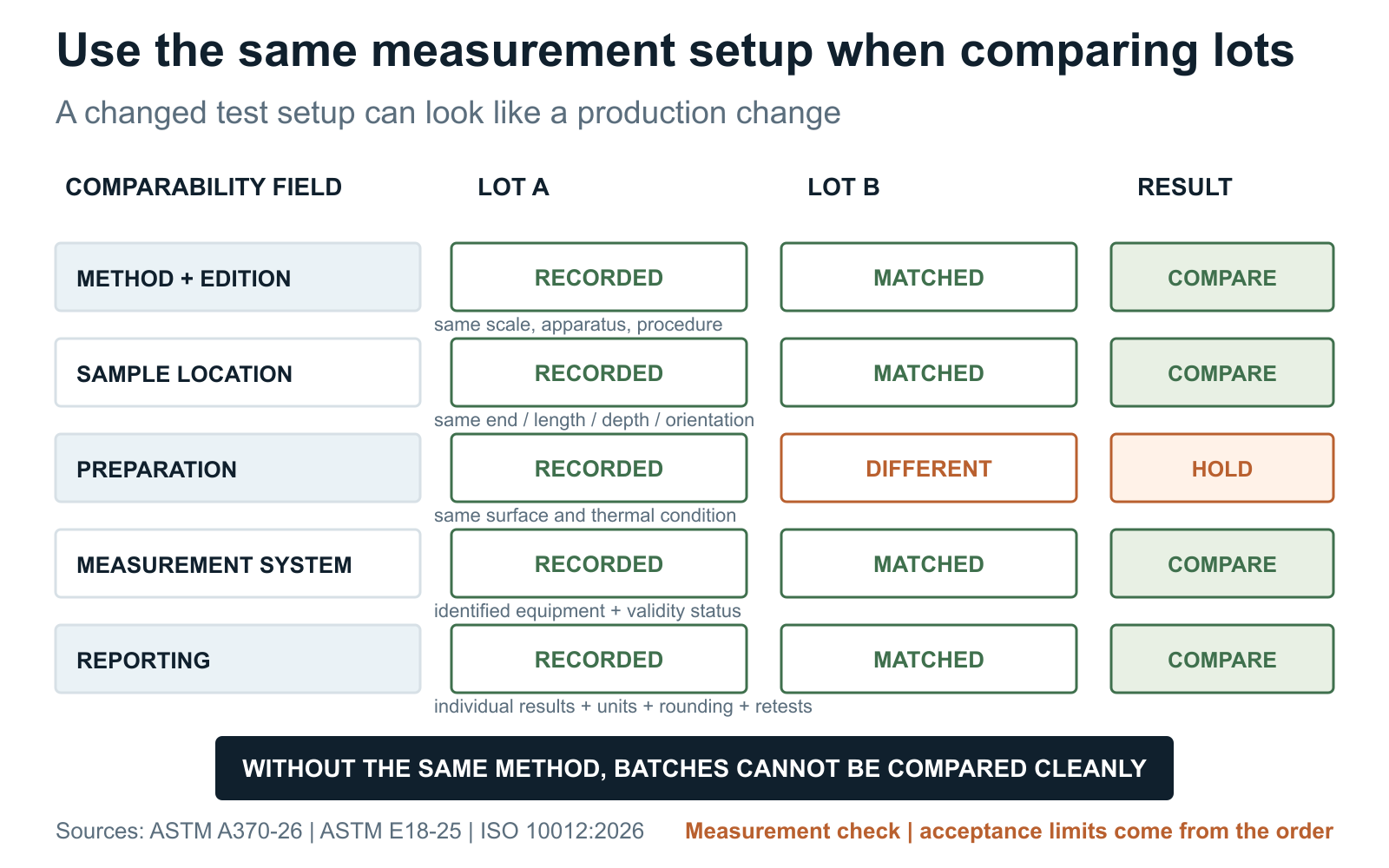
Traceability tells you what was tested; comparability tells you whether two results mean the same thing. For hardness, keep the direct method, scale, preparation, location, equipment status, lot, individual values, and any conversion. Do not place end readings and mid-length cross-sections on one trend line without explaining the difference.
Macrostructure, inclusion, dimensional, and NDT results also depend on method, location, preparation, and sample selection. A change in laboratory, equipment, operator, procedure, software, or sample position belongs in the change log. Where needed, run old and new methods in parallel before resetting the baseline.
Retests and missing data stay visible. Record why a result was invalidated, how replacement samples were chosen, what expanded sampling followed, and which result set decided the lot. A report that keeps only the final passing value makes an unstable process look cleaner than it was.
| Controlled field | Record for every lot | If the field changes | Unsafe shortcut |
|---|---|---|---|
| Method and edition | Direct test method, scale or technique, controlling standard and edition, internal procedure revision, and any order-specific supplement. | Assess technical difference; bridge, correlate, or re-baseline as approved. | Calling two results equivalent because both are labelled hardness, inclusions, macrostructure, or NDT. |
| Samples and locations | Rod and lot ID, sampling rule, longitudinal position, cross-section plane, depth, orientation, cast position when required, and number of rods covered. | Hold direct comparison until representativeness is reviewed. | Comparing an easy-to-reach end sample with a controlled working-length sample. |
| Preparation and condition | Surface removal, finish, thermal or delivery condition, mounting, any required etchant, and preparation procedure. | Record the difference and determine whether it changes the measured question. | Treating preparation as a laboratory detail with no effect on comparability. |
| Measurement system | Equipment ID, relevant verification or calibration status, reference material or block where required, laboratory, operator or authorization, and any required environmental controls. | Evaluate validity and use overlap testing when the approved control plan requires it. | Assuming a current calibration label makes every setup, location, and result representative. |
| Data and reporting | Individual readings, units, significant digits, rounding, derived values, conversions, images where required, rejected tests, retests, and final status. | Preserve both old and new fields and document the transition rule. | Retaining only an average or a pass mark. |
Distributions and process signals, not certificate averages
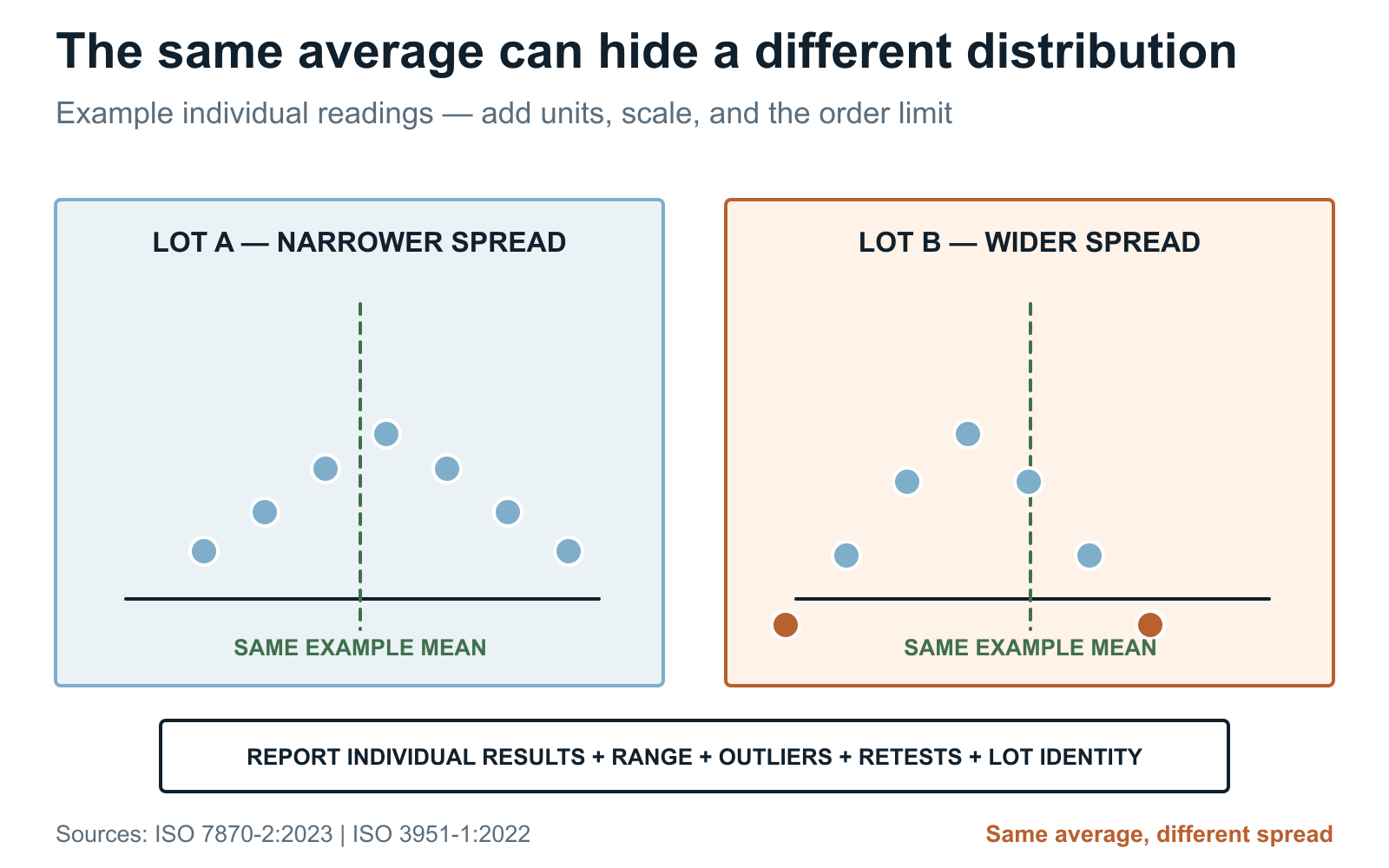
Review the individual results before the mean. Show the minimum, maximum, spread, test position, number of readings, missing values, and readings close to the limit. For visual checks, record how many rods were inspected and how each condition was defined.
Specification limits and control-chart limits answer different questions. The order decides conformity; a control chart looks for change in a comparable time sequence. ISO 7870-2 provides Shewhart chart principles, while ISO 3951-1 and ISO 2859-1 provide sampling frameworks under stated assumptions. The buyer still has to choose a plan that fits the lot, risk, and measurement.
Use charts to make variation visible, not to turn every result green. Label units, sample count, lot and position, specification lines, and any separate alert limits. If there is not enough stable data for a statistical limit, say so and use the qualification period to build the baseline.
| View | Question | Required context | How the result is used |
|---|---|---|---|
| Individual results | Which actual values occurred, at which mapped locations, and in what sequence? | Sample and lot IDs, locations, units, method, count, missing values, and status. | Individual values do not define acceptance until the order supplies the rule. |
| Mean and spread | Did central tendency or within-lot variation move relative to a comparable baseline? | Comparable method, sample plan, sufficient observations, baseline definition, and retained raw data. | The same mean can hide a different range, shape, or outlier pattern. |
| Specification status | Did the inspected lot meet the ordered requirements? | Controlling limit, rounding, agreed treatment of measurement variation, sampling, retest, and final lot action. | A pass cannot confirm process stability or guarantee every rod. |
| Control-chart signal | Does time-ordered process data show a shift, trend, or unusual variation that requires review? | Approved chart, rational subgroup, stable baseline, change history, signal rules, and assigned investigator. | A control signal isn't necessarily a product rejection; a stable chart isn't necessarily conforming. |
| Acceptance-sampling result | Does the sample support acceptance or non-acceptance under the selected plan? | Named standard and edition, lot size, inspection level, the selected AQL or other index, sample selection, switching status, and counts. | A sampling result applies to the inspected lot under that plan. It does not tell you that every rod was checked or that the next lot will behave the same way. |
| Retest and deviation history | Were adverse or invalid results handled according to the agreed rule? | Original data, reason the test was rejected, replacement sample, any expanded inspection, deviation approval, and final lot action. | A final average without the earlier record can conceal the very variation under review. |
Production records beside mill outcomes
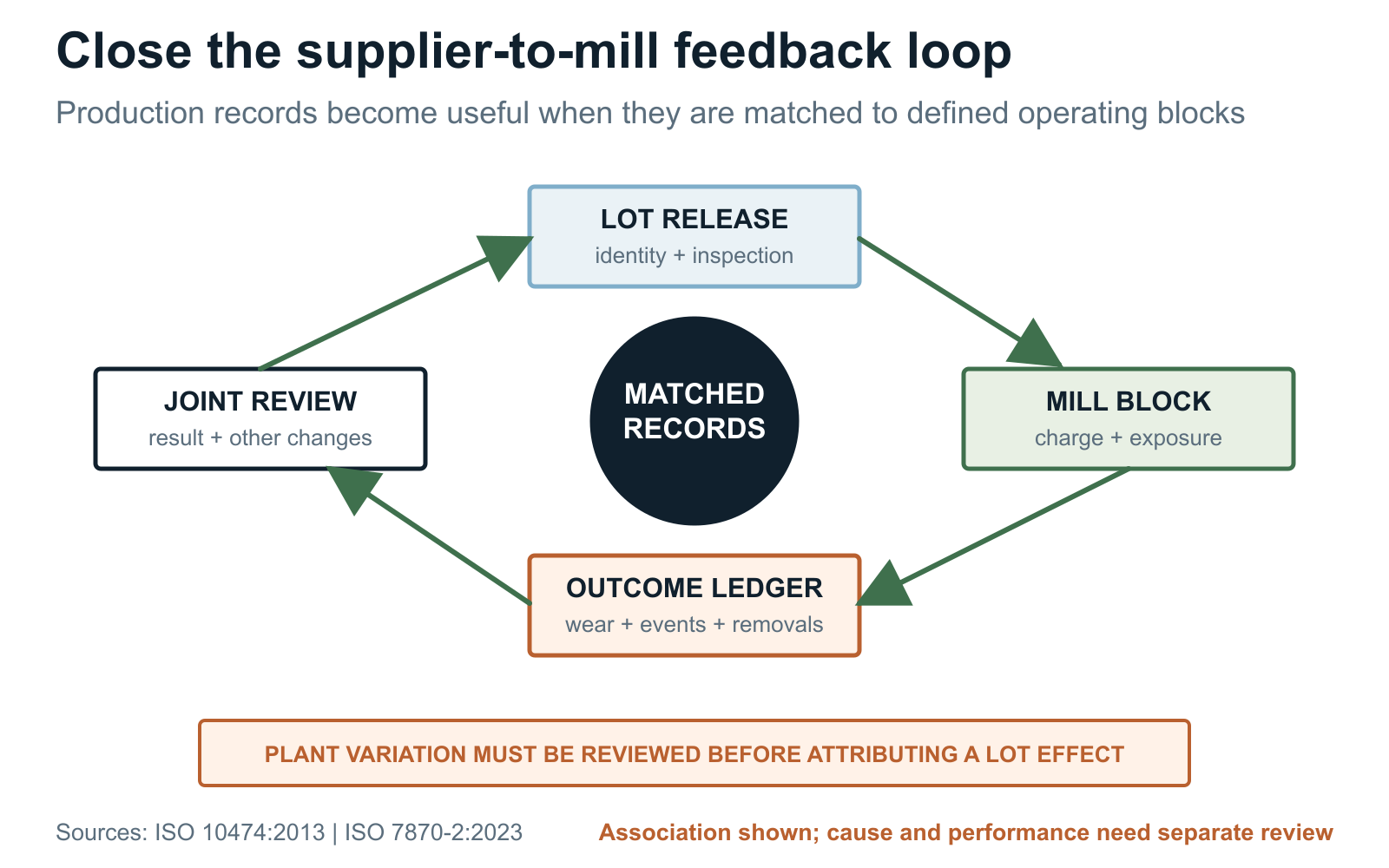
Before charging, connect the delivered bundle IDs to the named mill and operating block. Record old-charge carryover, additions and removals, inventory method, ore and feed, throughput, product target, liners, discharge condition, stops, and abnormal events. Retain mixed or unidentified material as an explicit limitation in the comparison.
Build consumption from a mass balance, not delivery invoices. Keep progressive wear, breakage, bent-rod removals, tangles, trial residue, stock adjustments, and handling loss separate. Use the same dry-tonnes denominator for the same period. For failure events, preserve the pieces, photographs, dimensions, timeline, and lot link.
A new lot mixed into an old charge may take time to become visible. Define the transition and formal comparison blocks before the trial. When a signal appears, hold the relevant records and samples, check product and mill changes, and decide whether to continue, monitor more closely, investigate, hold stock, or requalify.
Use the grinding rod consumption trial ledger to record the operating-block comparison alongside the heat, process-lot and bundle map. Keep the original inspection and charging records with it: a completed spreadsheet cannot reconstruct missing lot identity or prove batch conformity.
| Outcome | Core record | Denominator or exposure context | Other changes to check before assigning cause |
|---|---|---|---|
| Progressive wear and consumption | Opening inventory, additions by lot, weighed or defined removals, closing inventory, stock corrections, and calculation version. | Agreed tonnes basis, time, actual charge exposure, and transition status. | Ore and feed, throughput, target product, charge mix, liner state, inventory method, and unrecorded loss. |
| Premature breakage | Event register, recovered pieces, fracture map, rod and lot identity, photographs, sample custody, and synchronized mill event. | Rods or estimated mass at risk and exposure time or tonnes. | Impact event, charge state, handling, dimensions, prior damage, process excursions, recovery bias, and missing identity. |
| Bending | As-found geometry, measured bend definition, rod and lot ID, removal reason, handling history, and charge condition. | Rods exposed and the agreed opportunity for inspection or recovery. | Charging method, mill geometry, rod length and diameter mix, handling, overload, and measurement timing. |
| Rod tangling | Time, severity, affected charge, rod dimensions and lots, operating response, and recovered rods or fragments. | Operating hours, starts, stops, additions, and charge transition. | Rod geometry, mixed sizes or lengths, charge level, liner or discharge condition, feed interruption, and operator intervention. |
| Uneven wear | Mapped rod measurements or mass, identified locations, photographs, same-lot comparisons, and credible exposure history. | Rod position history where knowable, time or tonnes, and recovery selection method. | Unknown residence, selective recovery, end effects, mixed batches, corrosion environment, and measurement-location differences. |
| Batch-to-batch performance | Repeated blocks, lot genealogy, product and process records, comparable inspection distributions, operating data, and uncertainty notes. | Like-for-like or transparently normalized blocks across the approved review period. | Route or method change, seasonal ore change, maintenance, liner life, inventory error, and commercial selection of favorable periods. |
JOTAIN grinding rod heat treatment and inspection responsibilities
JOTAIN's own heat-treatment line can quench and temper grinding rods, with an engineer dedicated to Q&T. For each order, confirm the processing route and the party responsible for final inspection. Keep the heat and process-lot records linked to the test results, delivered bundles and the customer's mill feedback.
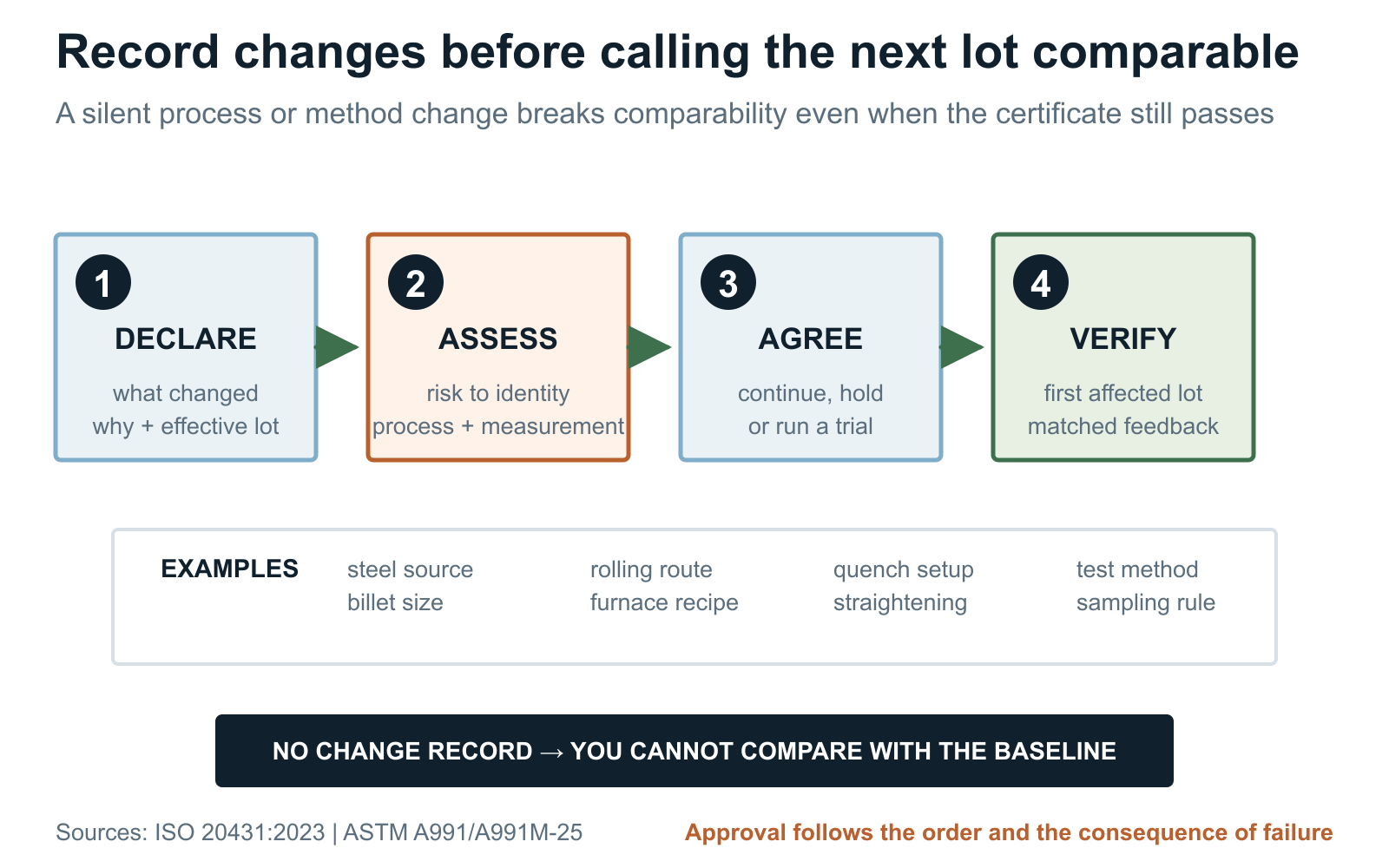
The starting point is an agreed baseline—material source, billet or bloom route where relevant, rolling and heat treatment, straightening, inspection methods and locations, bundle marking, and trial plan. A change in any of those fields is logged before the next lot is called comparable. Depending on risk, the response may be a record review, added tests, a confirmation run, a hold, or requalification.
Keep release responsibility clear. Identify the party performing each process, the laboratory issuing each report and the person authorising release. Where a partner performs an operation, retain its process records with the lot. JOTAIN checks the order and coordinates the commercial dossier; the purchaser controls receiving and mill use. Deviations, failed samples, retests, late notices, and non-comparable plant blocks stay in the record.
| Change class | Examples | Minimum review | Possible order-defined response |
|---|---|---|---|
| Material and steelmaking | Steel source, chemistry route, secondary metallurgy, caster, strand logic, billet or bloom section, or conditioning route. | Identity impact, relevant upstream records, lots affected, technical risk, and first affected heat. | Notice, added traceability or testing, segregation, trial, hold, or requalification according to risk. |
| Rolling and geometry | Rolling campaign definition, pass or setup route, product diameter, length route, straightening, end treatment, or surface finishing. | Dimensional and process comparability, transferred structure, inspection plan, and first affected process lot. | Documented continuation, additional dimensional review, first-article review, or controlled plant block. |
| Heat treatment | Procedure or recipe revision, furnace, qualified working zone, loading pattern, time-temperature route, quench configuration, or tempering route. | Approved procedure, monitoring and furnace-status records, section response, sample map, and affected heat-treatment lot. | Technical approval, added product verification, hold, parallel comparison, or requalification. |
| Inspection and measurement | Laboratory, equipment, method edition, procedure, sample location, preparation, conversion, rounding, retest, or reporting system. | Measurement-system validity, method equivalence, correlation need, baseline continuity, and affected inspection lot. | Bridge study, duplicate testing, reporting annotation, new baseline, or hold of direct comparison. |
| Identification and logistics | Bundle scheme, tag format, label replacement, packing split or merge, warehouse transfer, shipment composition, or receiving practice. | Heat-to-bundle continuity, quantity reconciliation, segregation ability, and mill charging plan. | Authorized re-identification, segregation, an added receiving check, or a hold. |
| Plant trial and operating context | Mill, ore or feed window, charge mix, liner state, denominator, transition logic, stop rule, or outcome definition. | Whether the new block remains comparable to the approved baseline and whether conclusions need narrower wording. | Show the adjustment, extend the observation period, repeat the block, keep it as background information, or stop the trial. |
RFQ wording for consistency, release, and feedback
Agree the required heat, process-lot, and bundle links during quotation. Specify the accepted production route, test methods and locations, individual results, retests, retained samples, change notifications, and release records. Name the people responsible for resolving an inspection discrepancy and reviewing the later mill feedback.
Ask for individual data as well as the inspection document. State the sample locations, units, rounding, rejected tests, retests, deviations, images or maps where needed, and how each result links to the heat, process lot, bundle, and packing list. Set the response when a link or record is missing.
Keep the plant block short enough to run and clear enough to compare. Define transition, inventory and additions, dry-tonnes basis, breakage, bending, wear, tangling, consumption, abnormal periods, stop rules, review timing, and the final choices: release, repeat, adjust one variable, hold, investigate, requalify, or stop.
| Part of the file | Records | Check before release | Required status |
|---|---|---|---|
| Identity and quantity | Heat-to-bundle links, lot definitions, split and merge history, tags, packing-list map, piece or mass reconciliation, and retained-sample IDs. | Can every shipped lot be identified and kept separate as ordered? | Complete, explained exception, or hold. |
| Process and change status | Approved route revisions, relevant run or campaign IDs, monitoring records required by the order, deviations, concessions, and declared changes. | Was the inspected lot made under the approved process route? | Baseline, approved change, conditional review, or hold. |
| Inspection records | Sample map, method and edition, equipment status, individual results, calculations, images where required, invalid tests, rejected pieces, retests, and final lot action. | Does the inspection answer the ordered question for the lot or rods stated? | Conforming, nonconforming, conditional, incomplete, or disputed. |
| Document validation | Selected inspection document, authorized validator, supporting reports, version control, and cross-reference to heat, process lot, inspection lot, and bundle. | Does each signed document cover the role and material required by the order? | Validated, exception recorded, or hold. |
| Shipment and receiving | Packing, marks, bundle condition, shipment composition, receiving check, discrepancies, storage, and identity preservation before charging. | Did the released material arrive with its identity and segregation intact? | Received and released, segregated, damaged, discrepant, or hold. |
| Mill-block handoff | Planned bundle IDs, transition logic, operating data fields, outcome registers, denominator, stop rules, review date, and responsible parties. | Can the plant return a comparable, reconciled result to the same lot chain? | Ready, conditional, not comparable, stopped, or awaiting review. |
GRINDING ROD BATCH-CONSISTENCY RFQ / PO OUTLINE

Product: [grade/standard, diameter, length, condition, quantity]
Lot links: [heat, cast position if required, billet/bloom, rolling, heat treatment, inspection, bundle]
Bundle rules: [unique tag fields, mixed-lot restriction, split/merge/re-bundling record]
Baseline route: [approved source, process revision, test method and locations]
Changes requiring notice: [material, process, site, subcontractor, measurement, marking]
Notice and response: [timing, first affected lot, review / added tests / trial / hold]
Inspection document: [type, issuer/validator, required results]
Individual data: [locations, values, units, images/maps, equipment status, raw-data format]
Sampling and retest: [lots or rods sampled, selection, invalid tests, replacements, added inspection]
Release file: [lot links, process status, results, deviations, packing map, open items]
Retained sample: [identity, storage, access and release]
Mill trial link: [bundle IDs, changeover, trial block, legacy-media treatment]
Plant record: [additions, removals, inventory, dry tonnes, ore/feed, mill and charge changes]
Outcomes: [breakage, bending, wear map, tangling, adjusted kg/t, working range]
Stop and hold rules: [site safety contact, product hold, notification]
Next step: [release / repeat / adjust / hold / investigate / stop]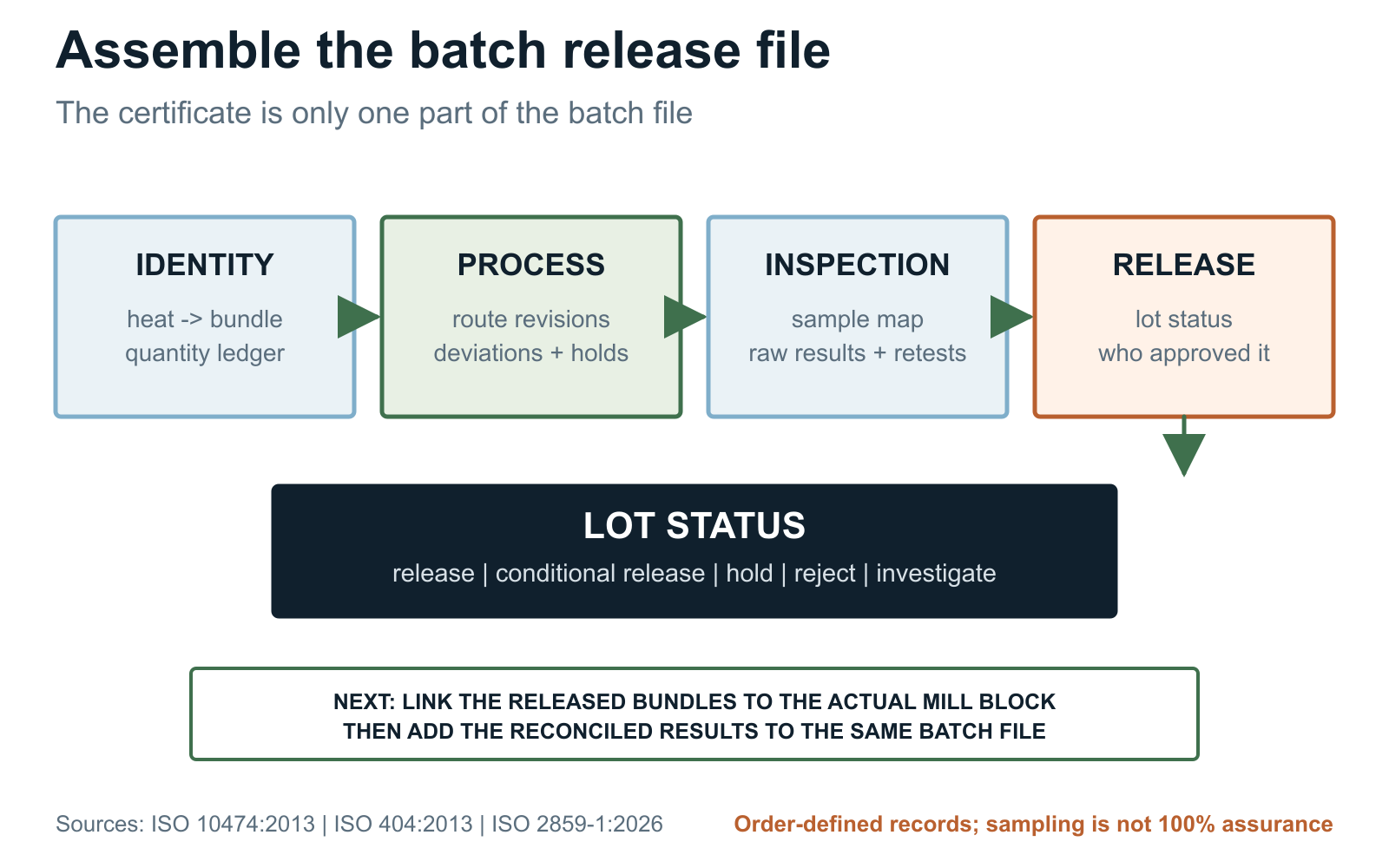
Questions buyers ask
Does the same grinding rod grade and HRC mean two batches are consistent?
No. Grade and HRC are useful specified characteristics, but consistency also depends on material and process genealogy, comparable sampling and measurement, the distribution of individual results, declared changes, and matched mill outcomes. Similar certificate averages do not prove that two batches represent the same route or will repeat the same plant performance.
What is the difference between a steel heat, process lot, inspection lot, and bundle?
A steel heat identifies one melt. A process lot groups material that passed through a production step together. An inspection lot groups the rods covered by one sampling and test plan. A bundle is a shipping unit. They may overlap, but each should keep its own ID and links instead of sharing one vague batch number.
Why should buyers request individual grinding rod test results instead of only averages?
Individual results reveal range, location pattern, extreme values, missing data, rejected pieces, and retest history that an average can hide. They also allow a buyer to compare distributions over time, provided the lot, sample locations, methods, units, and reporting rules remain comparable. The order still controls acceptance.
Does an accepted sampling lot prove every grinding rod conforms?
No. Acceptance sampling tells you about one lot under the selected plan; it is not the same as checking every rod. It also says nothing certain about the next lot or future mill performance. Critical requirements may need tighter controls written into the order.
Which production changes should trigger grinding rod requalification?
There is no fixed list. Review changes in steel source, cast route, billet size, rolling route, heat-treatment recipe or setup, straightening, inspection method or location, identification, and plant-trial conditions according to risk. The RFQ or purchase order should say which changes require a record, buyer notice, extra tests, a controlled trial, or a hold.
How does JOTAIN manage grinding rod heat treatment and batch records?
JOTAIN can quench and temper grinding rods on its own line, with a dedicated Q&T engineer. The agreed order should identify the processing route, final-inspection responsibility and release records. Lot and bundle IDs should link the production records, inspection results and the buyer's mill feedback. Retain the partner's records where a production partner performs work.
RFQ checklist
- State the rod mill, application, current problem, qualification objective, and consequence of inconsistent performance.
- Name the product grade standard and edition; do not rely on an informal grade label alone.
- State diameter, length, straightness, ends, delivery condition, quantity, and allowed product variations.
- Define the hierarchy between purchase order, product specification, drawing, buyer specification, approved procedures, and referenced standards.
- Define the steel heat and required chemistry record.
- Decide whether cast strand, sequence, or position identity is required and confirm feasibility during RFQ review.
- Define billet or bloom identity, grouping, conditioning, and transfer to rolling where required.
- Define where one rolling campaign or process lot ends and the next begins.
- Define the heat-treatment lot, procedure revision, load or zone identity, and records required by the order.
- Define straightening, finishing, and inspection-lot boundaries.
- Prohibit or control mixed heats and process lots within bundles according to the order risk.
- Require unique bundle tags and a packing-list map to heat, process lot, and inspection lot.
- Define how splits, merges, re-bundling, label replacement, substitutions, and lost identity are recorded and dispositioned.
- Reconcile quantities by pieces, mass, or both at the agreed transfer points.
- Name the inspection document type and the validator role required by the order.
- Specify each direct test method, standard edition, procedure revision, unit, and reporting basis.
- Map hardness and other sample locations longitudinally and through the cross-section.
- Record sample orientation, preparation, thermal condition, and the lot or pieces each sample represents.
- Require identified measurement equipment and relevant validity records.
- Request individual results, not only averages or pass statements.
- Preserve minimum, maximum, range, location map, sample count, missing values, and every applicable result status.
- Keep direct measurements, converted values, calculations, and visual ratings distinguishable.
- Define invalid-test, retest, expanded-sampling, and replacement-sample rules before testing.
- Require original adverse results, rejected pieces, retests, deviations, and concessions to remain visible.
- Keep product specification limits separate from statistical control limits, alert signals, and commercial margins.
- Select any variables or attributes acceptance-sampling plan with its assumptions, lot formation, switching rules, and buyer approval.
- Do not treat AQL as a guaranteed defect percentage or accepted-lot quality statement.
- Establish an approved baseline route and identify the revision that applies to each lot.
- List material, process, inspection, identification, logistics, and plant-trial changes that require notice.
- State the notice timing, first affected lots, required technical review, and who approves the response.
- Define whether a change requires documentation, additional inspection, parallel testing, controlled trial, hold, or requalification.
- Specify retained samples, IDs, sampling locations, storage conditions, retention period, access, and final handling.
- Define the batch-release dossier and which missing records block shipment, receiving release, or plant use.
- Name who releases production, reviews shipment records, approves deviations, accepts delivery, and authorizes plant use.
- Link actual bundle and lot IDs to a defined mill charging or operating block.
- Record transition logic, opening inventory, additions, withdrawals, closing inventory, and stock corrections.
- Define the tonnes denominator, measurement source, time window, and calculation version for consumption.
- Keep wear, premature breakage, bending, tangling, uneven wear, deliberate removals, and handling loss as distinct outcomes.
- Record ore, feed, throughput, product target, charge, liner, water, stop, handling, and other agreed comparability fields.
- Define periods that cannot be compared, other operating changes to review, safety stop rules, and who may pause the trial.
- Link the reviewed mill results back to the same heat and process lots, and keep cause open when the records are inconclusive.
- Use the approved decisions: release, conditional release, repeat, adjust, hold, investigate, requalify, reject, or stop.
- Record open assumptions, unavailable fields, confidentiality boundaries, and limitations in every conclusion.
- Do not convert a passing certificate or a favorable plant block into a promise of zero failure, identical consumption, or guaranteed service life.
References
- ASTM E18-25 Standard Test Methods for Rockwell Hardness of Metallic Materials
- ASTM A370-26 Standard Test Methods and Definitions for Mechanical Testing of Steel Products
- ASTM E45-25 Standard Test Methods for Determining the Inclusion Content of Steel
- ISO 4967:2026 Steel — Determination of the non-metallic inclusion content — Micrographic method
- ASTM E381-22 Standard Method of Macroetch Testing Steel Bars, Billets, Blooms, and Forgings
- ISO 23692:2021 Microbeam analysis — Electron probe microanalysis — Quantitative analysis of Mn dendritic segregation in continuously cast steel product
- ISO 10474:2013 Steel and steel products — Inspection documents
- ISO 404:2013 Steel and steel products — General technical delivery requirements
- ISO 20431:2023 Heat treatment — Control of quality
- ASTM A991/A991M-25 Standard Test Method for Conducting Temperature Uniformity Surveys of Furnaces Used to Heat Treat Steel Products
- ISO 10012:2026 Quality management — Requirements for measurement management systems
- ISO 7870-2:2023 Control charts — Part 2: Shewhart control charts
- ISO 3951-1:2022 Sampling procedures for inspection by variables — Part 1: Specification for single sampling plans indexed by acceptance quality limit (AQL) for lot-by-lot inspection for a single quality characteristic and a single AQL
- ISO 2859-1:2026 Sampling procedures for inspection by attributes — Part 1: Sampling schemes indexed by acceptance quality limit (AQL) for lot-by-lot inspection
Inquiry support
Working from a part drawing?
Send the drawing or RFQ with the grade, size, condition, processing, inspection, quantity, and destination. We can flag open points before quotation.