
Key takeaways
- Normalize every quotation to the same delivered scope, currency, mass basis, taxes, duties, payment timing, and destination before comparing price per rod tonne.
- Calculate direct media cost per dry tonne from delivered rod price multiplied by adjusted rod consumption in kg per dry tonne, divided by 1,000. Keep the numerator and denominator synchronized.
- Do not charge broken, bent, or discarded rod mass twice. If the reconciled consumption ledger already includes that mass, add only separately evidenced incremental labor, equipment, disposal, inspection, maintenance, downtime, or production effects.
- Total cost is a buyer’s scenario under recorded conditions. Show assumptions, uncertainty, attribution, exclusions, and sensitivity; do not present one illustrative calculation as a benchmark or supplier promise.
Quote price and operating cost answer different questions
The lowest quote tells you only which offer has the lowest stated price. The plant needs a different answer: what each accepted rod costs per dry tonne processed while the product target is met.
Direct media cost per dry tonne is delivered rod price per rod tonne multiplied by adjusted rod consumption in kg per dry tonne, divided by 1,000. The arithmetic is simple; the quality of the result depends on using a comparable delivered price and a closed consumption ledger.
Stop at direct media cost if that is enough for the decision. Add handling, breakage, downtime, throughput, or product effects only when they are material, measured consistently, and linked to the candidate by an approved site method.
| Layer | Core question | Minimum data | What must match |
|---|---|---|---|
| Comparable delivered price | What does one tonne of accepted media cost at the same named destination and commercial basis? | Currency, mass unit, Incoterm, freight, insurance, duties and taxes treatment, payment timing, inspection, packing, validity, and destination. | Does not measure consumption, reliability, throughput, product size, or service life. |
| Direct media cost per dry tonne | How much delivered media cost is associated with one dry tonne processed in the matched block? | Comparable delivered price and reconciled adjusted kg per dry tonne for the same qualified candidate and duty. | Does not include event, maintenance, downtime, throughput, product, finance, or inventory costs unless stated. |
| Buyer-defined total cost | Which material and operational cost items belong to the decision and are attributable without double counting? | Direct media cost plus approved event categories, valuation rules, evidence, uncertainty, exclusions, and analysis period. | Not a standard for every case, supplier guarantee, or permission to add every correlated plant cost. |
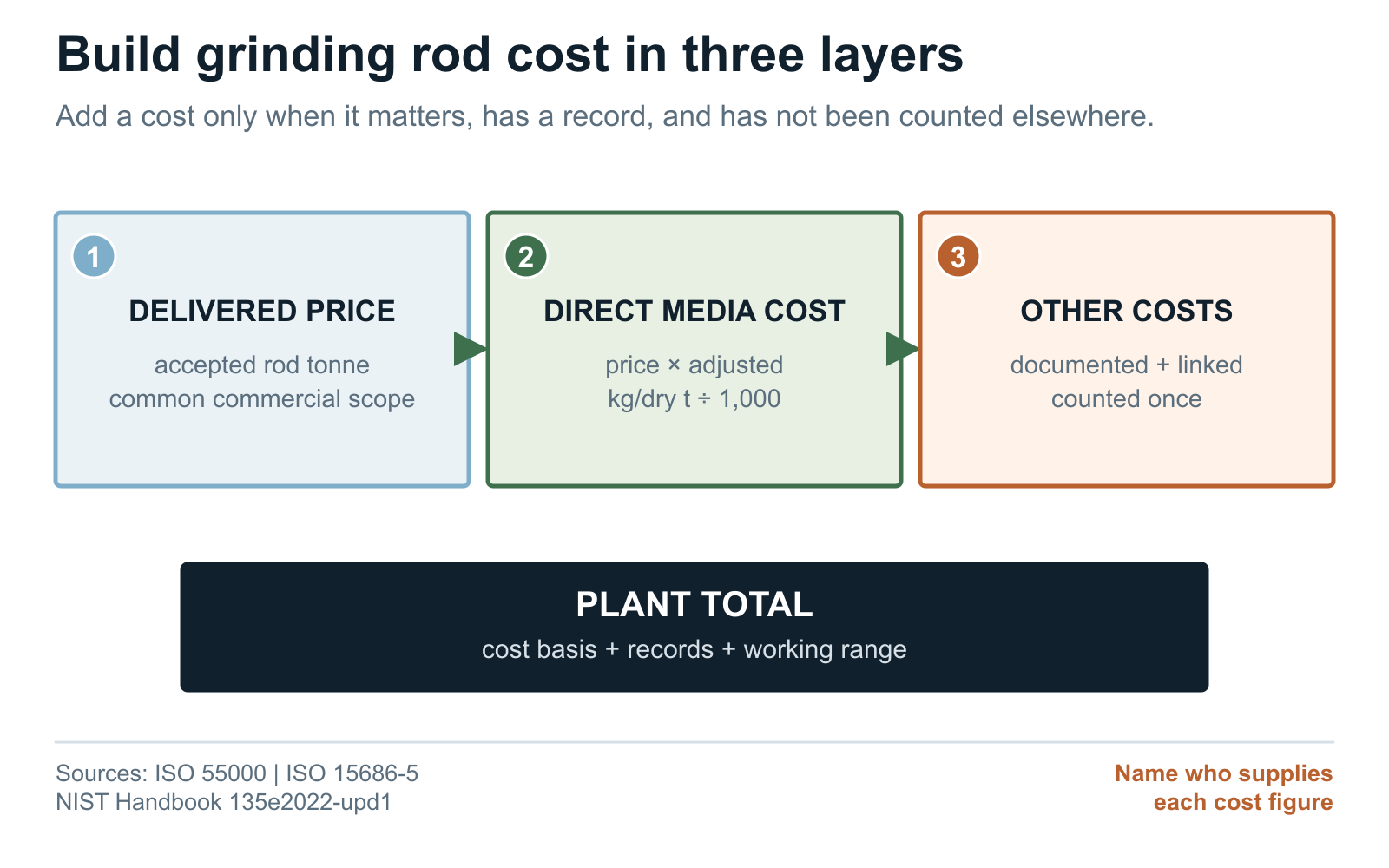
Normalize the delivered quotation before using the formula
Put every offer on the same commercial basis before using the formula. Align currency and date, Incoterm and named place, packing, inspection, inland and ocean freight, duties, recoverable taxes, insurance, payment timing, quantity break, and quotation validity.
Divide the agreed delivered cost by accepted delivered rod mass and record the weighing basis. Check which packing, freight, inspection, tax, and insurance charges are already included in that price. Enter plant consumption and event costs separately so the same invoice or material loss is not counted twice.
If lead time, minimum order, inventory, or financing affects the decision, define the analysis period and accounting method. Do not add carrying cost or discounting simply because one quotation arrives earlier; finance should own those inputs.
For a supply enquiry, send diameter, mill-approved length, quantity and destination through the grinding rod supply and quotation page so the offer can state its mass, inspection and delivery basis.
| Field | Candidate A | Candidate B | Control question |
|---|---|---|---|
| Quoted basis | Currency, price, mass unit, Incoterm, named place, validity. | Currency, price, mass unit, Incoterm, named place, validity. | Do the inclusions and date basis match? |
| Logistics and border items | Packing, inland and ocean freight, insurance, handling, duty and tax treatment. | Packing, inland and ocean freight, insurance, handling, duty and tax treatment. | Which costs remain payable by the buyer to reach the same destination? |
| Inspection and acceptance | Included inspection, third-party work, certificates, destination checks, and rejection handling. | Included inspection, third-party work, certificates, destination checks, and rejection handling. | Are equivalent evidence and acceptance costs included once? |
| Commercial timing | Payment terms, lead time, minimum order, quantity tier, financing or inventory method if approved. | Payment terms, lead time, minimum order, quantity tier, financing or inventory method if approved. | Are timing effects inside the stated analysis period and method? |
| Normalized result | Approved delivered cost per accepted metric tonne at the named point. | Approved delivered cost per accepted metric tonne at the named point. | Can both values enter the same direct-media equation? |
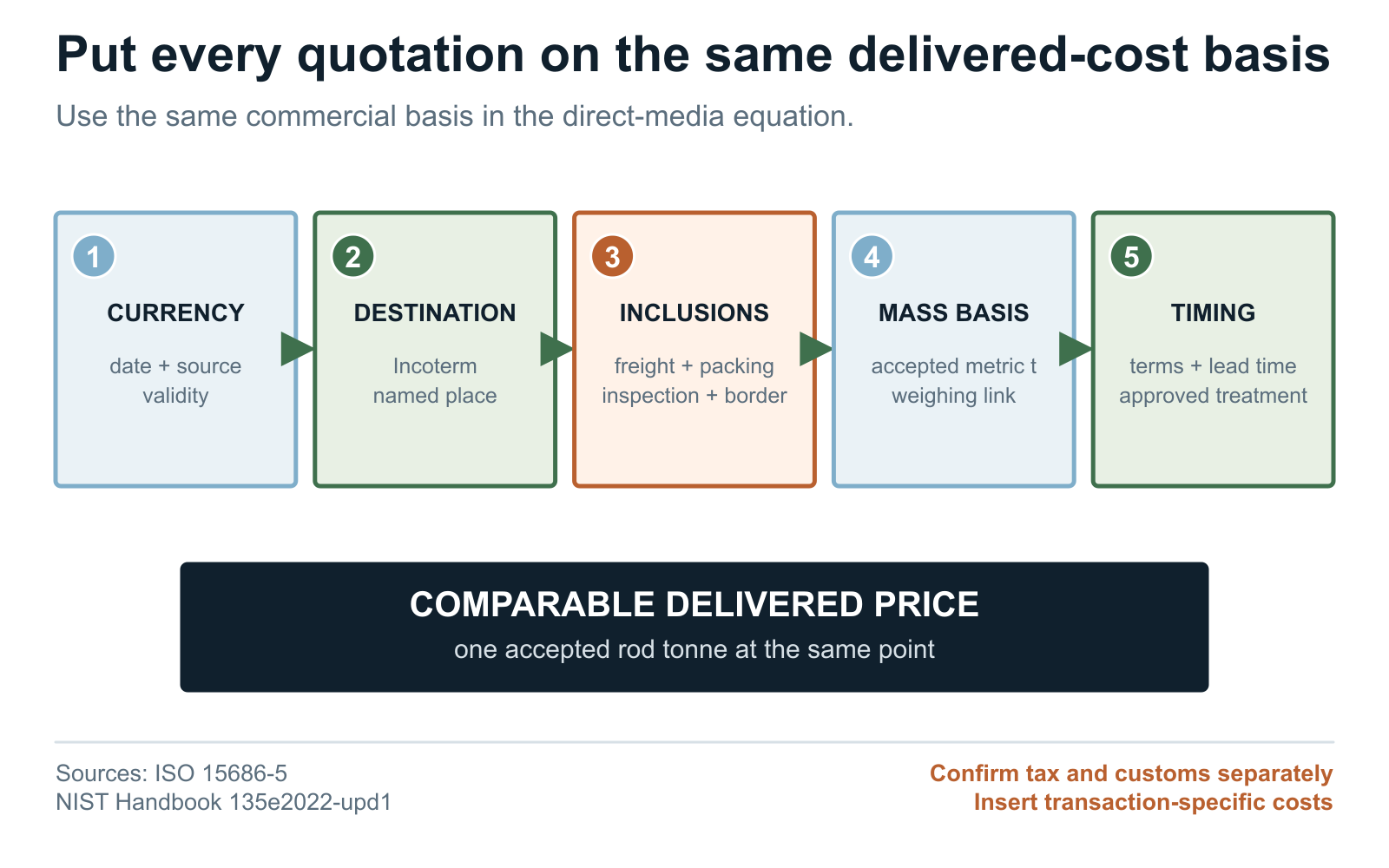
Use adjusted consumption and keep the mass ledger closed
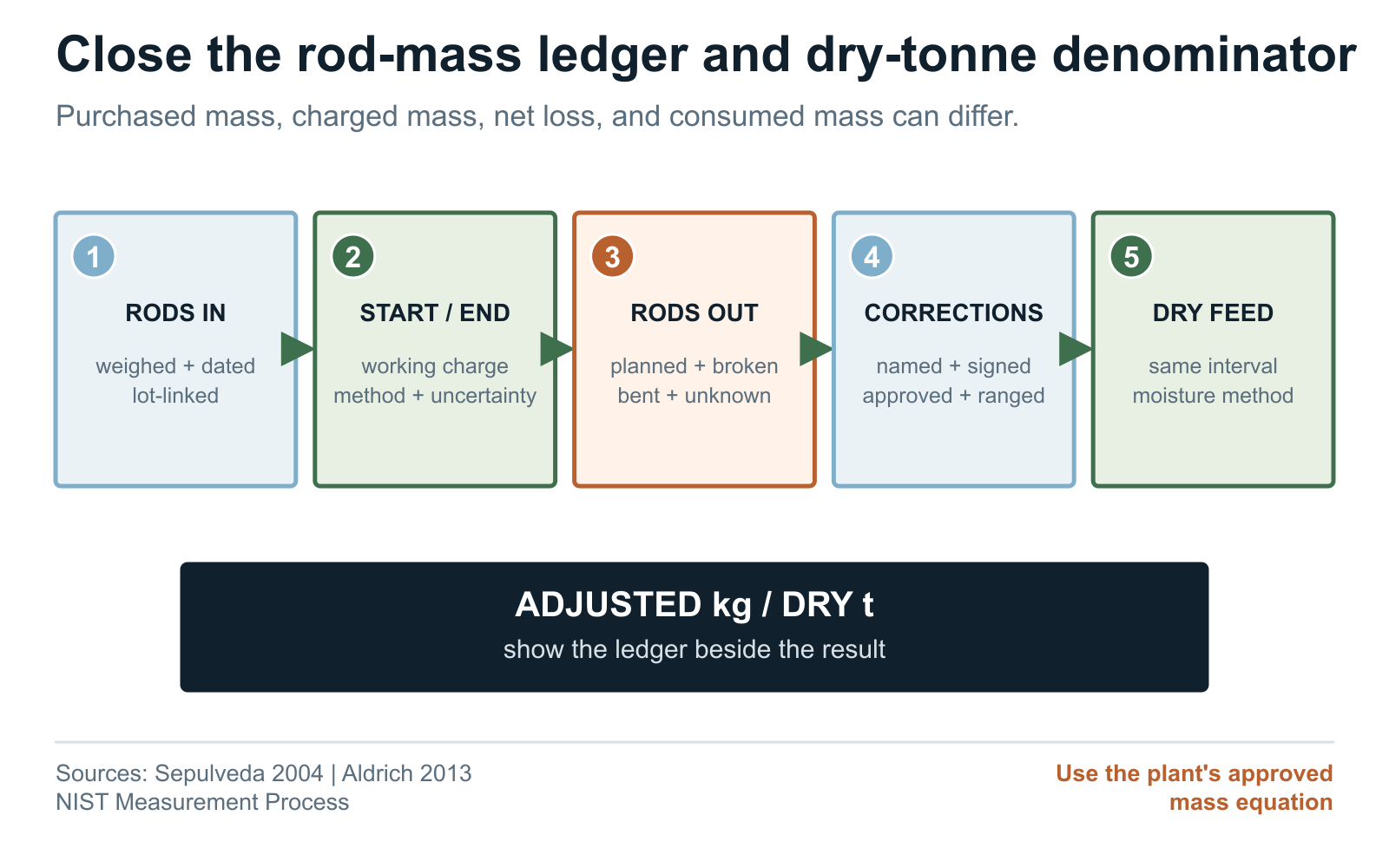
Adjusted consumption is net rod mass associated with the same dry-feed interval. The ledger may include additions, opening and closing charge inventory, planned removals, recovered broken or bent mass, scrap, transfers, unidentified pieces, and approved corrections. Purchased mass and consumed mass are not the same.
Build the dry-tonnes denominator from the same dates and feed processed. Record wet tonnes, moisture method, conversion, production source, and reconciliation. A precise kg/t result can still be wrong if moisture or inventory covers a different period.
Show opening and closing inventory, additions, removals, and corrections beside the reported consumption. Reconcile the dates with the dry-feed total. Keep the transition period separate while old and new rods coexist; where supplier attribution cannot be established, label the block as mixed and retain it outside the direct supplier comparison.
| Ledger item | Measurement and identity | Treatment | Common error |
|---|---|---|---|
| New rods in | Weighed or reconciled mass, date and time, supplier, heat or process lot, bundle, diameter and length. | Include in the same exposure interval and preserve mixed-lot identity. | Using purchase-order quantity as if it were charged and exposed mass. |
| Starting and ending working charge | Buyer-approved inventory method, date, uncertainty, size mix, and residual suppliers. | Use consistently to distinguish inventory change from net loss. | Assuming the charge is unchanged because no clean-out occurred. |
| Rods and pieces out | Weighed planned, broken, bent, tangled, scrap, transferred, and unidentified categories. | Keep mass and event classification; state whether material is returned to the charge. | Treating recovered mass as consumed while also leaving it inside ending inventory. |
| Dry new-feed tonnes | Synchronized wet tonnes, moisture sample and method, dry conversion, and production-data lineage. | Use the same interval as the media ledger and report the basis. | Mixing wet and dry denominators or using a monthly moisture average for an unrelated block. |
| Corrections and unknowns | Named rule, source, sign, approval, uncertainty, and affected material. | Show unadjusted and adjusted results and sensitivity. | Forcing an unknown mass to zero or hiding a correction in the final kg/t value. |
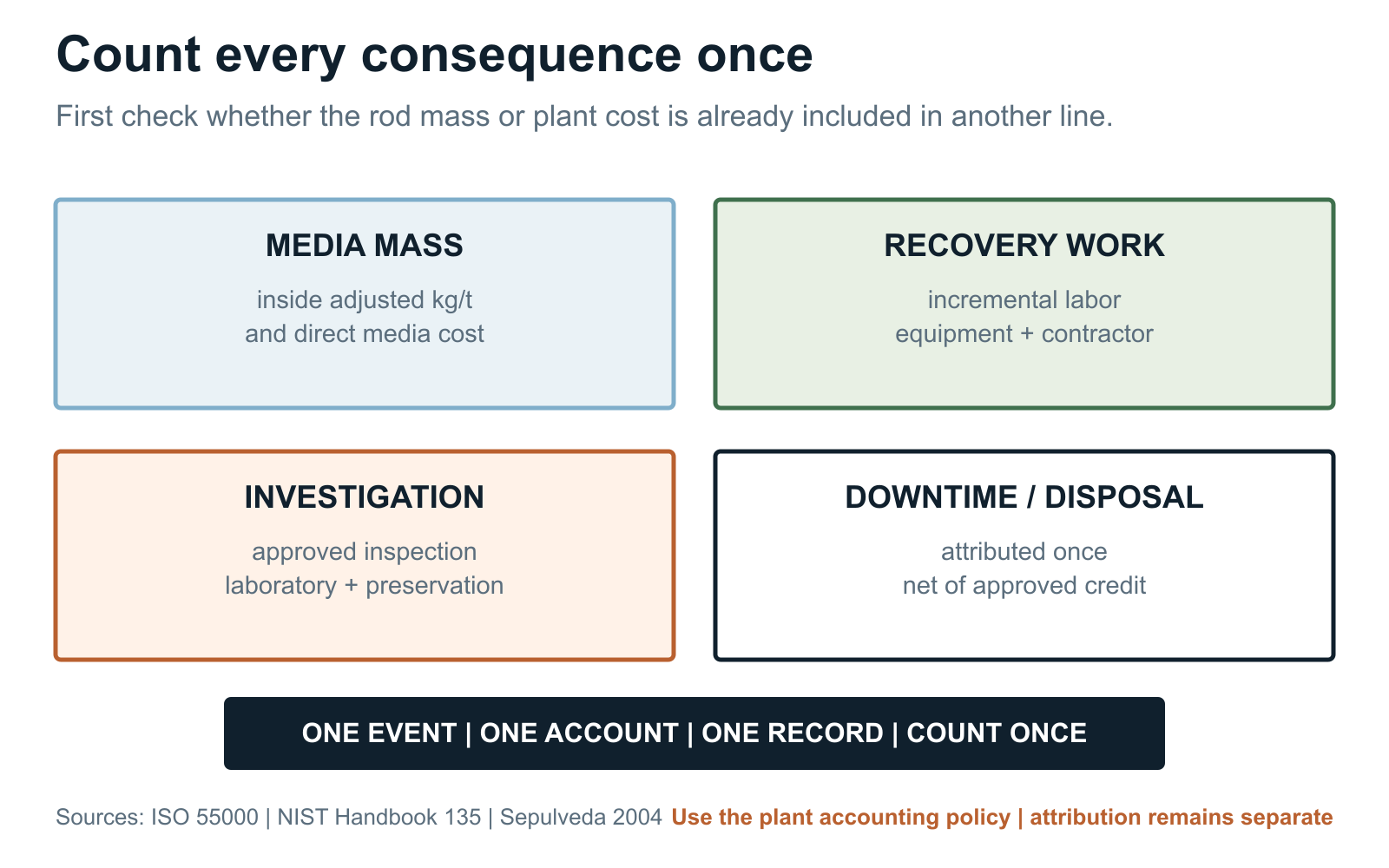
Count failure and handling consequences once
Breakage, bending, tangling, and unusual wear may add recovery, lifting, inspection, laboratory, disposal, or maintenance work. Cost these only when the event, resources, time, and valuation method are recorded in the same way for each candidate.
Check every event charge against the consumption ledger. If broken-rod mass is already included there, do not add its purchase price again. A separate line may cover additional recovery labour, hired equipment, laboratory examination, disposal, or attributable downtime. Record the work order or other source and check that the cost is absent from the remaining lines.
Routine charging and planned maintenance belong to the baseline unless the candidate changed them. Keep uncertain items unquantified or show a range. Safety stops and evidence preservation come first; the cost model records their consequence afterward.
| Event item | Potential cost field | Evidence | Double-count test |
|---|---|---|---|
| Broken, bent, or discarded rod mass | Delivered media cost represented through adjusted consumption. | Piece identity, weighed mass, ledger treatment, inventory treatment, supplier, and lot. | Do not add purchase cost again if the mass is already inside adjusted kg/t. |
| Recovery and classification | Incremental labor, equipment, contractor, and consumables beyond the approved baseline. | Event log, work order, time record, equipment record, photographs, and classification. | Exclude ordinary charging, routine inspection, or labor already included in downtime valuation. |
| Technical investigation | Incremental inspection, sample preparation, laboratory, expert, transport, and preservation costs. | Approved investigation plan, invoices or internal rates, sample chain, and lot linkage. | Do not allocate a general quality budget twice or assume every test was caused by one supplier. |
| Disposal or scrap credit | Net disposal fee or approved recoverable scrap value. | Weighed material, destination, rate, date, accounting treatment, and mass-ledger connection. | Do not count both gross disposal cost and net cost after credit. |
Attribute downtime, throughput, and product effects carefully
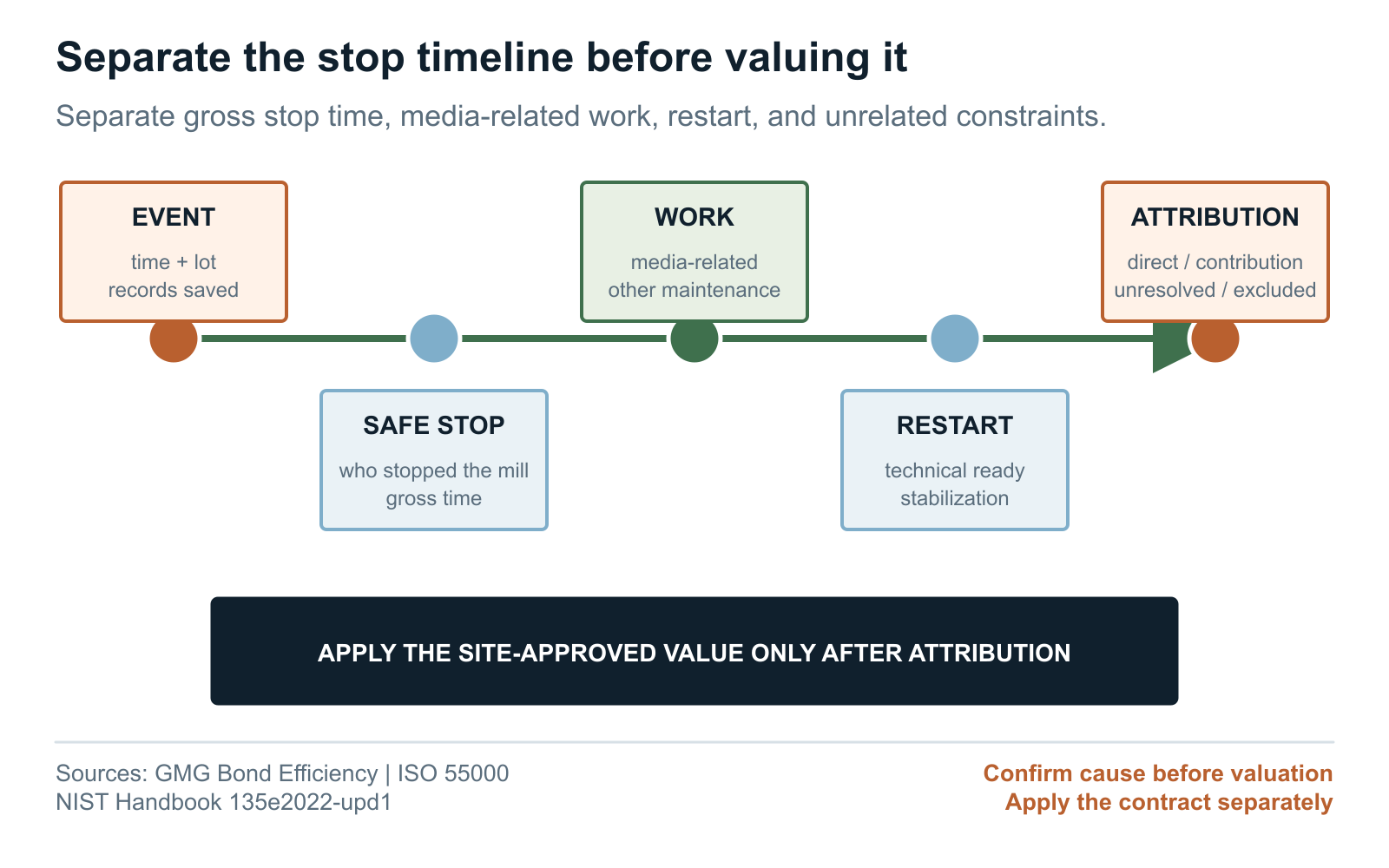
Downtime needs an event timeline: when the condition began, why the equipment stopped, what work was done, when the circuit was technically available, when production resumed, and which other constraints remained. Separate gross stop time from media-related incremental time and restart stabilization.
Use the plant's approved value method. Revenue per hour is not lost profit, and the same loss must not appear as stop hours, lost tonnes, and throughput loss. If production was recovered later, show how the method treats it.
Keep throughput and product size as constraints. A lower media cost achieved during easier feed, lower throughput, or a coarser product is not the same plant outcome. Classify attribution as direct, supported contribution, correlated but unresolved, or excluded.
| Status | Evidence standard | Cost treatment | Report wording |
|---|---|---|---|
| Confirmed direct | Time-linked event, identified rods, documented mechanism or approved finding, and separately measured extra time or resources. | Include once under the approved valuation method with uncertainty. | Directly attributable within this recorded event and method. |
| Supported contribution | Multiple factors remain, but evidence supports a material contribution and an approved allocation or scenario. | Show allocation basis and sensitivity; do not present as a unique cause. | Included as a supported contribution under the stated assumption. |
| Correlated, unresolved | Timing overlaps, but product, mill, feed, maintenance, or measurement alternatives remain open. | Keep qualitative or show a separate sensitivity range, not the base measured total. | Observed in the same block; attribution remains unresolved. |
| Excluded | Not incremental, already counted, not part of the calculation, unsupported, or unrelated. | Exclude from total and state the reason. | Reviewed and excluded to keep the calculation consistent. |
Show the scenario, uncertainty, and sensitivity
Someone else should be able to reproduce the total. Show the delivered price, adjusted consumption, dry tonnes, block dates, rod lots, mill conditions, each added cost, attribution, missing fields, range, and the person responsible for the calculation. Keep measurements separate from estimates and commercial assumptions.
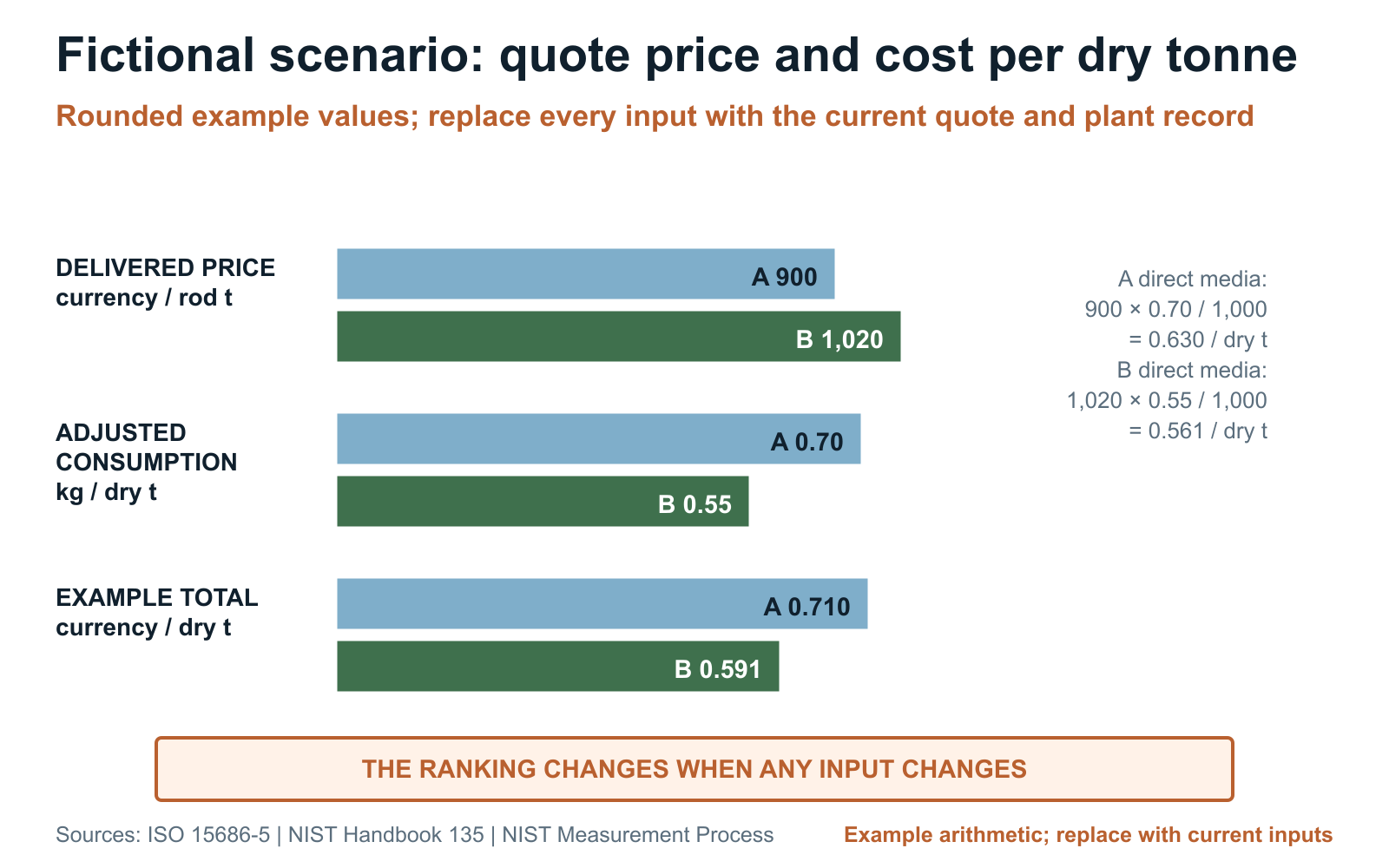
The worked table uses fictional rounded values to show how a lower rod price can still produce a higher direct media cost when consumption differs. It is an arithmetic example, not a market price, customer result, or expected saving.
Run sensitivity around the inputs that can reverse the decision: delivered price, consumption and inventory uncertainty, exchange rate, event frequency, attributed stop time, site value rate, and analysis period. If reasonable ranges overlap, another matched block is more honest than a forced winner.
| Input or result | Candidate A | Candidate B | How far the result goes |
|---|---|---|---|
| Delivered price per accepted rod tonne | 900 currency units | 1,020 currency units | Fictional rounded inputs; no market or supplier price represented. |
| Adjusted rod consumption | 0.70 kg/dry t | 0.55 kg/dry t | Fictional matched-block estimates; no benchmark or expected performance. |
| Direct media cost | 0.630 per dry t | 0.561 per dry t | Price × kg/dry t ÷ 1,000; arithmetic only. |
| Approved non-duplicated event-cost scenario | 0.080 per dry t | 0.030 per dry t | Fictional incremental recovery, inspection, or attributable event values. |
| Illustrative total | 0.710 per dry t | 0.591 per dry t | The ranking depends on every assumed input and on the stated calculation basis. |
Put the cost method into the RFQ before the trial starts
Procurement sets the delivered-price basis. Operations supplies the mill block, dry tonnes, product target, charge, and event records; maintenance supplies work records; finance sets the valuation and accounting rules; quality and technical teams review product records and investigations. Name the person who approves the final sourcing decision before the trial.
Ask the supplier for the rod specification, route, heat treatment, inspection, traceability, change notice, packing, quantity, and delivery—not a guaranteed plant saving. The buyer sets the baseline, transition, mass balance, attribution, uncertainty, and stop rules.
Record the sourcing decision with the comparable delivered prices, accepted product records, usable operating blocks, direct media cost, and separately supported event costs. List missing inputs and the ranges that could reverse the comparison. State whether to approve the candidate, adjust it, repeat the trial, hold the decision, or stop, and name the person responsible for the next action.
| Check | Pass question | Hold condition | Who reviews |
|---|---|---|---|
| Commercial basis | Are all offers normalized to one accepted delivered mass, date, currency method, named destination, and included-cost scope? | Material commercial fields differ or remain unknown. | Procurement and finance. |
| Product and lot | Is the candidate conforming and traceable from order through charged bundle and retained evidence? | Identity, process, inspection, change, or acceptance evidence is incomplete. | Buyer quality and supplier quality. |
| Comparable operating block | Are mass, dry tonnes, duty, product target, events, and transition sufficiently aligned? | The block is mixed, unsynchronized, or outside approved ranges. | Operations and the trial lead. |
| Cost integrity | Is every included item material, evidenced, valued by an approved method, attributable, and counted once? | The item is duplicated, ordinary rather than incremental, unresolved, or unsupported. | Finance, maintenance, operations, and technical review. |
| Sensitivity check | Does the ranking remain decision-relevant under uncertainty and sensitivity, with safety and product criteria met? | Plausible ranges overlap, reverse the ranking, or violate a stop or product rule. | Person approving the final sourcing decision. |
GRINDING ROD COST-COMPARISON OUTLINE

Rod offer: [grade/standard, diameter, length, quantity, route, inspection and traceability]
Common commercial basis: [currency/date, Incoterm/place, delivered metric tonne, included logistics]
Other commercial inputs: [duties/taxes, payment, lead time, minimum order, validity]
Decision layer: [delivered price / direct media cost / buyer-defined total cost]
Trial blocks: [baseline, transition, candidate, dates and repeat plan]
Consumption ledger: [additions, opening/closing inventory, removals, recoveries, corrections]
Dry tonnes: [source, moisture method and reconciliation]
Plant constraints: [feed, throughput, product size, charge and mill state]
Events: [breakage, bending, tangling, recovery, maintenance and inspection definitions]
Downtime and attribution: [timeline, approved value method, no-double-count rule]
Evidence labels: [measured / estimate / assumption / excluded / range]
Sensitivity: [price, consumption, inventory, exchange rate, event frequency and stop value]
Safety and hold rules: [owner, evidence preservation, product hold]
Decision: [approve / repeat / adjust / hold / stop]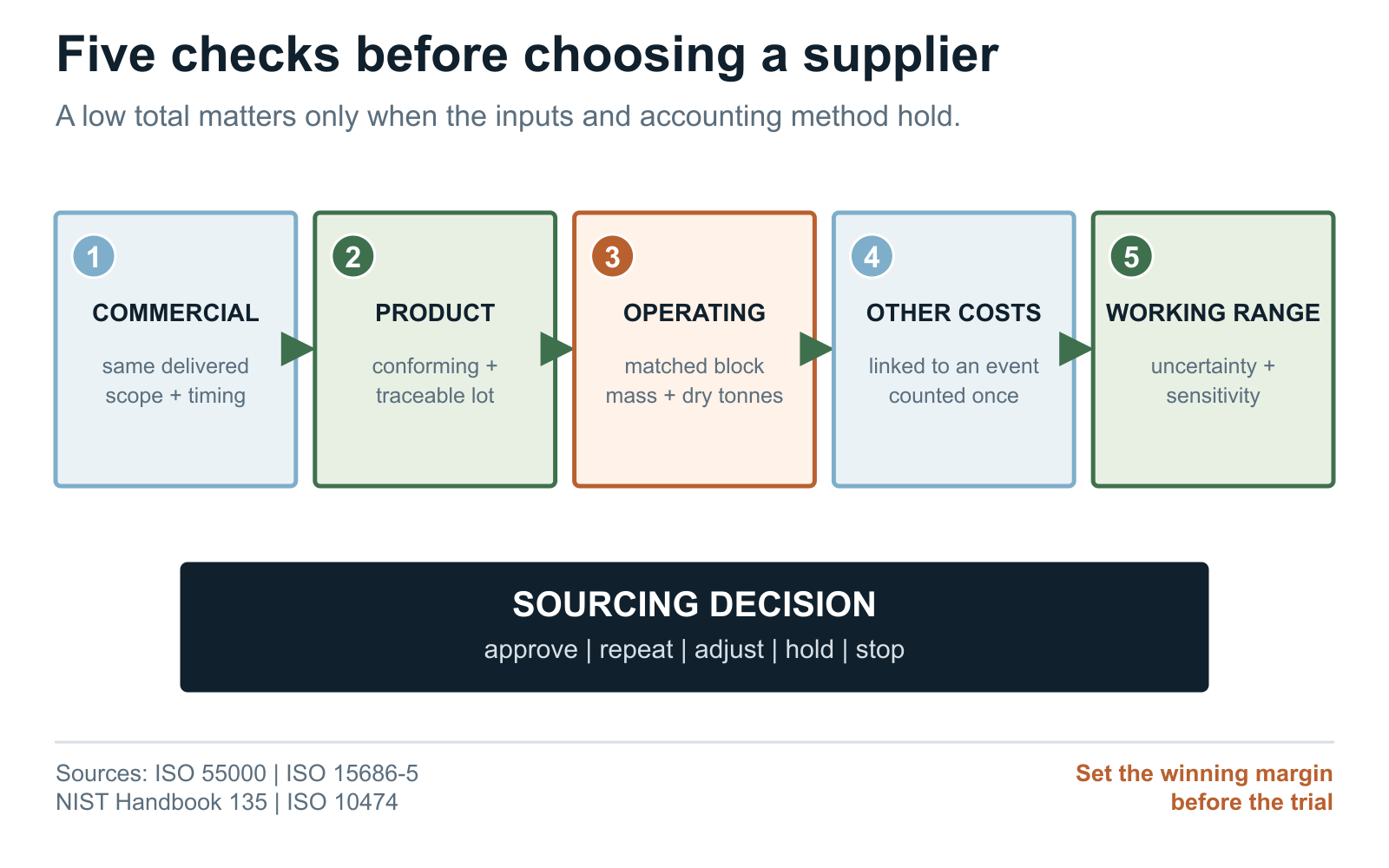
Grinding rod weight per metre and pieces per tonne
For a solid round grinding rod, theoretical mass per metre is density × π × (diameter in metres)² ÷ 4. Using an assumed density of 7,850 kg/m³ gives kg/m = 0.0061653756 × d², where d is the diameter in millimetres. Multiply by length in metres for theoretical mass per piece. These are geometric estimates for quantity planning; they are not measured JOTAIN batch weights.
For example, a hypothetical Ø100 mm × 5 m rod weighs about 308.27 kg by this calculation. One metric tonne corresponds to about 3.24 such pieces; three whole rods total about 924.81 kg and four total about 1,233.08 kg. The 5 m length is an arithmetic example, not a stock or mill-fit specification. Agree the whole-piece count and permitted quantity tolerance before ordering.
Use the contracted weighing basis for settlement and the trial ledger. Actual diameter, length, density, end geometry and weighing uncertainty can change the result. Keep packaging tare separate from net rod mass. A quoted tonne of rods and a dry tonne of processed ore belong to different parts of the cost calculation.
Before turning a weight estimate into an order, check grinding rod diameter, length and mill fit against the installed mill and the plant's accepted dimensional requirements.
| Nominal diameter | Theoretical kg/m | Theoretical metres per metric tonne |
|---|---|---|
| Ø60 mm | 22.20 | 45.05 |
| Ø80 mm | 39.46 | 25.34 |
| Ø100 mm | 61.65 | 16.22 |
| Ø120 mm | 88.78 | 11.26 |
| Ø140 mm | 120.84 | 8.28 |
| Ø160 mm | 157.83 | 6.34 |
Questions buyers ask
How do buyers calculate grinding rod cost per dry tonne?
First normalize the delivered price per accepted metric tonne. Then multiply that price by adjusted rod consumption in kg per dry tonne and divide by 1,000. The price, media ledger, dry-feed tonnes, candidate lot, and operating block must cover the same period and material.
Can the lowest grinding rod quote cost more in operation?
It can, but not necessarily. For a buyer, sufficiently higher measured consumption or properly attributed incremental event cost can outweigh a lower delivered price. The conclusion must come from comparable blocks, approved calculations, and uncertainty review rather than a general claim about low-priced rods.
Should broken grinding rod mass be added as a separate cost?
Not if that mass is already captured in adjusted rod consumption and direct media cost. Add only separately evidenced incremental recovery, inspection, disposal, maintenance, or attributable downtime costs, and document that each item is counted once.
How should grinding rod downtime be valued?
Use the buyer's approved site method after separating the event timeline and attribution. Gross stop hours or revenue aren't necessarily lost profit. Avoid counting the same consequence as hourly downtime, lost tonnes, and throughput loss when those values overlap.
Are the example prices and consumption figures benchmarks?
No. Every number in the worked scenario is fictional, rounded, and used only to demonstrate arithmetic. The figures are not market prices, supplier results, JOTAIN performance, customer data, expected savings, or acceptable consumption targets.
Who owns the grinding rod total-cost calculation?
The buyer does. Suppliers can provide quotations, traceable product records, assumptions, and technical input. Procurement, operations, maintenance, finance, quality, and engineering supply different parts of the comparison, while the buyer's named approver makes the final sourcing decision.
How much does a 100 mm grinding rod weigh per metre?
A solid Ø100 mm rod has a theoretical mass of about 61.65 kg/m when density is assumed to be 7,850 kg/m³. Multiply the unrounded result by the specified length for estimated piece mass. Confirm actual dimensions, net weighing and contractual quantity tolerance for shipment; the estimate is not a measured batch weight.
RFQ checklist
- Define whether the decision uses delivered price, direct media cost, or a broader buyer-defined total cost.
- Normalize currency, quotation date, exchange-rate source, and validity.
- Normalize the Incoterm, named destination, freight, insurance, and handling basis.
- State duty, tax, and recoverable-tax treatment without giving tax advice by assumption.
- Use accepted metric tonnes and reconcile quoted, invoiced, shipped, and received mass.
- Align packing, inspection, certificate, third-party, and destination-acceptance scope.
- Document payment terms, minimum order, quantity tier, lead time, and approved timing treatment.
- Define the analysis period and monetary basis.
- Identify the candidate grade, process route, heat, process lot, bundle, and rods charged.
- Check product conformity and plant performance separately.
- Set the baseline, transition, and matched operating blocks before results are known.
- Define the adjusted rod-consumption equation.
- Reconcile new rods in and starting and ending working-charge inventory.
- Weigh and classify planned, broken, bent, tangled, scrap, transferred, and unidentified removals.
- Keep mixed supplier and residual transition mass visible.
- Synchronize the media ledger with metric tonnes of dry new feed.
- Record wet tonnes, moisture sample, method, conversion, and production-data lineage.
- Show unadjusted and adjusted mass-balance results.
- Record every correction, source, sign, approval, and uncertainty.
- Calculate direct media cost as delivered price × adjusted kg/dry t ÷ 1,000.
- Define breakage, bending, tangling, recovery, inspection, and maintenance events.
- Separate routine work from incremental candidate-related work.
- Check whether broken or removed rod mass is already inside adjusted consumption.
- Count media purchase cost only once.
- Count recovery labor, equipment, investigation, and disposal only once.
- Apply scrap credit or disposal cost on one approved net basis.
- Build a time-stamped downtime, maintenance, restart, and stabilization timeline.
- Separate media-related time from unrelated parallel plant constraints.
- Assign confirmed direct, supported contribution, unresolved, or excluded attribution status.
- Use the site-approved hourly, contribution, lost-tonne, replacement-production, or other valuation method.
- Do not treat gross revenue as lost profit without the approved method.
- Do not count the same stop as hourly downtime, lost tonnes, and throughput loss when they overlap.
- Keep product-size, throughput, safety, and quality constraints beside cost.
- Label every field as measured, estimated, assumed, excluded, or unresolved.
- Report ranges or uncertainty for inventory, moisture, measurements, allocations, and rates.
- Run sensitivity for delivered price, consumption, exchange rate, event frequency, attribution, and plant value.
- Repeat the block when plausible ranges overlap or reverse the ranking.
- Name procurement, operations, maintenance, finance, quality, technical, and final decision makers.
- Preserve safety stops and evidence even when their cost is not yet known.
- Limit the conclusion to the recorded lots, mill conditions, dates, and approved assumptions.
References
- ISO 55000:2024 Asset management — Vocabulary, overview and principles
- ISO 15686-5:2017 Buildings and constructed assets — Service life planning — Part 5: Life-cycle costing
- NIST Handbook 135e2022-upd1: Life Cycle Costing Manual for the Federal Energy Management Program
- Methodologies for the evaluation of grinding media consumption rates at full plant scale
- Consumption of steel grinding media in mills — A review
- Determining the Bond Efficiency of Industrial Grinding Circuits
- Rod Mill Product Control and Its Relation to Energy Consumption: A Case Study
- NIST/SEMATECH Engineering Statistics Handbook, Chapter 2: Measurement Process Characterization
- ISO 10474:2013 Steel and steel products — Inspection documents
Inquiry support
Want us to review the RFQ before quotation?
Send the drawing or RFQ with the grade, size, condition, processing, inspection, quantity, and destination. We can flag open points before quotation.